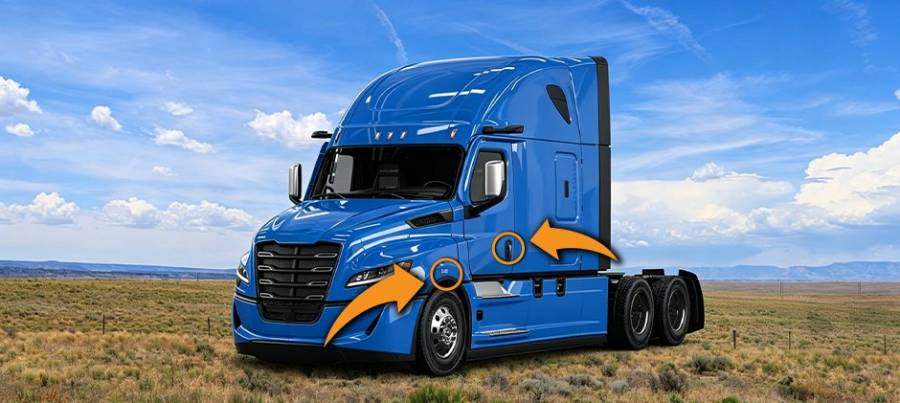
A Freightliner Cascadia VIN decoder is a tool that interprets a truck’s 17-character Vehicle Identification Number (VIN) to identify its manufacturer, model year, assembly plant, and available vehicle specifications. Each Freightliner Cascadia has a unique VIN that distinguishes it from other trucks and provides standardized identification information for vehicle registration, maintenance, and verification.
A Freightliner Cascadia VIN consists of three sections: the World Manufacturer Identifier (WMI), Vehicle Descriptor Section (VDS), and Vehicle Identifier Section (VIS). These sections contain manufacturer identification, vehicle attributes, and production-related information. The tenth character identifies the model year, while the ninth character serves as a check digit for VIN validation under the North American VIN system.
You can decode a Freightliner Cascadia VIN for free using the National Highway Traffic Safety Administration (NHTSA) VIN Decoder. Enter the complete 17-character VIN to retrieve available manufacturer-reported information. However, standard VIN decoding does not guarantee access to exact engine configurations, transmission specifications, accident records, or complete vehicle history.
This guide explains how to decode a Freightliner Cascadia VIN, interpret its characters, identify the model year, locate the VIN on your truck, and verify vehicle information before purchasing or servicing a Cascadia.
How Do You Decode a Freightliner Cascadia VIN?
To decode a Freightliner Cascadia VIN, locate the truck’s 17-character Vehicle Identification Number, enter it into a VIN decoder, and review the manufacturer-reported vehicle information. The decoded results can identify the manufacturer, model year, assembly plant, vehicle type, and additional specifications when those details are available in the database.
The National Highway Traffic Safety Administration (NHTSA) provides a free VIN decoder through its Vehicle Product Information Catalog (vPIC). This database uses information submitted by vehicle manufacturers and supports VIN identification for Freightliner Cascadia trucks sold in the United States.
Follow these five steps to decode your Freightliner Cascadia VIN:
- Find the VIN. Locate the 17-character identification number on the truck’s manufacturer identification label or official vehicle documents.
- Verify the VIN format. Confirm that the number contains 17 characters and does not include the letters I, O, or Q.
- Open the NHTSA VIN Decoder.
- Enter the VIN. Type the complete identification number into the search field and submit the lookup.
- Review the decoded information. Check the manufacturer, model year, vehicle type, assembly plant, and other available vehicle attributes.
A Freightliner Cascadia VIN lookup may return incomplete information for certain vehicle configurations. For example, the decoder may identify a truck’s model year and manufacturer without displaying its exact transmission model or axle ratio. These details may require a manufacturer build sheet or additional vehicle documentation.
Compare the decoded information with the truck’s identification label and registration records. A mismatch in the model year, manufacturer, or vehicle description requires further verification before ordering replacement parts or purchasing a used truck.
What Do the 17 Characters in a Freightliner Cascadia VIN Mean?
The 17 characters in a Freightliner Cascadia VIN identify the vehicle manufacturer, describe manufacturer-defined vehicle attributes, and distinguish the truck from other vehicles. The VIN follows the standardized identification structure established under Federal Motor Vehicle Safety Standard (FMVSS) No. 115 and 49 CFR Part 565.
A Freightliner Cascadia VIN contains three sections: the World Manufacturer Identifier (WMI), Vehicle Descriptor Section (VDS), and Vehicle Identifier Section (VIS). Each section serves a specific identification purpose, while individual character meanings depend on the manufacturer’s VIN coding system.
| VIN position | Section | Information |
|---|---|---|
| 1–3 | WMI | Manufacturer identification |
| 4–8 | VDS | Manufacturer-defined vehicle attributes |
| 9 | Check digit | VIN validation character |
| 10 | VIS | Model year |
| 11 | VIS | Manufacturing plant |
| 12–17 | VIS | Vehicle production sequence |
The VIN structure allows vehicle registration agencies, repair facilities, fleet operators, and truck buyers to identify a Freightliner Cascadia consistently. However, the exact meaning of manufacturer-specific characters must be verified using the applicable Freightliner VIN documentation.
What Do the First Three Characters of a Freightliner Cascadia VIN Identify?
The first three characters identify the vehicle manufacturer through the World Manufacturer Identifier (WMI). This code establishes the manufacturer responsible for the vehicle and forms the first section of its standardized VIN.
For example, 1FU is a WMI associated with Freightliner trucks manufactured in the United States. The first character indicates the country or geographic region of manufacture under the WMI system, while the complete three-character sequence identifies the manufacturer.
Not every Freightliner vehicle uses the same WMI. The correct manufacturer identification depends on the vehicle’s production details and assigned WMI. A VIN decoder verifies the complete manufacturer code rather than relying on the first character alone.
What Do Characters 4 Through 9 of a Freightliner Cascadia VIN Mean?
Characters 4 through 8 describe manufacturer-defined vehicle attributes, while character 9 is the VIN check digit. Together, these six characters form the Vehicle Descriptor Section (VDS) in the North American VIN format.
Freightliner uses manufacturer-specific coding to represent vehicle characteristics. Depending on the applicable VIN coding scheme, these positions can describe attributes such as the vehicle line, chassis configuration, or other characteristics required for identification.
The ninth character has a different function. It validates the VIN through a mathematical calculation based on the other 16 characters. The calculation assigns numerical values to VIN characters, applies position-specific weights, and determines a remainder using division by 11. A remainder of 10 is represented by the letter X.
For example, a VIN with an incorrect check digit may contain a transcription error even when all 17 characters are present. The check digit helps detect invalid character combinations, but it does not establish vehicle ownership, mechanical condition, or title authenticity.
What Do Characters 10 Through 17 of a Freightliner Cascadia VIN Identify?
Characters 10 through 17 form the Vehicle Identifier Section (VIS), which identifies the model year, manufacturing plant, and vehicle production sequence. This section distinguishes individual trucks within the manufacturer’s identification system.
The tenth character represents the vehicle’s model year. For example, the code N identifies model year 2022, P identifies 2023, R identifies 2024, S identifies 2025, and T identifies 2026. VIN model-year codes repeat in 30-year cycles, so the complete VIN and vehicle context are necessary when interpreting older vehicles.
The eleventh character identifies the manufacturing plant using a code assigned by the manufacturer. Its meaning must be confirmed against Freightliner’s applicable plant-code documentation because a single character does not independently reveal a plant’s name or location.
Characters 12 through 17 represent the vehicle’s sequential production identification. These six positions help distinguish one Freightliner Cascadia from another vehicle sharing the same manufacturer, model year, and other encoded characteristics.
For example, two Freightliner Cascadia trucks manufactured during the same model year may share the same manufacturer and vehicle descriptor codes while having different production sequence numbers. This distinction enables accurate vehicle identification for registration, maintenance records, manufacturer service information, and fleet management.
What Information Can a Freightliner Cascadia VIN Decoder Reveal?
A Freightliner Cascadia VIN decoder can reveal the truck’s manufacturer, model year, vehicle type, assembly plant, and manufacturer-reported vehicle specifications. The information comes from the 17-character VIN and manufacturer records submitted to vehicle identification databases such as the National Highway Traffic Safety Administration (NHTSA) vPIC system.
The amount of information available depends on the truck’s model year, VIN coding structure, and manufacturer-submitted data. A standard VIN lookup identifies the vehicle and its encoded characteristics but does not provide a complete factory build sheet or mechanical inspection report.
The following table shows the main types of information available through a Freightliner Cascadia VIN lookup.
| Vehicle information | What the VIN decoder can reveal |
|---|---|
| Manufacturer | Freightliner manufacturer identification |
| Vehicle model | Freightliner Cascadia model identification, when available |
| Model year | Model year encoded in the tenth VIN character |
| Vehicle type | Truck or truck-tractor classification |
| Manufacturing plant | Assembly plant identified by the manufacturer |
| Engine information | Engine manufacturer, model, or other attributes when reported |
| Cab configuration | Cab-related characteristics when encoded and available |
| Gross Vehicle Weight Rating (GVWR) | Vehicle weight classification or rating when reported |
| Production sequence | Manufacturer-assigned vehicle identification sequence |
Engine specifications are among the most useful details for Freightliner Cascadia owners and mechanics. Cascadia trucks have been offered with different diesel engines, including Detroit DD13, DD15, and DD16 engines in applicable model years and configurations. However, a VIN decoder does not guarantee identification of the exact installed engine or its current configuration. Confirm engine details using the engine identification label, manufacturer build records, or authorized Freightliner service documentation.
Transmission and axle specifications also require additional verification. Freightliner Cascadia trucks have been equipped with different transmission systems, including Detroit DT12 automated manual transmissions and other configurations depending on production year and application. A standard VIN lookup may not identify the exact transmission model, gear ratios, drive axle ratio, or installed optional equipment.
For example, two Freightliner Cascadia trucks from the same model year may have different engine ratings, axle ratios, and transmission configurations. Their VINs provide individual vehicle identification, but their complete factory specifications must be checked against manufacturer build records associated with each truck.
For accurate replacement parts selection, compare VIN decoder results with the truck’s factory build information and component identification numbers. This is particularly important for engine components, transmission parts, axle assemblies, and electronic control modules, where specifications differ between Cascadia configurations.
How Can You Identify a Freightliner Cascadia Model Year by VIN?
To identify a Freightliner Cascadia model year by VIN, examine the tenth character of the 17-character identification number. This position contains a standardized model-year code used in the North American VIN system. The code identifies the manufacturer’s designated model year rather than the exact date the truck was assembled.
Freightliner Cascadia trucks use the same standardized model-year coding system as other vehicles subject to the applicable United States VIN regulations. The codes use letters and numbers in a repeating 30-year sequence. The letters I, O, Q, U, and Z are not used as model-year codes, and the number 0 is excluded from the model-year sequence.
The following table lists VIN model-year codes relevant to Freightliner Cascadia trucks from 2008 through 2027.
| Model year | 10th VIN character |
|---|---|
| 2008 | 8 |
| 2009 | 9 |
| 2010 | A |
| 2011 | B |
| 2012 | C |
| 2013 | D |
| 2014 | E |
| 2015 | F |
| 2016 | G |
| 2017 | H |
| 2018 | J |
| 2019 | K |
| 2020 | L |
| 2021 | M |
| 2022 | N |
| 2023 | P |
| 2024 | R |
| 2025 | S |
| 2026 | T |
| 2027 | V |
For example, a Freightliner Cascadia VIN containing R in the tenth position identifies model year 2024 under the applicable VIN model-year cycle. Similarly, a tenth-position T identifies model year 2026. These characters must be interpreted at the correct VIN position; finding the same letter elsewhere in the VIN does not establish the model year.
The model year and manufacturing date are not necessarily identical. A Freightliner Cascadia designated as a 2025 model may have been manufactured during 2024 because manufacturers can begin producing vehicles for an upcoming model year before that calendar year begins.
The tenth VIN character also cannot establish the truck’s exact production month or day. To determine the manufacturing date, inspect the manufacturer’s certification label or obtain the vehicle’s factory production records. The label provides production-related identification information that supplements the VIN model-year code.
Model-year identification is particularly important when ordering replacement parts or reviewing technical service information. Freightliner Cascadia components, electronic systems, engine configurations, and emissions equipment can differ between production periods. Confirming the model year helps narrow the correct service documentation, while the complete VIN and factory build records provide more precise vehicle-specific information.
How Can You Check Whether a Freightliner Cascadia VIN Is Valid?
To check whether a Freightliner Cascadia VIN is valid, verify its 17-character length, inspect the characters for formatting errors, calculate the ninth-position check digit, and compare the decoded information with the truck’s identification records. A valid VIN follows the standardized identification requirements established under 49 CFR Part 565.
A Freightliner Cascadia VIN must contain exactly 17 characters consisting of numbers and permitted uppercase letters. The letters I, O, and Q are excluded because they resemble the numbers 1 and 0. A VIN containing these letters, missing characters, or additional characters does not meet the standard 17-character format used for modern Cascadia trucks.
The ninth character is the VIN check digit, which verifies the mathematical consistency of the identification number. The calculation converts letters into assigned numerical values, multiplies each character’s value by a position-specific weight, and divides the total by 11. The remainder determines the expected check digit, with X representing a remainder of 10.
A valid check digit confirms that the VIN passes this mathematical test, but it does not prove that the truck is authentic, legally owned, or free from title problems. A copied VIN can pass the check-digit calculation while belonging to a different vehicle.
The following table identifies common Freightliner Cascadia VIN decoding problems and their solutions.
| VIN problem | Possible cause | Recommended action |
|---|---|---|
| VIN contains fewer than 17 characters | Missing or incorrectly copied characters | Recheck the vehicle identification label |
| VIN contains I, O, or Q | Character transcription error | Compare the VIN with the original label |
| Invalid check digit | Incorrect character or character position | Verify all 17 characters |
| Decoder returns no vehicle information | Unsupported or incomplete database records | Check manufacturer documentation |
| Model year does not match records | Incorrect VIN entry or conflicting documentation | Compare the VIN with the certification label and title |
| Decoded specifications are incomplete | Manufacturer-specific information is unavailable | Request the factory build record |
For example, entering the letter O instead of the number 0 can cause a VIN decoder to reject an otherwise correctly copied Freightliner Cascadia VIN. Correcting the character and submitting the complete number allows the decoder to perform another validation.
If a Freightliner Cascadia VIN passes the format and check-digit tests but produces conflicting vehicle information, compare the physical identification labels with the title, registration, and manufacturer records. Unresolved discrepancies should be investigated before purchasing the truck or using the VIN to order vehicle-specific components.
Where Is the VIN Located on a Freightliner Cascadia?
The Freightliner Cascadia VIN can be found on the truck’s manufacturer identification labels and official vehicle documents, including its title and registration. The driver’s-side door opening is a primary location to inspect for the vehicle certification label, although the exact label placement depends on the truck’s model year and cab configuration.
The manufacturer certification label contains the vehicle identification number and additional information such as the manufacturing date, Gross Vehicle Weight Rating (GVWR), and Gross Axle Weight Ratings (GAWR). These details help identify the truck and verify whether its documented specifications correspond to the physical vehicle.
Check the following locations when searching for a Freightliner Cascadia VIN:
- Driver’s-side door opening: Inspect the door jamb and surrounding cab structure for the manufacturer certification label.
- Vehicle identification markings: Consult the applicable Freightliner operator’s manual or service documentation to locate additional manufacturer identification markings.
- Vehicle registration: Find the VIN listed on the truck’s registration documents.
- Certificate of title: Compare the title’s VIN with the identification number displayed on the truck.
- Insurance and fleet records: Review existing vehicle documentation when the physical VIN label is difficult to access.
For example, a fleet operator inspecting a used Freightliner Cascadia can compare the VIN on the driver’s-side certification label with the VIN recorded on the certificate of title. All 17 characters should match exactly, including the model-year code and production sequence.
A Freightliner Cascadia VIN should not be confused with the engine serial number or other component identification numbers. The VIN identifies the complete vehicle, while the engine serial number identifies a specific engine assembly. Engine replacements can change the installed engine’s serial number without changing the truck’s original VIN.
If the VIN label is damaged, missing, or unreadable, consult an authorized Freightliner service location for guidance on identifying the vehicle through manufacturer records and approved identification procedures. Do not alter, replace, or reproduce a VIN label without following applicable legal and manufacturer requirements.
Verifying the physical VIN against official documentation is particularly important when purchasing a used Freightliner Cascadia. Matching identification numbers help establish consistency between the truck and its records, while missing or conflicting VIN information requires further investigation.
Read more: Freightliner Cascadia SPN 521221 FMI 19: Causes & Fixes
Can You Check a Freightliner Cascadia’s History Using Its VIN?
You can use a Freightliner Cascadia VIN to research the truck’s accident history, title records, reported mileage, and safety recalls, but a standard VIN decoder does not provide a complete vehicle history report. VIN decoding identifies the truck’s manufacturer and vehicle attributes, while vehicle history services retrieve records associated with its unique identification number.
The National Highway Traffic Safety Administration (NHTSA) provides manufacturer-reported vehicle identification data and safety recall information. Additional services, including approved National Motor Vehicle Title Information System (NMVTIS) providers, offer access to title-related records. Commercial vehicle history services may provide accident or odometer information, depending on their available data sources.
A Freightliner Cascadia vehicle history check can help investigate five categories of information:
- Title history: Reported title brands, including salvage, rebuilt, or flood damage designations.
- Accident records: Documented collisions or damage events included in available reporting databases.
- Odometer records: Reported mileage readings that help identify possible inconsistencies.
- Safety recalls: Manufacturer-issued safety recalls associated with the vehicle.
- Vehicle identification: Manufacturer, model year, and specifications used to confirm the truck’s identity.
For example, a used Freightliner Cascadia may have a valid VIN and accurate manufacturer information but still carry a salvage title or have previously reported collision damage. These conditions cannot be established through the VIN’s 17 characters alone.
Vehicle history reports also have limitations. Accident databases do not contain every collision, and commercial truck maintenance records are not always publicly accessible. A clean report therefore does not guarantee that a Freightliner Cascadia has never been damaged or repaired.
How Can You Check Freightliner Cascadia Recalls by VIN?
To check Freightliner Cascadia recalls by VIN, enter the truck’s 17-character identification number into the official. The database allows vehicle owners and buyers to search for applicable, unrepaired safety recalls reported to NHTSA.
Freightliner Cascadia safety recalls can involve vehicle systems such as braking components, steering equipment, electrical systems, or other safety-related assemblies. The affected components and eligible vehicles depend on the specific recall campaign, production period, and manufacturer records.
Follow these steps to check a Freightliner Cascadia for recalls:
- Visit the official NHTSA vehicle recall website.
- Select the VIN search option.
- Enter the complete 17-character Freightliner Cascadia VIN.
- Review any unrepaired safety recalls returned for the vehicle.
- Contact an authorized Freightliner service provider to confirm recall eligibility and repair status.
For example, a recall may apply only to Freightliner Cascadia trucks manufactured during a specified production period or equipped with particular components. Two trucks from the same model year may therefore have different recall eligibility.
The NHTSA VIN recall lookup focuses on applicable unrepaired safety recalls and does not provide a complete history of every previously completed repair or manufacturer service campaign. Owners should contact an authorized Freightliner dealer when additional recall or service information is required.
Can a Freightliner Cascadia VIN Decoder Show Accident or Mileage History?
A standard Freightliner Cascadia VIN decoder cannot show a complete accident or mileage history. The VIN identifies the truck, but accident reports and odometer readings come from external records rather than information encoded in the identification number.
Accident history information may come from insurance claims, law enforcement reports, vehicle auctions, repair facilities, or other reporting organizations. Whether a particular event appears in a commercial vehicle history report depends on the reporting service’s data coverage and the availability of records.
Mileage verification requires similar caution. Freightliner Cascadia trucks used in long-distance transportation can accumulate substantial mileage, making accurate odometer records important when evaluating engine wear, maintenance requirements, and resale value.
For example, a used Freightliner Cascadia advertised with 450,000 miles should have its displayed odometer reading compared with available maintenance invoices, inspection records, and electronic vehicle data where accessible. Conflicting readings require investigation because they may indicate an odometer replacement, reporting error, or another documentation issue.
For commercial trucks, engine operating hours and electronic control module data can provide additional context about vehicle usage. However, engine hours do not directly establish total mileage, and electronic records must be interpreted alongside service documentation and the truck’s mechanical condition.
What Should You Verify Before Buying a Used Freightliner Cascadia?
Before buying a used Freightliner Cascadia, verify the VIN, vehicle specifications, title status, maintenance history, and mechanical condition. These five checks help determine whether the truck matches its advertised description and whether its documented history supports the seller’s claims.
Start by comparing the 17-character VIN displayed on the truck’s manufacturer identification label with the number recorded on the title, registration, and available maintenance documents. The identification numbers must match exactly. A missing label or conflicting VIN requires investigation before completing the purchase.
Next, decode the VIN to confirm the manufacturer, model year, vehicle type, and available specifications. Request the Freightliner factory build information when exact engine, transmission, axle, or equipment details are important. A VIN decoder alone cannot confirm that every original component remains installed.
The following table summarizes the main verification checks for a used Freightliner Cascadia.
| Inspection area | What to verify | Why it matters |
|---|---|---|
| VIN identification | VIN matches the truck and ownership documents | Confirms consistency of vehicle identification |
| Model year | Tenth VIN character matches the advertised model year | Identifies incorrect vehicle descriptions |
| Engine | Engine model, serial number, and operating condition | Supports maintenance and repair planning |
| Transmission | Installed transmission model and operating condition | Helps identify drivetrain specifications |
| Title records | Title brands and ownership documentation | Reveals reported title problems |
| Mileage | Odometer reading and available historical records | Helps evaluate usage and inconsistencies |
| Safety recalls | Applicable unrepaired recalls | Identifies outstanding safety repairs |
| Maintenance history | Service intervals, major repairs, and component replacements | Provides evidence of previous maintenance |
A pre-purchase mechanical inspection is necessary because VIN decoding and vehicle history reports cannot establish the current condition of the engine, transmission, braking system, suspension, or emissions equipment. A qualified heavy-duty truck technician should inspect these systems and review available diagnostic information.
For example, a Freightliner Cascadia with matching VIN records and a clean title may still require expensive repairs involving its diesel particulate filter (DPF), selective catalytic reduction (SCR) system, or automated transmission. These problems require mechanical diagnostics rather than VIN interpretation.
Used-truck buyers should also compare the vehicle’s configuration with its intended operating requirements. Engine power, axle ratios, gross vehicle weight ratings, and cab configurations affect whether a Cascadia is suitable for regional delivery, long-haul transportation, or other commercial applications.
Combining Freightliner Cascadia VIN decoding, vehicle history research, and a professional mechanical inspection provides a more complete assessment than relying on any single source. The VIN establishes the truck’s identity, historical records document reported events, and a physical inspection evaluates its present condition.