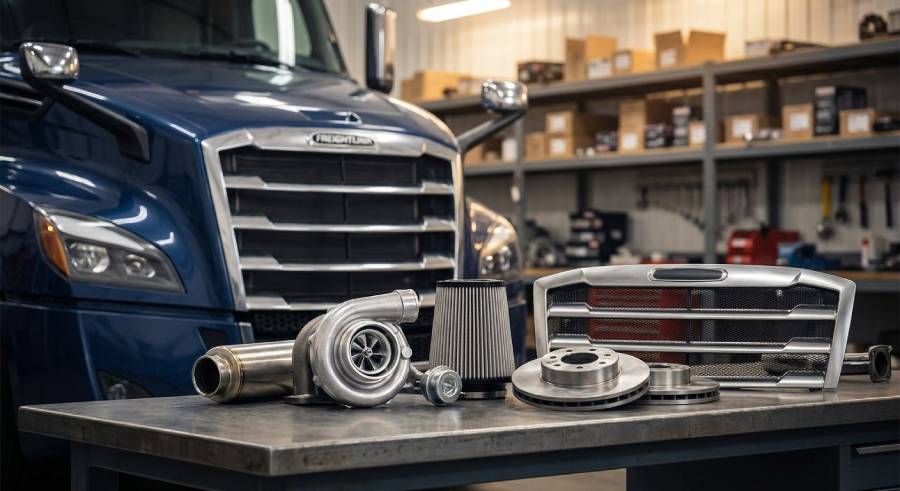
Freightliner Cascadia parts for sale are available through authorized Freightliner dealerships, online heavy-duty truck parts suppliers, and commercial truck salvage yards. Buyers can find replacement components for major vehicle systems, including engines, transmissions, brakes, suspension, electrical systems, and exterior body assemblies. These parts are offered in OEM, aftermarket, remanufactured, and used conditions, providing different options based on repair requirements and budget.
Choosing the right Freightliner Cascadia replacement parts requires matching each component to the truck’s model year, vehicle identification number (VIN), engine configuration, and original equipment part number. For example, engine components designed for a Detroit DD15 may not fit a truck equipped with a DD13, while headlights, bumpers, and hood assemblies can differ between earlier Cascadia models and the New Cascadia generation. Incorrect fitment can result in installation problems, additional repair costs, and extended vehicle downtime.
Freightliner Cascadia parts prices vary according to component type, manufacturer, condition, and supplier. Genuine OEM parts provide manufacturer-specified fitment, while compatible aftermarket and remanufactured alternatives offer additional purchasing options. This guide covers the available parts categories, where to buy them, pricing considerations, OEM versus aftermarket differences, and how to verify compatibility before placing an order.
What Freightliner Cascadia Parts Are Available for Sale?
Freightliner Cascadia replacement parts are available for six major vehicle systems: engine and drivetrain, braking, suspension, exterior body, electrical, and interior components. These parts support routine maintenance, mechanical repairs, collision restoration, and the replacement of worn or damaged equipment. Availability and compatibility depend on the truck’s model year, engine configuration, and original equipment specifications.
What Engine and Drivetrain Parts Are Available for the Freightliner Cascadia?
Freightliner Cascadia engine and drivetrain parts include fuel injectors, turbochargers, water pumps, oil filters, fuel filters, radiators, engine sensors, clutch components, and transmission assemblies. These components support fuel delivery, engine cooling, lubrication, power generation, and power transfer to the drive wheels.
Detroit DD13, DD15, and DD16 engines have different component specifications, making engine identification essential when purchasing replacement parts. For example, a fuel injector designed for a specific DD15 engine configuration should not be assumed compatible with a DD13 engine. Buyers must verify the engine serial number and applicable OEM part number before ordering fuel system or internal engine components.
Transmission replacement parts also vary according to the installed transmission model. Freightliner Cascadia trucks equipped with Detroit DT12 automated manual transmissions require components compatible with their specific transmission configuration. Available replacement parts include transmission sensors, actuators, seals, and related service components. Major assemblies, including engines and transmissions, may also be available as remanufactured or used units.
What Brake and Suspension Parts Are Available for the Freightliner Cascadia?
Freightliner Cascadia brake and suspension replacement parts include brake chambers, brake pads, brake shoes, brake drums, brake rotors, air brake valves, air springs, shock absorbers, and suspension bushings. These components maintain braking performance, axle stability, ride quality, and vehicle load support.
Brake system components differ according to axle configuration and whether the truck uses disc or drum brakes. For example, a Cascadia equipped with air disc brakes requires compatible brake pads, rotors, and caliper components, while a drum brake configuration uses brake shoes, drums, and related hardware. Brake chambers and air system components must also match the vehicle’s original specifications.
Suspension parts include air springs, shock absorbers, torque rods, leveling valves, and suspension bushings. Air springs support the vehicle’s weight through compressed air, while shock absorbers control suspension movement. Worn air springs may cause air leaks or uneven ride height, whereas damaged shock absorbers can reduce ride stability. Replacement components must match the truck’s axle and suspension configuration.
What Body, Electrical, and Interior Parts Are Available for the Freightliner Cascadia?
Freightliner Cascadia body, electrical, and interior parts include hoods, bumpers, grilles, headlights, mirrors, fenders, wiring harnesses, sensors, dashboard switches, instrument clusters, and HVAC components. These parts are available for repairing collision damage, restoring electrical functions, and replacing worn cabin equipment.
Exterior components vary significantly between Cascadia generations. Earlier Cascadia trucks and New Cascadia models have different front-end designs, including hood shapes, headlight assemblies, bumper configurations, and grille dimensions. For example, a headlight assembly manufactured for an earlier Cascadia model should not be purchased for a New Cascadia without confirming the applicable part number and fitment.
Electrical replacement parts include engine sensors, lighting components, control modules, switches, and wiring harnesses. Electronic modules require particular attention because compatibility may depend on vehicle configuration, software, and programming requirements. Some replacement modules must be programmed or configured after installation.
Interior replacement components include dashboard panels, seat assemblies, climate control parts, door handles, window regulators, and cabin switches. Buyers should confirm the cab configuration and component specifications before purchasing, especially when sourcing used interior assemblies.
Where Can You Buy Freightliner Cascadia Parts?
Freightliner Cascadia parts can be purchased from authorized Freightliner dealerships, specialized online heavy-duty truck parts retailers, aftermarket distributors, and commercial truck salvage yards. Each purchasing channel offers different advantages regarding product selection, component condition, technical support, warranty coverage, and pricing.
Authorized Freightliner dealerships are a primary source for genuine replacement components and manufacturer-supported parts identification. Freightliner dealers can use vehicle identification information to help locate compatible parts, including engine components, electronic modules, braking systems, and body assemblies. The Freightliner dealer network also provides access to parts support for specific vehicle configurations. Buyers can locate authorized dealerships through the official Freightliner website.
Online heavy-duty truck parts retailers provide access to OEM and aftermarket components from multiple manufacturers. These suppliers commonly organize inventory by truck make, model, component category, or part number, allowing buyers to compare replacement options without visiting a physical dealership. Online catalogs may include product specifications, compatibility references, manufacturer details, and warranty information. However, a product listed for the Freightliner Cascadia is not automatically compatible with every model year or engine configuration.
Aftermarket parts distributors offer replacement components manufactured by companies other than the original vehicle manufacturer. Available products include filters, brake components, suspension parts, lighting assemblies, and selected engine accessories. Established heavy-duty component manufacturers such as Bendix and Meritor supply parts for commercial vehicle applications, although compatibility must be verified for the specific Cascadia configuration. Buyers should compare manufacturer specifications, part numbers, and warranty terms rather than relying on price alone.
Commercial truck salvage yards supply used Freightliner Cascadia parts recovered from dismantled or damaged trucks. Commonly sourced components include hoods, doors, mirrors, bumpers, interior panels, transmission assemblies, and other reusable parts. Salvage parts can provide an alternative when new components are expensive or difficult to obtain. Their condition depends on previous use, mileage, accident damage, and storage conditions.
Before purchasing used parts, buyers should request the donor vehicle’s identification details, component part number, condition photographs, and available testing records. Mechanical assemblies require additional checks for wear, leaks, and operational condition. Safety-critical components, particularly braking and steering parts, require stricter evaluation and must meet applicable specifications.
The best purchasing source depends on the component being replaced. Authorized dealerships are particularly useful for manufacturer-specific electronic components and complex fitment requirements. Online retailers offer broader opportunities to compare OEM and aftermarket products, while salvage yards are an option for selected used body panels, interior components, and major assemblies. Regardless of the supplier, confirming the exact part number and vehicle compatibility is essential before completing the purchase.
How Much Do Freightliner Cascadia Parts Cost?
Freightliner Cascadia replacement parts range from inexpensive maintenance components to major assemblies costing thousands of dollars. Prices depend on five primary factors: component type, manufacturer, vehicle compatibility, product condition, and supplier. Routine maintenance parts, such as filters and selected sensors, generally cost less than turbochargers, transmission assemblies, or complete engine replacements.
Engine and drivetrain components represent some of the most expensive replacement parts for the Freightliner Cascadia. Oil and fuel filters are relatively inexpensive because they are manufactured as routine service items. Fuel injectors, turbochargers, and cooling system components cost more due to their mechanical complexity, manufacturing requirements, and engine-specific specifications. Complete Detroit DD13 or DD15 engine assemblies involve substantially higher expenses, particularly when installation labor, shipping, and additional service components are included.
Exterior replacement parts also vary considerably in price. Individual mirrors, headlight assemblies, and bumper components generally cost less than complete hood assemblies. A replacement hood may require additional expenses for painting, mounting hardware, and installation. The distinction between an individual component and a complete assembly is important because product listings may include different quantities of hardware or accessories.
The following table summarizes the relative pricing characteristics of common Freightliner Cascadia replacement parts. Actual prices must be confirmed through current supplier quotations.
| Part Category | Common Components | Relative Cost |
|---|---|---|
| Maintenance parts | Oil filters, fuel filters, air filters | Low |
| Electrical parts | Sensors, switches, lighting components | Low to high |
| Brake parts | Brake pads, chambers, rotors | Low to high |
| Suspension parts | Air springs, shocks, bushings | Low to moderate |
| Exterior parts | Mirrors, headlights, bumpers, hoods | Low to high |
| Engine parts | Injectors, turbochargers, engine assemblies | Moderate to very high |
| Transmission parts | Sensors, actuators, complete transmissions | Low to very high |
OEM parts, aftermarket alternatives, and remanufactured components can have different purchase prices even when they serve the same function. Genuine OEM components are supplied through manufacturer-approved channels, while aftermarket parts are offered by independent manufacturers. Remanufactured components undergo a rebuilding process that may include disassembly, inspection, replacement of worn parts, and performance testing according to the remanufacturer’s procedures.
Used Freightliner Cascadia parts are often priced below equivalent new components, but the initial purchase price does not represent the complete replacement cost. Buyers must consider remaining service life, shipping, installation labor, warranty coverage, and the possibility of another repair. A lower-priced used transmission, for example, may become more expensive than a remanufactured alternative if it requires additional repairs shortly after installation.
Some remanufactured components also carry core charges, which are refundable deposits associated with returning an eligible old component. Buyers should verify the core return requirements, shipping arrangements, and refund conditions before comparing final prices.
Should You Buy OEM or Aftermarket Freightliner Cascadia Parts?
Choosing between OEM and aftermarket Freightliner Cascadia parts depends on component specifications, compatibility, warranty requirements, and total replacement cost. OEM parts are supplied through the original equipment manufacturer’s approved parts channels, while aftermarket components are manufactured and distributed as alternatives to original equipment replacements.
OEM components are identified through manufacturer part numbers and application catalogs. Aftermarket components use their own part numbers and may provide cross-references to original equipment numbers. However, a matching cross-reference does not eliminate the need to verify the truck’s model year, engine configuration, and component specifications.
Neither category guarantees superior performance in every application. A correctly specified aftermarket component from an established manufacturer may provide reliable service, while an incorrectly selected OEM component will still create fitment problems. Product quality, manufacturing standards, supplier support, and installation requirements must be evaluated alongside the part’s origin.
When Should You Choose OEM Freightliner Cascadia Parts?
OEM Freightliner Cascadia parts are a strong choice when manufacturer-specific compatibility, electronic integration, or warranty requirements are important. These considerations are particularly relevant to engine control modules, electronic sensors, vehicle communication components, and assemblies that require programming or configuration.
Electronic components illustrate the importance of original equipment specifications. A replacement control module must communicate correctly with the truck’s electronic systems and may require software configuration after installation. Selecting a module based only on physical appearance or connector shape can result in communication errors or unsuccessful installation.
OEM parts are also useful when buyers need to identify components through a Freightliner dealer using the vehicle identification number. Dealer parts departments can help determine the appropriate replacement number and identify manufacturer-approved supersessions when original components have been replaced by updated versions.
Warranty considerations provide another reason to evaluate OEM parts. Certain repairs performed under manufacturer warranty or service programs may require specific replacement components and procedures. However, aftermarket parts do not automatically invalidate an entire vehicle warranty. Coverage depends on the applicable warranty terms and whether a component or installation caused the claimed failure.
OEM parts may carry higher purchase prices than some aftermarket alternatives. Buyers should therefore compare the quoted component price, included hardware, warranty coverage, and installation requirements before making a decision.
When Are Aftermarket Freightliner Cascadia Parts a Good Option?
Aftermarket Freightliner Cascadia parts are a practical option when a reputable manufacturer offers a compatible replacement that meets the required technical specifications. They are particularly relevant to routine maintenance, selected braking and suspension components, lighting assemblies, and exterior replacement parts.
For example, aftermarket air springs and shock absorbers are available for heavy-duty truck applications. Buyers must match dimensions, mounting configurations, load requirements, and manufacturer cross-reference information to the original component. A part advertised as compatible with Freightliner Cascadia trucks should still be checked against the specific vehicle configuration.
Aftermarket brake components require additional attention because braking performance depends on correct specifications and installation. Brake chambers, pads, rotors, and related hardware must match the vehicle’s braking system. Where applicable, components should meet relevant regulatory requirements and manufacturer specifications. Price savings should not take priority over safety-critical compatibility.
Established aftermarket manufacturers may provide technical documentation, product warranties, and installation guidance. Buyers should examine these resources alongside supplier reputation and replacement availability. An aftermarket component with documented specifications and dependable support offers a more informed purchasing choice than an unverified low-cost product.
The most effective comparison considers the total cost of ownership rather than the initial price alone. A lower-priced aftermarket part can provide value when it delivers appropriate fitment, reliable service life, and suitable warranty protection. OEM parts remain an important option when manufacturer-specific requirements or complex vehicle integration make exact replacement specifications especially important.
How Do You Find Parts That Fit Your Freightliner Cascadia?
To find parts that fit your Freightliner Cascadia, verify the vehicle identification number (VIN), model year, engine configuration, and original equipment part number before ordering. These identifiers help distinguish compatible replacement components from parts designed for different Cascadia generations, drivetrain configurations, or production specifications. Matching the correct component reduces installation errors, unnecessary returns, and truck downtime.
Start with the truck’s 17-character VIN, which identifies the vehicle and provides a reference for retrieving its factory build information. The VIN is commonly displayed on the driver’s side dashboard, vehicle identification labels, and registration documents. Authorized Freightliner dealerships can use this information to identify the vehicle configuration and locate applicable replacement components through manufacturer-supported parts systems.
The VIN is particularly important because Freightliner Cascadia trucks produced within the same model year may have different engines, transmissions, axles, and electrical systems. For example, two Cascadia trucks equipped with Detroit DD15 engines may require different replacement components because of engine production revisions or equipment configurations. VIN-based identification helps narrow the search, but certain engine and transmission parts also require verification using component serial numbers.
Match the OEM part number before selecting a replacement. Original equipment numbers are available on many existing components, manufacturer labels, parts documentation, and authorized parts catalogs. These numbers identify specific component designs and provide a reference for locating genuine replacements or compatible aftermarket alternatives. When an original number has been discontinued, manufacturers may assign a superseding part number that replaces the previous version.
A superseding part number should be verified through manufacturer documentation or a qualified parts supplier. Updated components may require additional hardware, installation procedures, or related replacement parts. Likewise, an aftermarket cross-reference indicates a proposed equivalent but does not independently guarantee compatibility with every vehicle configuration.
Check the Cascadia generation and model year, especially when purchasing exterior body parts, lighting assemblies, dashboard components, and electronic equipment. The New Cascadia, introduced for the 2018 model year, features substantial design differences from earlier Cascadia trucks. Hood assemblies, headlights, bumpers, grilles, and other front-end components are not universally interchangeable between these generations.
Mechanical compatibility also depends on the installed engine and transmission. Detroit DD13, DD15, and DD16 engines use configuration-specific components, while trucks equipped with Detroit DT12 automated manual transmissions require parts matching their transmission model and production specifications. Engine serial numbers, transmission identification labels, and manufacturer catalogs provide additional information when VIN-based results are insufficient.
Compare the replacement part’s technical specifications with the original component. For mechanical parts, confirm dimensions, mounting points, connection types, and operating requirements. For electrical components, verify connector configurations, voltage requirements, communication compatibility, and programming needs. Brake and suspension components must also match the vehicle’s axle configuration, load requirements, and applicable safety specifications.
For example, replacing a Freightliner Cascadia air spring requires more than matching the truck’s make and model. The replacement must correspond to the installed suspension system, mounting arrangement, and specified dimensions. An air spring with an incorrect mounting configuration may not install correctly even when its product listing mentions the Freightliner Cascadia.
Before completing an online order, provide the supplier with the VIN, original part number, model year, and relevant component identification details. Request written fitment confirmation when the listing does not clearly identify the exact vehicle application. Keep the confirmation and review the supplier’s return policy, particularly for electronic modules, special-order components, and major mechanical assemblies.
Correct Freightliner Cascadia parts identification follows a consistent sequence: identify the vehicle, confirm its installed equipment, locate the original part number, verify any replacement or cross-reference number, and compare technical specifications. This process applies to OEM, aftermarket, remanufactured, and used components, making compatibility verification an essential step regardless of where the replacement part is purchased.
What Are the Most Common Freightliner Cascadia Parts That Need Replacement?
The Freightliner Cascadia parts that commonly require replacement include maintenance filters, brake components, suspension parts, cooling system components, and selected electrical components. Replacement frequency depends on vehicle mileage, operating conditions, maintenance history, and component wear. Parts exposed to friction, vibration, heat, and contamination generally require more frequent inspection than components designed for long-term structural use.
Maintenance filters are among the most regularly replaced Freightliner Cascadia components. Engine oil filters, fuel filters, and air filters protect critical systems by removing contaminants from lubricants, fuel, and intake air. Oil and fuel filters must be replaced according to the applicable engine maintenance schedule, while air filter service depends on manufacturer recommendations and restriction measurements. Using incorrect filters can affect filtration performance, fluid flow, and engine protection.
Brake components also require periodic inspection and replacement because friction materials wear during normal operation. Brake pads, brake shoes, rotors, and drums deteriorate according to braking frequency, vehicle weight, operating terrain, and driving conditions. For example, a Cascadia operating on mountainous routes with frequent braking may experience different brake wear patterns from a truck primarily traveling on flat interstate highways. Brake components should be replaced when inspection results reach the applicable service limits rather than according to mileage alone.
Suspension and cooling system components are additional replacement categories. Air springs, shock absorbers, and suspension bushings experience repeated mechanical loading, while coolant hoses, thermostats, and water pumps operate under changing temperatures and pressures. Damaged air springs can cause air leakage or uneven ride height, whereas cooling system failures may result in coolant loss and engine overheating. Replacement decisions should follow diagnostic findings and manufacturer service specifications.
Electrical components, including sensors, switches, wiring connectors, and lighting assemblies, require replacement when testing confirms a fault. Warning lights, intermittent electrical operation, damaged wiring, and communication errors can indicate problems, but these symptoms do not always identify a defective component. A diagnostic inspection helps distinguish failed parts from wiring faults, connection problems, or other system conditions.
Read more: Freightliner Cascadia VIN Decoder: Complete Guide
What Should You Check Before Ordering Freightliner Cascadia Parts Online?
Before ordering Freightliner Cascadia parts online, verify six purchasing details: vehicle compatibility, part number, supplier credibility, product condition, warranty coverage, and total delivered cost. These checks help buyers avoid incorrect components, unexpected charges, and delays caused by returns or replacement orders.
Vehicle compatibility is the first requirement. Confirm that the supplier’s product listing matches the truck’s VIN, model year, engine configuration, and relevant component specifications. Product descriptions stating that a part fits the Freightliner Cascadia may cover only certain production years or equipment configurations. Compare the listed manufacturer part number with the original component and request supplier confirmation when compatibility information is incomplete.
Supplier credibility should be evaluated through identifiable business information and product documentation. Reliable purchasing information includes the seller’s business identity, contact details, manufacturer references, product specifications, and clearly stated order policies. Customer reviews can provide additional context, but technical documentation and verified fitment information are more useful for determining whether a replacement component meets the vehicle’s requirements.
Product condition determines what additional inspections are necessary. New parts should be supplied with accurate manufacturer identification and product specifications. Remanufactured components should include information about the rebuilding process, testing, and warranty coverage. Used parts require closer examination of wear, damage, mileage when available, and previous operating conditions. Buyers purchasing used engines or transmissions should request identification numbers, inspection records, and any available operational test results.
Warranty and return policies must be reviewed before payment. Check the warranty duration, covered defects, exclusions, claim procedures, and responsibility for return shipping. Electronic modules, installed components, and special-order parts may have restricted return eligibility. Confirm whether the supplier accepts returns when a part is incorrectly listed as compatible with the vehicle.
Total delivered cost includes more than the advertised part price. Shipping charges, taxes, core deposits, return fees, and installation expenses can change the final cost of a replacement. Large Freightliner Cascadia components, such as hoods, engines, and transmissions, may require freight shipping rather than standard parcel delivery. Buyers should confirm packaging requirements, delivery arrangements, and procedures for reporting transportation damage.
Finally, review the product listing and order confirmation before completing the purchase. The documentation should identify the exact part number, quantity, condition, price, shipping terms, and applicable warranty. Keeping these records provides a reference for installation, future maintenance, and potential warranty claims.
Can You Buy Freightliner Cascadia Parts for Older Model Years?
Freightliner Cascadia parts for older model years are available through authorized dealerships, aftermarket parts suppliers, commercial truck salvage yards, and specialized online retailers. Replacement part availability depends on the vehicle’s production year, component specifications, manufacturer support, and whether compatible aftermarket or remanufactured alternatives exist.
Authorized Freightliner dealerships are a useful starting point for identifying older Cascadia replacement parts. Dealer parts departments can reference the truck’s vehicle identification number (VIN) to locate original equipment part numbers and check for updated replacements. Some discontinued components have manufacturer-approved superseding part numbers, allowing buyers to obtain compatible replacements even when the original part is no longer supplied.
Aftermarket manufacturers also provide replacement components for older Freightliner Cascadia trucks. Common examples include filters, brake components, air springs, shock absorbers, cooling system parts, and selected electrical components. These products may remain available after original equipment versions become difficult to source. However, compatibility must be confirmed using manufacturer cross-reference information, component specifications, and the vehicle’s original equipment configuration.
Commercial truck salvage yards offer another source for discontinued or difficult-to-find components. Used hoods, doors, bumpers, mirrors, dashboard assemblies, and other reusable parts may be recovered from dismantled Cascadia trucks. Buyers should verify the donor vehicle’s model year, original part number, and component condition before purchasing. Used mechanical assemblies require additional inspection because their remaining service life depends on previous operation and maintenance.
Parts interchangeability is particularly important when comparing earlier Cascadia trucks with the New Cascadia generation introduced for the 2018 model year. Exterior components such as headlights, hoods, grilles, and bumpers have generation-specific designs and should not be assumed interchangeable. Engine, transmission, and electrical components may also differ according to production revisions and installed equipment.
The most reliable purchasing approach is to identify the original component, check for manufacturer-approved replacements, and compare available OEM, aftermarket, remanufactured, or used options. Buyers should confirm compatibility with the supplier before ordering, particularly when replacing discontinued parts or components sourced from another vehicle.