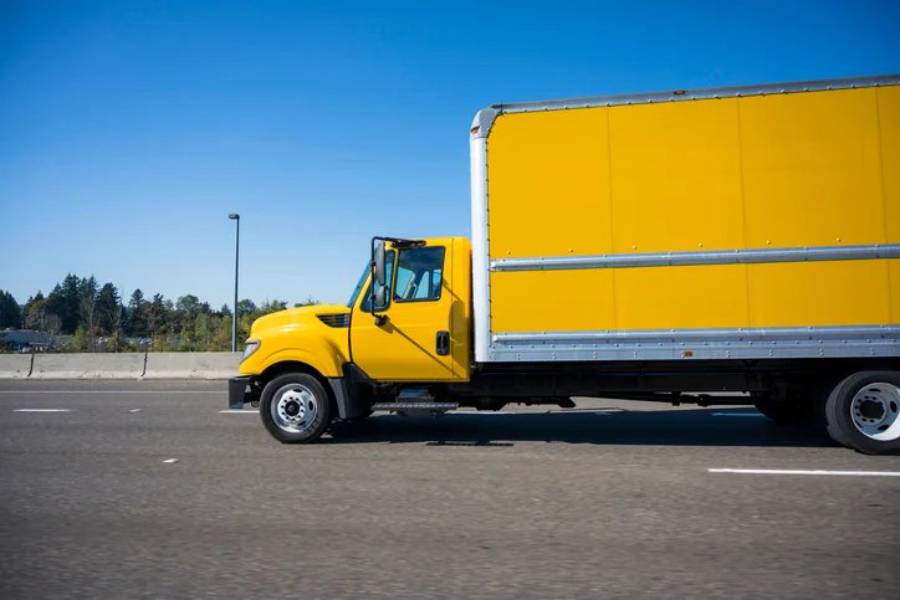
A non-CDL Freightliner box truck is a commercial straight truck that can generally be operated without a Commercial Driver’s License (CDL) when its Gross Vehicle Weight Rating (GVWR) is 26,000 pounds or less and no other CDL requirements apply. These trucks are used for local deliveries, moving services, freight transportation, and other commercial operations that require enclosed cargo space.
The Freightliner M2 106 is one of the models available in configurations suitable for non-CDL operation. Depending on the chassis configuration, these trucks can accommodate different cargo box lengths, diesel engines, automatic transmissions, and equipment such as hydraulic liftgates. However, not every Freightliner M2 106 qualifies as a non-CDL vehicle. Eligibility depends on the specific truck’s certified weight ratings and operating conditions.
Choosing a non-CDL Freightliner box truck requires evaluating more than its cargo dimensions. GVWR, actual payload capacity, engine specifications, maintenance costs, and purchase price determine whether a particular truck meets both licensing requirements and business needs. This guide explains which Freightliner configurations may qualify for non-CDL operation, how their specifications affect cargo capacity, what new and used trucks cost, and what buyers should inspect before purchasing.
What Is a Non-CDL Freightliner Box Truck?
A non-CDL Freightliner box truck is a commercial straight truck that generally does not require a Commercial Driver’s License (CDL) because its certified weight rating falls below the applicable CDL threshold. In the United States, a single Freightliner box truck with a Gross Vehicle Weight Rating (GVWR) of 26,000 pounds or less can typically be operated with a regular driver’s license, provided its use does not trigger other CDL requirements. These vehicles combine a Freightliner commercial chassis with an enclosed cargo body designed to protect freight during transportation.
Freightliner box trucks are commonly built on medium-duty chassis such as the Freightliner Business Class M2 106. The chassis supports different cargo body configurations, including 16-foot, 20-foot, 24-foot, and 26-foot boxes, depending on wheelbase, body installation, and weight specifications. Commercial equipment such as liftgates, cargo restraints, and roll-up rear doors can be added to support delivery operations. However, cargo box length does not determine whether the truck requires a CDL. A 26-foot box truck rated at 26,000 pounds GVWR may qualify for non-CDL operation, while a shorter truck rated at 33,000 pounds generally requires a Class B CDL.
Non-CDL Freightliner box trucks are used for furniture delivery, household moving, appliance transportation, retail distribution, and local freight services. Their enclosed cargo compartments accommodate palletized goods, furniture, and equipment while protecting shipments from weather exposure. Although these trucks may not require a CDL, commercial operators can still be subject to USDOT registration, vehicle inspections, hours-of-service regulations, and other safety requirements depending on the vehicle and operation.
Do You Need a CDL to Drive a Freightliner Box Truck?
You generally do not need a CDL to drive a Freightliner box truck with a GVWR of 26,000 pounds or less, provided the vehicle does not meet another CDL classification. Under federal regulations administered by the Federal Motor Carrier Safety Administration (FMCSA), CDL requirements depend on vehicle weight ratings, vehicle combinations, passenger capacity, and hazardous-material transportation. The Freightliner brand, cargo box length, and commercial purpose alone do not establish whether a CDL is required.
A standard driver’s license may be sufficient for an eligible non-CDL Freightliner box truck, although individual states can impose additional licensing requirements. Drivers should verify the truck’s manufacturer certification label and applicable state rules before operating the vehicle.
What Is the GVWR Limit for a Non-CDL Freightliner Box Truck?
The federal GVWR threshold for a typical non-CDL Freightliner straight box truck is 26,000 pounds. A single vehicle with a GVWR of 26,001 pounds or more generally falls under Class B CDL requirements. GVWR represents the maximum loaded vehicle weight established by the manufacturer, including the truck, cargo body, fuel, occupants, equipment, and freight.
For example, a Freightliner M2 106 with a certified GVWR of 26,000 pounds generally falls below the federal Class B CDL weight threshold. A different M2 106 configuration rated at 33,000 pounds generally requires a Class B CDL. The driver’s license classification depends on the specific vehicle’s rating rather than its model name.
Gross Combination Weight Rating (GCWR) also matters when towing a trailer. A combination rated at 26,001 pounds or more generally triggers Class A CDL requirements when the towed unit has a GVWR exceeding 10,000 pounds. Federal rules also establish CDL requirements for certain passenger vehicles and vehicles transporting hazardous materials requiring placards, regardless of whether the truck falls below the usual weight threshold.
Can You Drive a 26-Foot Freightliner Box Truck Without a CDL?
You can drive a 26-foot Freightliner box truck without a CDL when its certified weight ratings and operating configuration satisfy applicable non-CDL requirements. The 26-foot measurement describes the approximate length of the cargo body, not the vehicle’s GVWR. Two Freightliner trucks with identical cargo box lengths can have different weight ratings because of differences in chassis configuration, suspension, axles, and installed equipment.
For example, a 26-foot Freightliner box truck with a 26,000-pound GVWR may qualify for non-CDL operation, while another 26-foot truck rated at 33,000 pounds generally requires a Class B CDL. Buyers must also consider payload capacity because a larger cargo body adds empty weight and reduces the amount of freight the truck can legally carry.
Air brakes do not independently create a federal CDL requirement for a Freightliner box truck below the applicable CDL thresholds. However, CDL holders operating air-brake-equipped vehicles must satisfy relevant air-brake qualification requirements to avoid license restrictions. State licensing rules may impose additional conditions.
Before purchasing or driving a 26-foot Freightliner box truck, verify its GVWR on the manufacturer’s certification label, review its registration documents, and confirm applicable licensing requirements with the state motor vehicle agency.
Which Freightliner Box Truck Models Can Be Driven Without a CDL?
The Freightliner Business Class M2 106 is a primary model to consider for non-CDL box truck operation because it has been offered in configurations with a 26,000-pound GVWR. However, Freightliner manufactures trucks across multiple weight classes, and the model designation alone does not establish CDL eligibility. Buyers must verify the specific chassis configuration, certified GVWR, and intended operating conditions before determining whether a truck qualifies.
The Freightliner M2 106 is a medium-duty commercial truck used for local distribution, furniture transportation, moving services, and regional deliveries. Its conventional cab design, customizable wheelbase, and compatibility with enclosed cargo bodies make it suitable for different commercial applications. The M2 106 is also available in heavier configurations that exceed the federal non-CDL weight threshold. Therefore, two trucks carrying the same M2 106 designation can have different licensing requirements.
The Freightliner M2 112 is another commercial truck platform, but it is generally associated with heavier-duty applications and higher weight ratings. Buyers should not assume that an M2 112 qualifies for non-CDL operation without checking the manufacturer’s certification label. Freightliner MT45 step vans may also be relevant to businesses seeking non-CDL delivery vehicles, although their walk-in body design differs from a conventional box truck.
Is the Freightliner M2 106 Available in a Non-CDL Configuration?
Yes, the Freightliner M2 106 has been available in configurations rated at 26,000 pounds GVWR, making it suitable for non-CDL operation when no other CDL requirements apply. The M2 106 uses a configurable commercial chassis that accommodates different wheelbases, axle ratings, cargo bodies, and powertrain combinations. This flexibility allows businesses to select a truck for specific freight requirements while remaining within the applicable licensing threshold.
A 26,000-pound GVWR Freightliner M2 106 can be equipped with an enclosed cargo body for furniture deliveries, palletized freight, or commercial moving services. However, its actual payload depends on the completed vehicle’s empty operating weight. A larger cargo body, hydraulic liftgate, or additional equipment increases vehicle weight and reduces available cargo capacity. The truck must also remain within its front and rear Gross Axle Weight Ratings (GAWR).
Buyers can identify a qualifying configuration by examining the manufacturer’s vehicle certification label, typically located near the driver’s door opening. The label identifies the certified GVWR and axle ratings. The VIN, vehicle build documentation, and registration records provide additional information for verifying the chassis configuration. A truck advertised as “non-CDL” should never be evaluated solely on the seller’s description. Its certified weight ratings must support that classification.
What Are the Specifications of a Non-CDL Freightliner Box Truck?
Non-CDL Freightliner box truck specifications depend on the chassis model, production year, engine, transmission, and certified weight rating. The Freightliner M2 106 and M2 106 Plus offer multiple powertrain and chassis configurations, but only trucks meeting the applicable licensing requirements qualify for non-CDL operation. Buyers should evaluate engine output, transmission type, wheelbase, suspension, and axle ratings alongside the vehicle’s GVWR.
The Freightliner M2 106 Plus offers Detroit DD5 and DD8 diesel engines, along with Cummins B6.7 and L9 engine options in applicable configurations. Manufacturer specifications list engine output across the model family at approximately 200–360 horsepower, depending on the engine and configuration. These figures describe the broader M2 106 Plus lineup rather than the specifications of every non-CDL truck. Engine availability varies by model year, emissions requirements, and chassis configuration.
Transmission options include Allison 1000, 2000, and 3000 Series automatic transmissions, along with Eaton Fuller manual transmissions in selected configurations. Automatic transmissions are useful for urban delivery operations because they eliminate manual gear changes during repeated stops, intersections, and loading routes. The appropriate transmission must be matched to the engine’s torque output, vehicle weight, and operating conditions.
The following table summarizes important Freightliner M2 106 Plus specifications. Actual non-CDL configurations represent a subset of the broader model range.
| Specification | Freightliner M2 106 Plus |
|---|---|
| Vehicle class | Class 6–8 |
| Engine options | Detroit DD5, DD8; Cummins B6.7, L9 |
| Horsepower range | Approximately 200–360 hp |
| Transmission options | Allison automatic; Eaton Fuller manual |
| Cab configurations | Day cab, extended cab, crew cab |
| Wheel cut | Up to 55 degrees |
| Non-CDL GVWR target | 26,000 lbs or less |
| Cargo body | Depends on chassis and body installation |
Fuel economy depends on engine selection, cargo weight, driving speed, terrain, idling time, and delivery frequency. A Freightliner box truck operating on congested urban routes consumes fuel differently from an equivalent truck traveling at consistent highway speeds. Freightliner does not provide one universal MPG rating applicable to every M2 106 box truck configuration. Buyers should use vehicle-specific operating records and comparable fleet data to estimate fuel expenses.
Chassis dimensions and suspension specifications also affect commercial usability. The M2 106 Plus offers multiple axle and suspension configurations, while its wheel cut of up to 55 degrees supports maneuverability in confined delivery areas. However, the completed vehicle’s wheelbase, cargo body dimensions, and rear overhang determine its actual turning requirements. Selecting a truck with the appropriate chassis configuration helps balance cargo space, handling, and legal payload capacity.How Much Weight Can a Non-CDL Freightliner Box Truck Carry?
A non-CDL Freightliner box truck with a 26,000-pound GVWR can carry approximately 8,000–12,000 pounds of payload in some configurations, depending on the truck’s empty operating weight, cargo body, liftgate, and installed equipment. This range is illustrative rather than a manufacturer-certified payload specification. The actual cargo capacity must be calculated for each completed vehicle because trucks with identical GVWR ratings can have substantially different empty weights.
Payload capacity is determined by the difference between the vehicle’s Gross Vehicle Weight Rating (GVWR) and its actual empty operating weight. A Freightliner M2 106 equipped with a lightweight cargo body generally provides more available payload than an otherwise comparable truck fitted with a heavier body and hydraulic liftgate. Fuel, occupants, tools, and accessories also contribute to the vehicle’s operating weight, reducing the amount of freight it can transport.
Gross Axle Weight Ratings (GAWR) impose additional loading restrictions. A truck can remain below its 26,000-pound GVWR while exceeding the permitted weight on its rear axle because of improper cargo distribution. For example, placing several heavy pallets near the rear doors can overload the rear axle even when the total vehicle weight remains within its GVWR. Operators must distribute freight appropriately and verify axle loads when transporting heavy cargo.
How Do You Calculate the Payload Capacity of a Non-CDL Freightliner Box Truck?
Calculate payload capacity by subtracting the truck’s actual empty operating weight from its GVWR. The calculation establishes how much additional weight the vehicle can carry without exceeding its manufacturer-rated maximum loaded weight.
Payload Capacity = GVWR − Empty Operating Weight
For example, consider a Freightliner M2 106 with a certified GVWR of 26,000 pounds and an illustrative empty operating weight of 16,000 pounds. The remaining payload capacity is 10,000 pounds. If the truck subsequently carries a 200-pound driver and 100 pounds of additional equipment not included in its measured empty weight, the remaining cargo allowance decreases to 9,700 pounds.
A hydraulic liftgate further reduces available payload because its weight becomes part of the completed vehicle’s operating weight. For instance, adding a 1,000-pound liftgate to the hypothetical truck would reduce its 10,000-pound payload allowance to 9,000 pounds, assuming no other changes. The actual reduction depends on the installed liftgate’s weight and whether it was already included in the empty-weight measurement.
Buyers should obtain a scale weight for the completed truck, including its cargo body and permanently installed equipment, before calculating usable payload. The calculation must also account for passengers, fuel, tools, and applicable axle weight limits. A 26,000-pound GVWR does not mean the truck can carry 26,000 pounds of freight. It represents the maximum permitted weight of the entire loaded vehicle.
What Box Sizes Are Available for Non-CDL Freightliner Trucks?
Non-CDL Freightliner box trucks can be configured with cargo bodies measuring approximately 16, 20, 24, or 26 feet, provided the selected chassis, body installation, and completed vehicle meet applicable weight and dimensional requirements. These measurements describe nominal cargo body length rather than a standardized Freightliner factory specification. Actual availability depends on the chassis wheelbase, body manufacturer, axle configuration, and intended application.
A 16-foot Freightliner box truck provides enclosed cargo space for smaller delivery routes, appliance transportation, and local distribution. Its shorter body generally improves maneuverability compared with longer configurations built on similar chassis. A 20-foot cargo body provides additional space for furniture, packaged products, and palletized freight, making it suitable for businesses that need more volume without selecting the longest available body.
A 24-foot or 26-foot Freightliner box truck accommodates bulkier shipments and larger delivery loads. However, a longer cargo body does not automatically provide greater payload capacity. The additional weight of the box, flooring, rear door, and supporting structure reduces the freight weight available under the truck’s GVWR. A 26-foot body also requires an appropriate wheelbase and rear overhang to maintain safe handling and axle loading.
Cargo box height and width are equally important when evaluating usable space. Two trucks with 26-foot cargo bodies can have different interior dimensions because of differences in body construction, floor height, and roof design. Buyers transporting palletized freight should check interior width, door opening dimensions, and load distribution requirements rather than relying on nominal box length alone.
The following table summarizes common cargo body lengths and their potential applications.
| Box Length | Typical Commercial Application |
|---|---|
| 16 feet | Local deliveries, appliances, smaller moving jobs |
| 20 feet | Furniture delivery, retail distribution |
| 24 feet | Palletized freight, larger moving operations |
| 26 feet | High-volume deliveries, bulky commercial freight |
These lengths represent potential body configurations, not a guarantee that every size is available or suitable for a particular non-CDL Freightliner chassis.
For example, a 26-foot cargo body installed on a Freightliner M2 106 rated at 26,000 pounds GVWR may provide substantial cargo volume while leaving less usable payload than a shorter, lighter body on the same chassis. Businesses transporting lightweight furniture or packaged goods may prioritize cargo volume, while companies hauling dense equipment or heavy pallets should prioritize payload capacity and axle weight distribution.
Before choosing a cargo box size, verify the completed truck’s GVWR, empty operating weight, interior dimensions, wheelbase, and axle ratings. These specifications determine whether the truck can safely accommodate the intended freight while remaining within applicable non-CDL weight limits.
How Much Does a Non-CDL Freightliner Box Truck Cost?
The cost of a non-CDL Freightliner box truck depends on its model year, mileage, chassis configuration, cargo body, and mechanical condition. New trucks generally cost more than used models because their prices include the chassis, commercial body installation, and optional equipment. Used truck prices also reflect engine condition, maintenance history, and remaining service life. Buyers should compare complete vehicle configurations rather than evaluating the advertised purchase price alone.
A Freightliner M2 106 equipped with a 26,000-pound GVWR, enclosed cargo body, automatic transmission, and hydraulic liftgate may cost substantially more than a comparable chassis without specialized equipment. Cargo body length also influences pricing because larger bodies require additional materials and installation work. The purchase budget should account for sales taxes, registration, insurance, inspections, and initial maintenance.
How Much Does a New Non-CDL Freightliner Box Truck Cost?
A new non-CDL Freightliner box truck is typically priced through a dealer quote based on its chassis and completed body specifications. The final purchase price depends on the selected engine, transmission, wheelbase, axle ratings, cargo box dimensions, and optional equipment. A new Freightliner M2 106 Plus chassis does not necessarily include the enclosed cargo body, making it important to distinguish chassis-only prices from completed box truck prices.
For example, a business ordering a 26,000-pound GVWR Freightliner with a 20-foot dry freight body and a hydraulic liftgate must account for three major cost components: the commercial chassis, body installation, and liftgate equipment. Additional features such as cargo tracking systems, backup cameras, interior lighting, and reinforced flooring increase the total purchase price.
Buyers should request an itemized quotation showing the completed truck’s specifications, warranty coverage, delivery charges, and applicable fees. A lower chassis price does not guarantee a lower total vehicle cost when cargo body installation and required equipment are excluded.
How Much Does a Used Non-CDL Freightliner Box Truck Cost?
Used non-CDL Freightliner box truck prices vary according to age, mileage, maintenance history, and mechanical condition. A newer M2 106 with documented service records and a functioning cargo body generally commands a higher price than an older truck with extensive mileage or deferred maintenance. Engine hours provide additional information because delivery trucks can accumulate substantial idling time without corresponding increases in odometer mileage.
Used truck buyers should examine the engine, transmission, braking system, suspension, tires, and frame before making a purchase. Diesel engine diagnostics can reveal active fault codes, emissions-system problems, and operating conditions that may require expensive repairs. The cargo body should also be inspected for roof leaks, damaged flooring, corrosion, and structural deterioration. Trucks equipped with hydraulic liftgates require additional checks of the hydraulic system, electrical connections, lifting capacity, and platform operation.
Maintenance documentation is particularly important when comparing vehicles with similar mileage. A truck with consistent oil changes, transmission servicing, brake maintenance, and documented repairs provides a clearer picture of its operating history than one with incomplete records. Buyers should also verify the VIN, title status, certified GVWR, and any previous modifications that affect the truck’s weight or configuration.
The best purchase value is determined by total ownership cost rather than the lowest advertised price. A less expensive used Freightliner requiring immediate engine, transmission, or cargo body repairs may ultimately cost more than a higher-priced truck in better condition. A professional pre-purchase inspection and an accurate estimate of necessary repairs help buyers evaluate the truck’s financial suitability before completing the transaction.
What Businesses Use Non-CDL Freightliner Box Trucks?
Non-CDL Freightliner box trucks are used by delivery companies, moving businesses, retail distributors, and independent freight operators. Their enclosed cargo bodies protect shipments from weather exposure, while their commercial chassis support repeated loading, unloading, and transportation. Businesses select these trucks based on cargo volume, payload capacity, delivery frequency, and operating costs rather than licensing eligibility alone.
Local delivery companies use Freightliner box trucks to transport furniture, appliances, packaged merchandise, and commercial supplies between warehouses, distribution centers, and customer locations. A Freightliner M2 106 with a 20-foot cargo body, for example, can accommodate multiple deliveries on a single route when the combined freight weight remains within the vehicle’s payload and axle limits. Hydraulic liftgates improve loading efficiency when delivery locations lack loading docks or forklifts.
Moving companies use non-CDL Freightliner box trucks to transport household furniture, office equipment, and boxed belongings. A 24-foot or 26-foot cargo body provides additional space for bulky items, although larger cargo volume does not guarantee greater weight capacity. Moving operators must account for the combined weight of furniture, packing materials, moving equipment, and personnel when planning each load.
Independent owner-operators also use non-CDL Freightliner box trucks for local freight contracts and regional transportation services. These operations may involve palletized goods, replacement parts, or commercial inventory. Non-CDL classification does not eliminate commercial transportation regulations, and operators must satisfy applicable registration, insurance, safety, and driver qualification requirements.
Read more: Freightliner Air Pressure Gauge Problem: Causes & Fixes
What Are the Operating Requirements for a Non-CDL Freightliner Box Truck?
Operating a non-CDL Freightliner box truck requires compliance with applicable vehicle registration, insurance, maintenance, and commercial motor vehicle safety regulations. A truck that does not require a CDL can still qualify as a commercial motor vehicle under federal or state rules. For example, federal interstate safety regulations generally apply to vehicles used in commerce with a GVWR, GCWR, gross vehicle weight, or gross combination weight of 10,001 pounds or more, subject to regulatory definitions and exceptions.
Commercial operators must maintain their vehicles in safe operating condition. Required inspections and maintenance depend on the truck’s classification and operation, but commonly involve brakes, tires, steering components, lighting, suspension, and other safety-related systems. Diesel-powered Freightliner trucks equipped with emissions-control systems also require appropriate maintenance of components such as diesel particulate filters and selective catalytic reduction systems.
Commercial insurance requirements depend on the business activity, operating location, vehicle classification, and type of freight transported. Coverage may include commercial auto liability, physical damage protection, and motor truck cargo insurance. Interstate for-hire carriers can face federal financial responsibility requirements, while intrastate operators must follow applicable state regulations. Insurance premiums also depend on driving history, vehicle value, cargo exposure, operating radius, and claims experience.
Do Non-CDL Freightliner Box Trucks Need a USDOT Number?
A non-CDL Freightliner box truck generally requires a USDOT number when it meets the federal definition of a commercial motor vehicle and operates in interstate commerce, unless an applicable exception applies. Under 49 CFR §390.5, qualifying vehicles include those used in interstate commerce with a GVWR, GCWR, gross vehicle weight, or gross combination weight of 10,001 pounds or more. This threshold is separate from the 26,001-pound weight threshold associated with Class B CDL requirements.
For example, a Freightliner M2 106 rated at 26,000 pounds GVWR and used to transport commercial freight across state lines generally falls within federal motor carrier safety regulations. The operator may need a USDOT number, applicable driver qualification records, hours-of-service compliance, and vehicle inspection documentation. Depending on the business arrangement and cargo, operating authority and additional insurance filings may also be required.
Intrastate operations follow the requirements of the state where the truck operates. Some states require USDOT registration for qualifying intrastate commercial vehicles, while others impose separate registration or safety requirements. A regular driver’s license does not automatically exempt an owner-operator from USDOT registration or federal motor carrier regulations. Businesses should verify their operating classification before placing a Freightliner box truck into commercial service.
How Does a Non-CDL Freightliner Box Truck Compare With Isuzu and Hino?
Non-CDL Freightliner, Isuzu, and Hino box trucks differ primarily in chassis design, engine configurations, maneuverability, cargo capacity, and maintenance requirements. Freightliner M2 106 trucks use a conventional cab design, while Isuzu N-Series and Hino L-Series trucks use cab-over-engine configurations. These differences affect vehicle dimensions, driver visibility, service access, and suitability for commercial delivery operations.
The Freightliner M2 106 is designed for medium-duty transportation and can accommodate enclosed cargo bodies in configurations rated at 26,000 pounds GVWR. Its conventional cab places the engine ahead of the driver, increasing overall vehicle length compared with a cab-over truck with a similar cargo body. However, the M2 platform offers multiple wheelbase, engine, transmission, and suspension configurations for different commercial applications.
Isuzu N-Series trucks, including applicable NRR configurations, provide an alternative for businesses prioritizing maneuverability in urban environments. Their cab-over design allows a shorter overall vehicle length relative to cargo space, making them suitable for delivery routes involving narrow streets, loading areas, and frequent stops. The Isuzu NRR is available with a GVWR of 19,500 pounds, placing it below the federal Class B CDL weight threshold. Its usable payload depends on the completed vehicle’s body and equipment.
Hino L-Series trucks, including the L6, offer another medium-duty alternative. The Hino L6 has been offered with a 25,950-pound GVWR, allowing qualifying configurations to operate below the federal Class B CDL weight threshold. Its cab-over layout supports urban distribution, while its chassis can accommodate commercial cargo bodies for delivery and freight applications. Buyers should verify model-year availability, manufacturer specifications, and local parts and service support before purchasing.
The following table compares representative configurations rather than every vehicle offered within each model family.
| Specification | Freightliner M2 106 | Isuzu NRR | Hino L6 |
|---|---|---|---|
| Cab design | Conventional | Cab-over | Cab-over |
| Example GVWR | 26,000 lbs | 19,500 lbs | 25,950 lbs |
| CDL eligibility | Configuration-dependent | Generally non-CDL by weight | Generally non-CDL by weight |
| Cargo body | Configurable | Configurable | Configurable |
| Primary applications | Delivery, moving, freight | Urban delivery, distribution | Delivery, distribution |
| Payload capacity | Depends on completed truck | Depends on completed truck | Depends on completed truck |
Freightliner is a suitable choice for businesses seeking a configurable conventional-cab box truck, while Isuzu and Hino provide cab-over alternatives for commercial delivery operations. However, vehicle selection should be based on verified payload capacity, cargo dimensions, local service availability, and total ownership costs rather than cab design alone.
A business transporting bulky but relatively lightweight furniture may benefit from a Freightliner equipped with a longer cargo body. A delivery company operating on narrow urban streets may prioritize the shorter overall length of an Isuzu NRR. Operators comparing a Freightliner M2 106 with a Hino L6 should evaluate actual empty weight, engine performance, maintenance history, and parts availability before choosing between them.
All three manufacturers offer vehicles that can meet non-CDL weight requirements in specific configurations. The final decision depends on whether the completed truck provides sufficient cargo capacity, satisfies applicable licensing regulations, and supports the business’s operating requirements.