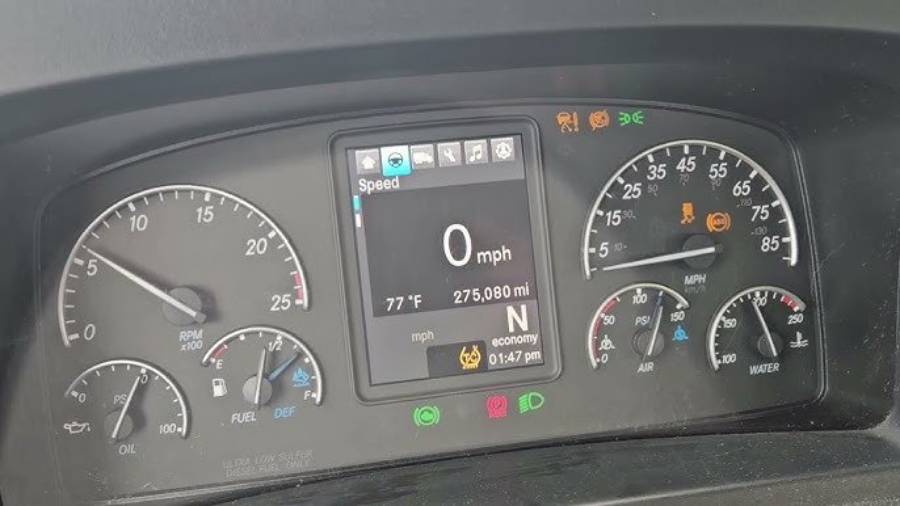
To reset Freightliner caution lights, identify the dashboard warning, diagnose the underlying fault, fix the problem, and clear the fault code using a compatible diagnostic scanner when necessary. Some warning lights turn off automatically after the issue is resolved, while others require a specific reset procedure depending on the Freightliner model, model year, and electronic control system.
Freightliner trucks, including the Cascadia and M2 series, use dashboard warning indicators to alert drivers to engine problems, braking system faults, diesel exhaust fluid (DEF) issues, and electrical malfunctions. These warnings are monitored by electronic control modules that may store diagnostic trouble codes (DTCs). Clearing a stored code does not repair the underlying problem, and an active fault can cause the warning light to return immediately.
Before attempting a reset, determine whether the warning indicates a minor maintenance issue or a safety-critical malfunction. A red Stop Engine warning requires immediate attention, while an amber Check Engine light calls for diagnosis according to the vehicle’s operating instructions.
This guide explains how to reset Freightliner caution lights with or without a diagnostic scanner, how procedures differ between truck models, and why certain warnings remain illuminated after a reset. It also covers common dashboard indicators and the steps needed to prevent recurring faults.
How Do You Reset Freightliner Caution Lights?
To reset Freightliner caution lights, identify the warning, retrieve any diagnostic trouble codes, repair the underlying fault, and complete the appropriate reset procedure. Some warnings clear automatically when the affected system returns to normal operation, while others require a compatible diagnostic scanner. The correct procedure depends on the truck model, model year, warning type, and electronic control module.
Follow these five steps to reset Freightliner caution lights safely.
- Identify the dashboard warning light. Check the illuminated symbol and any message displayed on the instrument cluster. An amber Check Engine light indicates a condition requiring diagnosis, while a red Stop Engine warning requires immediate attention according to Freightliner’s operating instructions. Do not attempt to clear a safety-critical warning simply to continue driving.
- Retrieve diagnostic trouble codes. Use the truck’s available diagnostic display or a compatible heavy-duty scanner to identify stored faults. Freightliner electronic systems commonly communicate diagnostic information through SAE J1939, which uses Suspect Parameter Numbers (SPNs) and Failure Mode Identifiers (FMIs) to describe detected problems.
- Repair the underlying problem. Address the component or operating condition responsible for the warning. For example, a low DEF level warning requires checking and replenishing the correct diesel exhaust fluid, while an ABS warning may require inspecting wheel-speed sensors, wiring, or the braking system.
- Perform the appropriate reset procedure. After correcting the fault, check whether the warning clears automatically. Where the manufacturer’s procedure permits, switch off the ignition and restart the truck to allow the system to reassess its status. If an inactive fault remains stored and requires clearing, use a diagnostic tool compatible with the affected control module.
- Verify the reset. Confirm that the warning light remains off and that the diagnostic system reports no unresolved active faults. Complete any manufacturer-required verification procedure before returning the truck to normal service.
Resetting a warning indicator does not repair a defective component. An unresolved fault can immediately reactivate the warning, even after its stored diagnostic code has been cleared.
Can You Reset Freightliner Caution Lights Without a Scanner?
Some Freightliner caution lights can turn off without a diagnostic scanner after the underlying problem has been corrected. However, there is no universal manual reset procedure for every Freightliner warning light.
For example, a low fluid level indicator may disappear after the fluid reaches the required level and the monitoring system updates its reading. Certain temporary electronic warnings may also clear after a normal ignition cycle, provided the triggering condition no longer exists.
An ignition cycle involves switching off the engine and ignition, waiting for the relevant systems to shut down, and restarting the truck according to the manufacturer’s instructions. This allows electronic control modules to perform their normal startup checks. It does not guarantee that stored diagnostic trouble codes will be erased.
Disconnecting the battery is not a recommended universal method for resetting Freightliner caution lights. It may interrupt electronic systems, erase useful diagnostic information, or create additional electrical problems without correcting the original fault.
A compatible diagnostic scanner is necessary when the applicable repair procedure requires fault-code clearing, system calibration, or another electronically controlled service function.
How Do You Reset Freightliner Caution Lights With a Diagnostic Scanner?
To reset Freightliner caution lights with a diagnostic scanner, connect a compatible heavy-duty diagnostic tool, identify the active or stored fault codes, complete the necessary repairs, and clear eligible inactive codes. The scanner must support the vehicle’s communication protocol and the electronic control module responsible for the warning.
Freightliner trucks commonly use SAE J1939 communication for heavy-duty vehicle diagnostics. Compatible tools may retrieve SPN and FMI information from engine, transmission, braking, and aftertreatment control systems. Detroit DiagnosticLink supports diagnostic and service functions for compatible Detroit-equipped vehicles, although available functions depend on the vehicle configuration and software access.
Follow these steps when using a diagnostic scanner:
- Locate the diagnostic connector. Find the truck’s diagnostic port using the vehicle service documentation. Connector type and location vary by model and model year.
- Connect the scanner. Attach a compatible diagnostic tool and establish communication with the relevant electronic control modules. Follow the scanner’s instructions regarding ignition position and engine operation.
- Read the fault codes. Retrieve active and previously recorded diagnostic trouble codes. Record the SPN, FMI, fault description, and affected control module before making changes.
- Diagnose and repair the fault. Use the diagnostic information and manufacturer service procedures to identify the actual cause. A sensor-related code, for example, may result from a damaged sensor, faulty wiring, or an electrical connection problem.
- Clear eligible fault codes. After completing the repair, use the scanner’s supported fault-clearing function when required. Active faults generally cannot be successfully cleared while the triggering condition remains present.
- Verify the repair. Read the diagnostic system again and confirm that the original active fault is no longer present. Perform any required system test, calibration, or drive cycle specified in the service documentation.
Not every Freightliner warning can be reset through a generic scanner. ABS, DEF, engine protection, and emissions-related systems may require manufacturer-specific diagnostic functions. Certain aftertreatment faults and engine derate conditions also require additional verification before the warning or restriction is removed.
A successful reset means the underlying fault has been resolved and the warning system confirms an acceptable operating condition. Simply erasing a stored code without completing the repair does not establish that the truck is safe to operate.
How Do You Reset Freightliner Caution Lights on Different Truck Models?
Resetting Freightliner caution lights depends on the truck model, model year, instrument cluster, and electronic control system. The Freightliner Cascadia and M2 series use different vehicle configurations, so a reset procedure that works on one truck may not apply to another. Both models require the underlying fault to be corrected before applicable diagnostic codes are cleared.
The main differences involve how drivers access diagnostic information, which electronic modules control the warnings, and whether a compatible diagnostic scanner is required. A dashboard message may disappear after the system detects normal operation, while a stored fault may remain in the control module until the required clearing conditions are met.
How Do You Reset Caution Lights on a Freightliner Cascadia?
To reset caution lights on a Freightliner Cascadia, identify the dashboard warning, check the available diagnostic information, repair the detected fault, and use the appropriate manufacturer-supported clearing procedure. Depending on the warning and model year, the light may turn off automatically or require a compatible diagnostic tool.
Cascadia trucks use electronic control modules to monitor systems such as the engine, transmission, braking system, and diesel aftertreatment equipment. The instrument cluster displays warning indicators and vehicle messages when a monitored system detects an abnormal condition. Newer Cascadia configurations may provide additional diagnostic information through their digital displays, but the available functions vary by model year and equipment.
For example, a Cascadia with an illuminated Check Engine light may have an active engine-related diagnostic trouble code. A compatible heavy-duty scanner can retrieve the relevant fault information, including SPN and FMI values when supported. After the technician repairs the cause, the warning may clear through the system’s normal monitoring process or require an authorized diagnostic clearing operation.
Detroit-equipped Cascadia trucks can use Detroit DiagnosticLink for supported engine and aftertreatment diagnostic functions. However, DiagnosticLink does not provide universal reset access to every control module or warning indicator on the truck.
An ignition cycle may allow the instrument cluster to update a resolved warning condition, but restarting the truck does not guarantee that active or stored fault codes will disappear. Red Stop Engine warnings, brake-related warnings, and emissions-related derate conditions must be addressed according to the applicable service procedures before normal operation resumes.
How Do You Reset Caution Lights on a Freightliner M2?
To reset caution lights on a Freightliner M2, identify the illuminated indicator, retrieve the associated diagnostic information, correct the underlying problem, and follow the reset procedure supported by the truck’s electronic system. Some warnings clear after the fault is resolved, while others require a diagnostic scanner capable of communicating with the affected control module.
Freightliner M2 trucks are available with different engine, transmission, and braking system configurations. These variations influence which diagnostic tools and procedures are appropriate. An M2 equipped with a Cummins engine, for example, may require Cummins-compatible diagnostic software for certain engine functions, while a Detroit-equipped configuration may use Detroit-specific diagnostic tools.
For an M2 displaying an ABS warning, the technician should inspect the braking system and retrieve fault information from the ABS control module. Possible causes include a defective wheel-speed sensor, damaged wiring, or a module-related fault. After the issue is repaired, the ABS controller must complete its applicable self-check or diagnostic clearing procedure before the warning can be considered resolved.
The M2 instrument cluster may also display engine, transmission, and electrical system warnings. Some indicators update automatically when the triggering condition disappears, but an active diagnostic fault cannot be reliably eliminated by repeatedly cycling the ignition.
The following table summarizes the main differences between the two Freightliner truck series.
| Feature | Freightliner Cascadia | Freightliner M2 |
|---|---|---|
| Diagnostic information | Instrument cluster and supported diagnostic tools | Instrument cluster and supported diagnostic tools |
| Engine configurations | Commonly Detroit-equipped | Varies by configuration, including Cummins and Detroit applications |
| Diagnostic software | Detroit DiagnosticLink for supported Detroit systems | Engine- and module-specific diagnostic software |
| Warning reset method | Automatic clearing or supported diagnostic procedure | Automatic clearing or supported diagnostic procedure |
| Main consideration | Model year and electronic system configuration | Engine, chassis, and control module configuration |
Neither the Cascadia nor the M2 has a single reset sequence that applies to every caution light. The correct procedure must match the specific warning, installed control module, and vehicle service documentation. Confirming the truck’s model year and system configuration before clearing codes helps prevent incorrect diagnostics and recurring dashboard warnings.
How Do You Reset Specific Freightliner Warning Lights?
Freightliner warning lights require different reset procedures depending on the system reporting the fault. Check Engine, ABS, DEF, and Stop Engine indicators monitor different vehicle functions, and each has specific conditions that must be resolved before its warning can disappear. Clearing diagnostic trouble codes without repairing the underlying problem does not permanently reset these indicators.
Check Engine and ABS warnings may require diagnostic fault clearing after repairs, while DEF and Stop Engine warnings can involve additional system checks or operating restrictions. The correct approach depends on the active fault, electronic control module, and manufacturer service requirements.
How Do You Reset a Freightliner Check Engine Light?
To reset a Freightliner Check Engine light, retrieve the engine diagnostic trouble codes, repair the identified malfunction, and clear eligible inactive codes using a compatible diagnostic scanner when required. The warning may turn off automatically after the engine control module confirms that the fault condition no longer exists.
Freightliner trucks use engine control modules to monitor components such as fuel system sensors, intake pressure sensors, exhaust temperature sensors, and emissions-related equipment. When the module detects a condition outside its programmed operating limits, it may activate the Check Engine light and record diagnostic information.
For example, a faulty intake manifold pressure sensor may trigger an engine-related diagnostic code. Replacing the sensor without checking its wiring and electrical connections may leave the original fault unresolved. The technician should inspect the affected circuit, confirm the repair, and then use the applicable diagnostic procedure to clear the inactive fault if necessary.
A normal ignition cycle may update the warning status after a temporary condition disappears, but it does not reliably erase stored engine codes. If the Check Engine light returns, retrieve the current fault information rather than repeatedly attempting to reset the indicator.
How Do You Reset a Freightliner ABS Warning Light?
To reset a Freightliner ABS warning light, diagnose the anti-lock braking system, repair the detected fault, and complete the ABS controller’s required self-test or diagnostic clearing procedure. The light should turn off only after the system confirms that the relevant fault is no longer active.
The ABS control module monitors wheel-speed signals and other braking system inputs to detect conditions that could interfere with anti-lock braking operation. Common causes of an illuminated ABS warning include damaged wheel-speed sensor wiring, incorrect sensor positioning, defective electrical connections, and ABS module faults.
For example, a damaged wheel-speed sensor cable can interrupt the signal transmitted to the ABS controller. Repairing the cable may resolve the electrical problem, but the controller may require a successful self-check or a supported diagnostic operation before the warning disappears. Some ABS faults require vehicle movement under specified conditions to complete verification.
Use a diagnostic scanner that supports the installed ABS controller to retrieve fault codes and perform any required clearing procedure. Engine-only diagnostic tools may not provide access to braking system faults.
An illuminated ABS warning indicates that anti-lock braking functionality may be reduced or unavailable. Conventional braking may remain operational in certain fault conditions, but this must not be assumed when additional brake warnings or abnormal braking behavior are present. Inspect and repair the braking system before returning the truck to normal service.
Freightliner DEF Warning Light
A Freightliner DEF warning light generally clears after the underlying diesel exhaust fluid or aftertreatment system problem is corrected and the electronic control system completes its required checks. The correct procedure depends on whether the warning concerns low DEF level, fluid quality, dosing performance, or another selective catalytic reduction (SCR) system fault.
For a low DEF level warning, check the tank and refill it with DEF meeting the vehicle manufacturer’s specifications. The level indicator may update after the system recognizes the corrected fluid level. However, a warning associated with DEF quality or SCR performance requires diagnostic testing rather than simply adding more fluid.
For example, an SCR system fault caused by a malfunctioning NOx sensor will not be repaired by refilling the DEF tank. A technician must identify the relevant diagnostic code, inspect the affected components, and complete any required aftertreatment verification procedure.
Some emissions-related faults can trigger engine torque or speed restrictions known as derates. Clearing a diagnostic code alone does not necessarily remove these restrictions. Manufacturer-specific service procedures may require additional testing before normal operation is restored.
Freightliner Stop Engine Light
A Freightliner Stop Engine light must not be treated as a routine warning that can be reset to continue driving. It indicates a condition requiring immediate action under the truck’s operating instructions and may be associated with serious engine protection faults.
Possible triggers include critically low engine oil pressure, excessive coolant temperature, or other severe engine operating conditions. Continuing to operate the truck under these circumstances can cause substantial mechanical damage or create unsafe operating conditions.
When the Stop Engine light activates, follow the vehicle’s instructions to stop safely and shut down the engine as required. Check the available diagnostic information and arrange appropriate inspection or repair before attempting to restart or return the truck to service.
After the underlying condition has been corrected, the engine control system may clear the warning automatically or require a supported diagnostic verification procedure. A Stop Engine warning should never be bypassed by disconnecting the battery or repeatedly erasing fault codes.
The essential difference between these warning types is the system they protect. Engine and emissions warnings require powertrain or aftertreatment diagnostics, ABS warnings require braking system verification, and Stop Engine warnings demand immediate attention to potentially severe operating conditions.
Why Do Freightliner Caution Lights Stay On After Resetting?
Freightliner caution lights stay on after resetting when the underlying fault remains active, the repair has not been verified, or the electronic control module continues detecting an abnormal operating condition. Clearing diagnostic trouble codes does not eliminate mechanical, electrical, or emissions-related problems. The warning will remain illuminated or return when the monitoring system detects the same fault again.
There are five common reasons Freightliner caution lights remain illuminated after a reset:
- Unresolved active fault codes. An electronic control module continues reporting a malfunction when the triggering condition has not been corrected. For example, a defective exhaust temperature sensor may repeatedly activate an engine warning until the sensor or its electrical circuit is repaired.
- Damaged sensors or wiring. Faulty wheel-speed sensors, loose electrical connectors, corroded terminals, and damaged wiring harnesses can interrupt signals between vehicle components and control modules. Clearing the stored code does not restore the missing or incorrect signal.
- Low battery voltage or charging system problems. Weak batteries, poor ground connections, and alternator malfunctions can cause unstable electrical supply conditions. These problems may trigger voltage-related diagnostic codes or interfere with communication between electronic modules.
- Incomplete system verification. Certain warning systems require successful self-tests, operating cycles, or manufacturer-specific diagnostic procedures after repairs. For example, an ABS controller may need valid wheel-speed signals during vehicle movement before confirming that a previously detected fault has been resolved.
- Aftertreatment system restrictions. DEF quality faults, SCR performance problems, and other emissions-related malfunctions may keep warning indicators active until the control system verifies that the required operating conditions have been restored. Some engine derate conditions require additional service procedures.
To identify why a Freightliner caution light remains on, connect a compatible diagnostic scanner and retrieve the current fault information. Compare active codes with previously recorded codes to determine whether the original problem persists or a separate malfunction has developed.
For example, replacing an ABS wheel-speed sensor may not resolve the warning when the actual problem is a damaged wiring connector. A diagnostic inspection of the sensor circuit can identify the remaining fault and prevent unnecessary component replacement.
Repeatedly disconnecting the battery or clearing fault codes without completing repairs is not a reliable solution. The correct troubleshooting process identifies the affected system, confirms the cause, repairs the malfunction, and verifies normal operation through the appropriate diagnostic procedure.
What Do Freightliner Dashboard Caution Lights Mean?
Freightliner dashboard caution lights indicate operating conditions, maintenance needs, or faults detected by the truck’s monitoring systems. Their meanings depend on the illuminated symbol, warning color, accompanying dashboard message, and vehicle configuration. Understanding these indicators helps drivers distinguish routine alerts from conditions requiring immediate action.
Amber warning lights generally indicate conditions requiring attention or diagnosis, while red warnings indicate more urgent problems. However, the exact response must follow the truck’s owner’s manual because warning priorities and indicator designs vary across Freightliner models and model years.
The following table explains common Freightliner dashboard warning indicators.
| Warning Light | Meaning | Recommended Action |
|---|---|---|
| Check Engine | Engine or related electronic system has detected a fault | Retrieve diagnostic codes and identify the cause |
| Stop Engine | Engine protection system has detected a potentially serious condition | Stop safely and follow the manufacturer’s shutdown instructions |
| ABS Warning | Anti-lock braking system has detected a malfunction | Inspect the braking system and diagnose ABS fault codes |
| DEF Warning | DEF level, quality, or aftertreatment system requires attention | Check DEF status and diagnose related faults |
| DPF Warning | Diesel particulate filter requires attention or regeneration under specified conditions | Follow the vehicle’s regeneration and service instructions |
| Battery Warning | Charging system or electrical supply problem may be present | Inspect battery connections, charging voltage, and related components |
| Low Air Pressure Warning | Air brake system pressure is below the required operating range | Stop safely and restore or repair the air pressure system before driving |
| Coolant Temperature Warning | Engine coolant temperature is outside the acceptable operating range | Follow engine protection instructions and investigate the cooling system |
A Check Engine warning does not identify a specific defective component by itself. It indicates that the electronic monitoring system has detected a condition requiring further diagnosis. Reading the associated diagnostic trouble code provides more useful information than relying on the warning symbol alone.
Brake-related warnings require particular attention because Freightliner trucks commonly use air brake systems. A low air pressure warning is different from an ABS warning: insufficient air pressure can compromise normal brake operation, while an ABS malfunction concerns the system that helps prevent wheel lockup during braking. Drivers should never assume that these warnings have the same severity or reset procedure.
DEF and DPF indicators also serve different functions. DEF warnings relate to diesel exhaust fluid or SCR aftertreatment operation, whereas DPF warnings concern particulate filter conditions and regeneration requirements. Attempting an inappropriate regeneration or clearing emissions-related codes without diagnosis can leave the original problem unresolved.
Dashboard symbols and their meanings should always be confirmed using the documentation for the specific Freightliner model and model year. When multiple warnings appear together, diagnosing the associated fault codes and identifying their common cause is more effective than resetting each indicator separately.
Read more: Freightliner Cascadia Won’t Start? Causes & Fixes
When Should You Take a Freightliner Truck to a Mechanic for Warning Lights?
You should take a Freightliner truck to a qualified mechanic when caution lights remain illuminated after basic troubleshooting, diagnostic faults repeatedly return, or the warning indicates a potentially serious mechanical or electrical problem. Safety-critical warnings require immediate attention, while other faults may allow the truck to reach a repair facility when permitted by the manufacturer’s operating instructions.
Five situations require professional diagnosis or repair:
- Stop Engine warning activation. A red Stop Engine indicator may signal critical engine conditions, including low oil pressure or excessive coolant temperature. Stop in a safe location and follow the manufacturer’s shutdown instructions. Arrange professional inspection before returning the truck to service.
- Brake system warnings. Low air pressure, abnormal braking behavior, or multiple brake-related indicators require immediate attention. A qualified technician should inspect the air brake system, ABS components, and relevant diagnostic codes before the truck resumes operation.
- Recurring Check Engine warnings. A Check Engine light that returns after fault-code clearing indicates that the original problem may remain unresolved or another fault has developed. Professional diagnosis can identify sensor failures, wiring defects, or engine control system problems.
- DEF system faults and engine derates. Persistent DEF warnings, SCR malfunctions, and emissions-related operating restrictions may require manufacturer-specific diagnostic software and repair verification procedures.
- Electrical and communication faults. Multiple dashboard warnings appearing simultaneously may indicate unstable supply voltage, damaged wiring, poor ground connections, or communication problems between electronic control modules.
For example, a Freightliner Cascadia displaying a Stop Engine warning alongside an overheating message requires immediate action rather than a diagnostic reset attempt. Continuing to drive can worsen engine damage.
Choose a repair facility with experience servicing the truck’s engine and electronic systems. Freightliner service centers and qualified heavy-duty truck technicians can use compatible diagnostic equipment to identify faults and complete the required repairs.
How Can You Prevent Freightliner Caution Lights From Coming Back?
Preventing Freightliner caution lights from returning requires scheduled maintenance, regular inspections of monitored vehicle systems, and prompt correction of developing faults. Warning indicators activate when electronic control modules detect abnormal conditions, so maintaining the components and operating systems they monitor reduces avoidable warning events.
Five preventive maintenance practices help reduce recurring Freightliner caution lights:
- Follow the manufacturer’s maintenance schedule. Replace engine oil, filters, coolant, and other service items at the intervals specified for the truck’s engine and operating conditions. Proper maintenance reduces the risk of lubrication, cooling, and engine performance problems that can trigger dashboard warnings.
- Inspect batteries and electrical connections. Check battery condition, terminal connections, charging system performance, and accessible wiring harnesses. Corrosion, loose connections, and unstable voltage can contribute to electrical faults and communication problems between control modules.
- Maintain the DEF and aftertreatment systems. Use DEF that meets the manufacturer’s specifications, prevent contamination during storage and refilling, and address aftertreatment diagnostic faults promptly. Poor fluid quality and defective SCR components can cause warning lights and engine operating restrictions.
- Monitor braking system components. Inspect air brake components, wheel-speed sensor wiring, and related electrical connections according to the vehicle maintenance schedule. Correcting damaged components helps prevent recurring ABS and brake system warnings.
- Check diagnostic trouble codes during maintenance. Use compatible diagnostic equipment to review active and stored fault information. Recording fault codes, repair actions, and verification results helps technicians identify recurring problems and distinguish new malfunctions from previously resolved conditions.
For example, inspecting battery terminals and ground connections during routine maintenance can reveal corrosion before it causes voltage instability and electrical warning messages. Similarly, identifying damaged ABS sensor wiring early can prevent repeated braking system fault alerts.
Preventive maintenance cannot eliminate every Freightliner caution light because components can fail unexpectedly. However, consistent inspections, timely repairs, and accurate diagnostic records help reduce recurring faults and keep the truck’s warning systems functioning as intended.