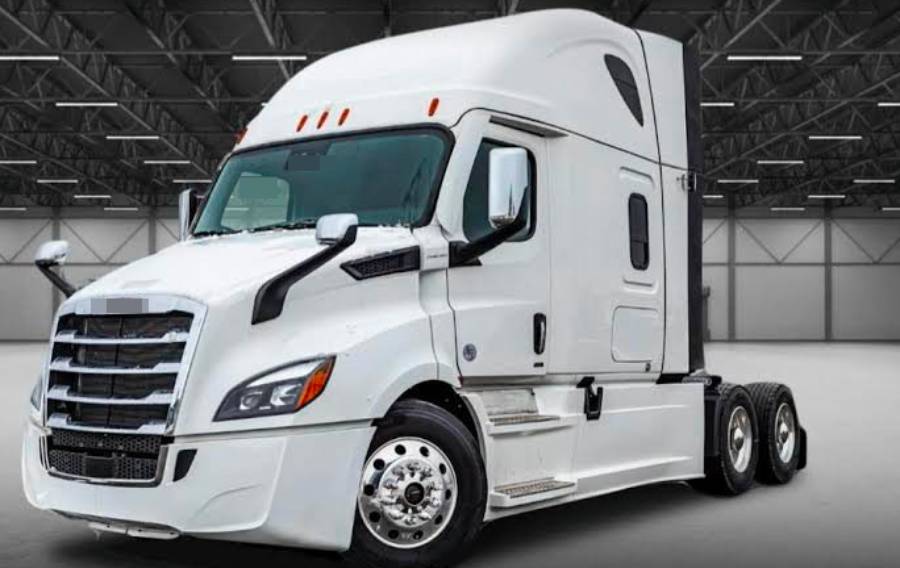
A Freightliner truck that won’t crank typically has a problem with its batteries, starter motor, starter relay, electrical connections, or starting control system. These faults prevent the starter from turning the engine when the ignition key is turned or the start button is pressed. Identifying the cause requires checking battery power, starter engagement, and the electrical signals that control the starting circuit.
A Freightliner no-crank condition produces three common symptoms: dashboard lights illuminate but the engine does not turn, a clicking sound occurs when starting, or the truck shows no response to the ignition command. Each symptom helps narrow the possible causes. For example, rapid clicking often indicates insufficient voltage at the starter, while a single click may indicate a starter solenoid or high-current circuit problem.
Freightliner Cascadia, M2, Columbia, and Coronado trucks can experience no-crank failures, although their electrical systems and starting controls differ by model and production year. Some configurations also require electronic authorization from vehicle control modules before the starter can operate.
This guide explains why a Freightliner won’t crank, how to diagnose the starting system, and which repairs address specific failures. The troubleshooting process begins with battery and cable inspections before moving to starter relays, control circuits, and starter motor testing.
Why Won’t a Freightliner Truck Crank?
A Freightliner truck won’t crank because of insufficient battery power, a faulty starter motor, a defective starter relay, or a problem in the starting control circuit. These failures interrupt either the electrical power needed to rotate the engine or the signal required to activate the starter. The most likely cause depends on whether the truck produces a clicking sound, displays dashboard lights, or remains completely unresponsive when starting.
Weak or discharged batteries are a common cause of Freightliner no-crank problems. Heavy-duty Freightliner trucks typically use multiple 12-volt batteries connected in parallel to supply the high current required by the starter motor. A fully charged 12-volt lead-acid battery generally measures approximately 12.6–12.8 volts at rest, but voltage alone does not confirm its ability to deliver starting current. A weak battery, corroded terminal, or damaged ground cable can prevent the starter from operating even when the dashboard lights remain functional.
A faulty starter motor or starter solenoid can also prevent the engine from turning. The starter solenoid engages the starter drive and connects battery power to the motor when it receives the appropriate start signal. Worn motor brushes, damaged internal contacts, or mechanical failure can interrupt this process. For example, a Freightliner that produces a single click without rotating the engine may have a defective solenoid, excessive resistance in the starter power circuit, or a seized starter motor.
A failed starter relay, blown fuse, or damaged ignition circuit can stop the starter from receiving its activation signal. The starter relay allows a low-current control circuit to operate the starter solenoid. When relay contacts fail or a required fuse opens, the starter may remain inactive even with fully charged batteries. Faulty wiring and loose electrical connectors can produce similar symptoms.
Electronic starting interlocks are another possible cause, particularly on Freightliner Cascadia and M2 trucks. Depending on the model and year, the starting system may require a valid ignition request, an acceptable transmission neutral signal, and authorization from vehicle control modules. A missing signal or communication fault can inhibit cranking without indicating a mechanical starter failure.
What Does It Mean When a Freightliner Won’t Crank but Has Power?
A Freightliner that has electrical power but won’t crank typically has insufficient starter current, a faulty starter component, or an interrupted starting control signal. Dashboard lights, headlights, and other accessories can operate normally because they require significantly less current than the starter motor. Therefore, working electrical accessories do not confirm that the batteries and starter circuit can deliver enough power to rotate the engine.
A Freightliner that clicks once but won’t crank may have a faulty starter solenoid, worn starter motor contacts, or excessive resistance in the battery cables. A single click indicates that an electrical or mechanical component has activated, but it does not prove that the starter motor is receiving sufficient current. For example, a corroded positive battery cable can allow the solenoid to engage while preventing enough current from reaching the starter motor.
Rapid clicking when starting a Freightliner commonly indicates low battery voltage or a high-resistance electrical connection. When the starter solenoid attempts to engage, the electrical load causes voltage to drop below the level needed to hold it engaged. The solenoid then releases, voltage recovers, and the cycle repeats. This produces a series of rapid clicks without normal engine rotation. Weak batteries, loose terminals, and deteriorated ground connections are common sources of this behavior.
A Freightliner with dashboard power but no clicking sound may have an open starter control circuit, a defective starter relay, a faulty ignition switch, or an unsatisfied starting interlock. On electronically controlled Freightliner trucks, a missing transmission neutral signal or start authorization can prevent the starter command from reaching the solenoid. However, a completely silent starter can also result from an internal solenoid failure.
The distinction between a single click, rapid clicking, and no clicking helps identify which part of the starting system requires testing. Battery load testing, voltage-drop measurements, and starter control signal checks are necessary to confirm the cause before replacing electrical components.
How Do You Diagnose a Freightliner That Won’t Crank?
To diagnose a Freightliner that won’t crank, check the batteries and electrical connections first, then test the starter relay, fuses, and starter motor. This sequence helps identify whether the failure originates in the high-current power circuit or the low-current starter control circuit. A digital multimeter, battery load tester, and the correct Freightliner wiring diagram are the primary diagnostic tools.
Before testing, park the truck on level ground, apply the parking brake, place the transmission in neutral, and secure the wheels against movement. Keep hands and tools away from moving engine components. Starter terminals carry high current, so avoid bridging electrical connections or bypassing starting interlocks.
How Do You Check Freightliner Batteries and Connections?
To check Freightliner batteries, measure battery voltage, test their ability to supply starting current, and inspect the positive and ground connections. Most heavy-duty Freightliner trucks use a nominal 12-volt electrical system with multiple batteries connected in parallel. Battery condition must be evaluated under load because an acceptable resting voltage does not guarantee sufficient cranking power.
A fully charged 12-volt lead-acid battery generally measures 12.6–12.8 volts after resting. A reading near 12.2 volts indicates a substantially discharged battery, although exact state-of-charge values depend on battery chemistry and temperature. During a conventional battery load test, voltage below approximately 9.6 volts at 70°F (21°C) can indicate inadequate battery performance, subject to the manufacturer’s testing procedure and temperature corrections.
Inspect battery terminals for corrosion, loose connections, damaged cables, and deteriorated insulation. Check the engine-to-chassis ground straps and battery negative cables because excessive resistance can restrict starter current. A voltage-drop test performed during an attempted crank can reveal resistance that is not visible during a static inspection. Compare the results with the applicable Freightliner service specifications.
How Do You Test the Starter Relay and Fuses?
To test the Freightliner starter relay and fuses, locate the correct starting circuit components, verify fuse continuity, and check whether the relay receives its activation signal. Fuse and relay locations vary among Freightliner Cascadia, M2, Columbia, and Coronado models, so the vehicle-specific electrical diagram is necessary to identify the correct components.
Begin by inspecting the starter-related fuses for an open circuit. A digital multimeter can verify continuity with the circuit de-energized or confirm voltage on both sides of an energized fuse. A blown fuse indicates an interrupted circuit, but the underlying cause must be investigated before replacement. Repeated fuse failure suggests an electrical fault such as a short circuit or excessive current.
Next, verify that the starter relay receives the required control voltage and ground when a start request is made. A functioning relay should switch its output circuit when commanded, although an audible click alone does not confirm healthy relay contacts. If the relay receives the correct command but fails to deliver its specified output, the relay or its connections require further testing.
If no activation signal reaches the relay, investigate the ignition switch, wiring, transmission neutral status, and applicable electronic start authorization system.
How Do You Test a Freightliner Starter Motor?
To test a Freightliner starter motor, verify battery power at the starter’s main terminal and confirm that the solenoid receives a valid start signal. These measurements distinguish a defective starter assembly from a power supply or control circuit failure.
The starter’s main battery terminal should have battery voltage when the electrical system is connected. A substantial voltage drop during a start attempt indicates possible resistance in the positive cable, battery connections, or ground return path. Voltage-drop measurements across individual connections help locate the affected section of the circuit.
The starter solenoid control terminal should receive the specified activation signal when the truck requests cranking and all starting conditions are satisfied. If adequate battery power and the correct control signal reach the starter but the engine does not rotate, the starter assembly becomes a primary suspect. However, excessive mechanical resistance or a seized engine must also be excluded before replacement.
Starter terminal testing should be performed by a qualified technician when terminals are difficult to access or exposed to high-current connections. Do not jump starter terminals to bypass the vehicle’s starting controls, as unexpected engine rotation or vehicle movement can cause serious injury.
A confirmed diagnosis should identify whether the fault involves battery current delivery, starter control authorization, or the starter assembly itself. This prevents unnecessary replacement of expensive components and establishes the correct repair procedure.
How Do You Fix a Freightliner That Won’t Crank?
To fix a Freightliner that won’t crank, repair the electrical or mechanical component identified during diagnosis. The appropriate repair may involve charging or replacing weak batteries, restoring damaged electrical connections, replacing a faulty starter relay, or installing a new starter motor. Electronic starting faults require verification of the ignition request, transmission interlocks, and vehicle control signals before replacing components.
How Do You Fix Battery and Electrical Connection Problems?
To fix battery and electrical connection problems on a Freightliner, restore sufficient battery capacity, clean corroded terminals, and repair damaged power or ground cables. These repairs address voltage loss and excessive electrical resistance that prevent the starter from receiving the current needed to rotate the engine.
Recharge discharged batteries using a charger compatible with their chemistry and capacity. After charging, perform a battery load or conductance test to determine whether each battery can supply the required starting current. Replace batteries that fail the manufacturer’s specifications. On trucks with multiple batteries, inspect and test each battery individually because one defective battery can reduce the performance of the entire battery bank. Replacement batteries should meet the vehicle’s specified cold cranking amperage (CCA), capacity, and configuration requirements.
Clean corroded battery terminals using an approved battery terminal cleaning method after safely disconnecting the batteries according to the vehicle service procedure. Replace terminals or cables with damaged conductors, severe corrosion, or loose connections that cannot be secured properly. Tighten connections to the manufacturer’s specified torque rather than overtightening them. Inspect the engine ground straps and battery negative connections because poor grounding can cause the same no-crank symptoms as a weak battery.
A defective starter relay or blown fuse should be replaced only after the associated circuit has been tested. Use replacement components with the correct electrical ratings and specifications. If the replacement fuse blows again, locate and repair the underlying circuit fault rather than installing a higher-rated fuse.
When Should You Replace a Freightliner Starter Motor?
Replace a Freightliner starter motor when testing confirms that the starter receives adequate battery power and the correct activation signal but cannot rotate the engine properly. Internal motor damage, worn brushes, defective solenoid contacts, and mechanical drive failures can prevent starter operation even when the external electrical circuit is functioning correctly.
Before replacement, confirm that excessive voltage drop, faulty ground connections, and engine mechanical resistance are not responsible for the failure. A starter that produces a single click without cranking is not automatically defective because insufficient current can produce the same symptom. Voltage and circuit tests help distinguish these conditions.
Select a replacement starter that matches the Freightliner’s engine, transmission, mounting arrangement, electrical specifications, and original equipment requirements. For example, a Freightliner Cascadia equipped with a Detroit DD15 engine may use a different starter configuration from a Freightliner M2 equipped with a Cummins engine. Verify compatibility using the vehicle identification number (VIN), engine specifications, and appropriate parts catalog.
Starter replacement requires disconnecting the battery supply, securing the vehicle, removing the electrical connections, and installing the replacement assembly according to the manufacturer’s service instructions. Heavy-duty starters are substantial components, so proper support and safe handling are necessary during removal and installation.
After completing the repair, verify that the engine cranks normally, electrical connections remain secure, and the starting system operates consistently. If the truck still does not crank despite a verified starter circuit, further diagnosis of the ignition switch, transmission neutral signal, wiring, and electronic start authorization system is necessary. Replacing control modules without confirming the fault can create unnecessary repair costs and may require additional programming.
Why Won’t a Freightliner Cascadia Crank?
A Freightliner Cascadia won’t crank when the starter circuit loses battery power, the starter motor fails, or the electronic starting system does not authorize engine cranking. In addition to conventional battery and starter problems, Cascadia trucks can experience no-crank conditions involving the Common Powertrain Controller (CPC), Signal-Detect and Actuation Module (SAM), transmission controls, or associated wiring. The components involved depend on the truck’s model year and electrical architecture.
On electronically controlled Cascadia models, the starting process requires the appropriate ignition request and vehicle operating conditions before the starter can engage. A missing transmission neutral signal, interrupted communication between control modules, or a fault in the starter control circuit can prevent cranking even when the dashboard and accessories operate normally. For example, a Cascadia with an automated manual transmission may inhibit starter operation when the transmission controller cannot confirm the required starting conditions.
Battery connections and ground circuits remain essential diagnostic points on Freightliner Cascadia trucks. Loose battery terminals, corroded chassis grounds, and damaged starter cables can restrict current delivery without completely disabling the electrical system. A clicking starter or dashboard lights that dim during a start attempt can indicate a voltage supply problem rather than an electronic module failure.
Diagnosing a Cascadia no-crank condition requires checking battery voltage, starter circuit power, transmission status, and applicable diagnostic fault codes. A compatible diagnostic scan tool can help identify missing start authorization signals or communication faults. Module replacement should only follow electrical testing and verification against the correct Freightliner service information.
Why Won’t a Freightliner M2 Crank?
A Freightliner M2 won’t crank because of battery supply problems, starter motor failure, defective starter control components, or an interrupted starting interlock. The M2 series includes different engine, transmission, and electrical configurations, so the exact starting circuit depends on the vehicle’s production year and equipment.
Freightliner M2 trucks equipped with Cummins or Detroit engines rely on a functioning battery supply, starter relay circuit, and starter solenoid to rotate the engine. A discharged battery, loose ground connection, or damaged starter cable can prevent cranking. For example, an M2 that produces rapid clicking when the key is turned may have insufficient battery voltage or excessive resistance in the starter power circuit.
Starter relay and ignition circuit faults can also prevent an M2 from cranking. Depending on the configuration, the starting system may require a valid transmission neutral or park signal before allowing starter engagement. A defective ignition switch, damaged relay connection, or missing interlock signal can interrupt the starting command without causing a complete loss of dashboard power.
To diagnose the problem, measure battery voltage, inspect the battery and engine ground connections, and verify the starter relay’s input and output signals. Check the starter solenoid activation circuit during an attempted start. If the starter receives adequate power and the correct control signal but does not rotate the engine, inspect the starter assembly and rule out engine mechanical resistance.
Use the Freightliner M2 wiring diagram and service information corresponding to the truck’s VIN to identify the correct fuse locations, relay circuits, and starting interlocks. Model-specific electrical testing prevents unnecessary starter replacement and helps distinguish wiring faults from electronic control problems.
Read more: Freightliner Not Building Air Pressure: Causes & Fixes
Why Does a Freightliner Crank Sometimes but Not Others?
A Freightliner that cranks intermittently typically has an unstable electrical connection, a failing starter motor, a defective starter relay, or an inconsistent starting control signal. These faults interrupt the starting circuit under specific operating conditions, allowing the truck to start normally on some attempts while remaining unresponsive on others. Temperature changes, vibration, and electrical load can influence when the failure occurs.
Loose battery terminals and deteriorated ground connections are common causes of intermittent Freightliner no-crank problems. Engine vibration can temporarily interrupt contact between damaged electrical connections, while corrosion increases resistance and reduces current delivery. For example, a Freightliner may crank normally after its battery cables are repositioned but fail again when vibration changes the connection. Voltage-drop testing during an actual no-crank event helps identify these faults more reliably than visual inspection alone.
A failing starter motor or solenoid can also produce inconsistent cranking. Worn internal contacts, damaged brushes, or heat-sensitive electrical components may function when cold but fail after the engine reaches operating temperature. A Freightliner that refuses to crank after a long drive but starts again after cooling may have a heat-related starter problem. However, the same symptoms can result from deteriorated wiring or relay contacts, so starter replacement requires confirmation through electrical testing.
Intermittent ignition switch faults, starter relay failures, and electronic starting interlocks can prevent the starter from receiving a consistent activation signal. On Freightliner trucks with electronically controlled transmissions, an unreliable neutral status signal or communication problem may temporarily inhibit cranking. Recording fault codes and checking starter command signals during the failure helps distinguish control circuit problems from starter motor defects.
How Can You Prevent Freightliner No-Crank Problems?
To prevent Freightliner no-crank problems, maintain the batteries, inspect electrical connections, test the charging system, and monitor starter performance. Preventive maintenance reduces the likelihood of voltage loss, excessive circuit resistance, and unexpected starter failures. These inspections are particularly important for commercial trucks that operate for extended periods or experience frequent engine starts.
Battery maintenance should include checking terminal condition, testing battery capacity, and confirming that the charging system operates within the manufacturer’s specifications. Heavy-duty Freightliner trucks frequently use multiple batteries, making individual battery testing important when performance becomes inconsistent. A weak battery within the bank can reduce available starting current and place additional demands on the remaining batteries. Replace batteries that fail the specified performance tests rather than relying exclusively on resting voltage measurements.
Electrical connection inspections help prevent resistance-related starting failures. Examine positive battery cables, negative terminals, engine ground straps, and starter connections for corrosion, looseness, damaged insulation, or overheating. Repair deteriorated connections and tighten terminals to the specified torque. Trucks exposed to road salt, moisture, and frequent vibration require particular attention because these conditions accelerate electrical connection deterioration.
Charging-system inspections are necessary to maintain adequate battery charge during normal operation. A failing alternator, damaged charging cable, or excessive electrical draw can gradually discharge the batteries until the starter no longer receives sufficient current. Measure charging voltage and evaluate battery condition whenever the truck shows slow cranking, repeated battery discharge, or abnormal electrical behavior.
Starter performance should also be monitored during routine operation. Unusual clicking, delayed starter engagement, grinding noises, and inconsistent cranking indicate conditions that require investigation. Addressing these symptoms before complete starter failure reduces the risk of unexpected downtime.
For Freightliner Cascadia and M2 trucks, scheduled maintenance should also include checking relevant diagnostic fault codes and investigating recurring transmission or start authorization warnings. A properly maintained battery bank, reliable electrical connections, and a verified starter control circuit provide the foundation for consistent Freightliner starting performance.