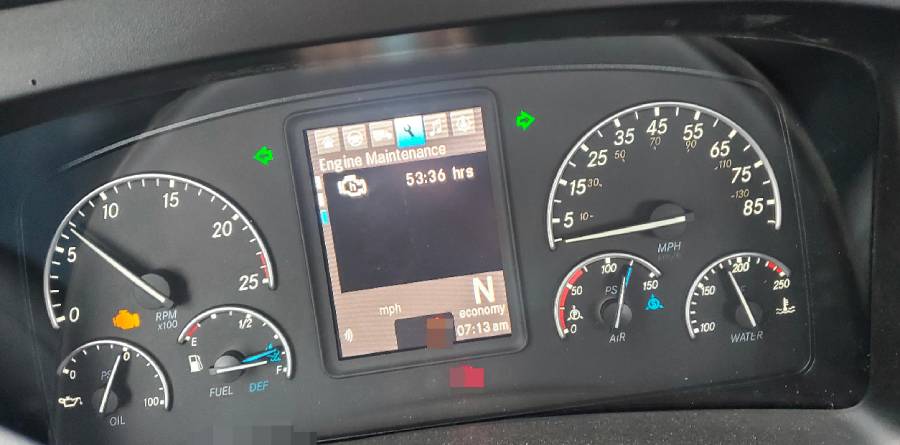
The Freightliner Stop Engine Light is a high-priority warning that indicates the truck’s engine control system has detected a condition requiring immediate attention. Unlike a routine maintenance reminder, this warning can be associated with conditions that threaten engine operation, including low engine oil pressure, excessive engine temperature, low coolant, sensor or electrical faults, and certain engine or aftertreatment faults. Depending on the detected fault and engine configuration, the protection system may reduce engine power or initiate an engine shutdown sequence to limit further damage.
A driver should not ignore the Stop Engine Light simply because the truck still runs normally. The warning identifies a detected fault, while the actual severity depends on the condition that triggered it. Checking additional dashboard warnings, engine temperature, oil pressure, coolant status, and active diagnostic fault codes helps determine the appropriate response. Continuing to drive without identifying a serious lubrication or cooling-system problem can increase the risk of engine damage.
This guide explains what the Freightliner Stop Engine Light means, whether you can continue driving, the main conditions that trigger it, how to diagnose the underlying fault, and what must be repaired before the warning can be safely cleared.
What Does the Stop Engine Light Mean on a Freightliner?
The Stop Engine Light on a Freightliner means the engine control system has detected a serious operating condition that requires immediate attention. The warning is designed to alert the driver before an active fault causes additional engine damage or creates an operating condition that requires the engine protection system to intervene.
The warning light itself is not the mechanical problem. It is the visible result of a fault or abnormal operating condition detected by the truck’s electronic control system. For example, abnormal engine oil pressure, excessive coolant temperature, or another critical engine parameter can cause the control system to generate a fault and illuminate the Stop Engine Light. Identifying the underlying fault is therefore more important than trying to clear the warning itself.
A Stop Engine Light should also be distinguished from a lower-priority engine warning. Its purpose is to indicate that the detected condition has reached a level where continued operation requires immediate evaluation. Depending on the engine, fault severity, and vehicle configuration, the engine protection strategy can reduce available power or progress toward an automatic shutdown.
For this reason, the driver should use the Stop Engine Light as a signal to evaluate the truck’s operating condition immediately. The next decision is not simply whether the light can be turned off, but whether the truck can continue operating without risking engine damage.
Can You Drive a Freightliner With the Stop Engine Light On?
You should not continue normal driving with the Freightliner Stop Engine Light on until the cause of the warning has been identified. Move the truck to a safe location as soon as traffic and road conditions allow, then check the dashboard and engine operating conditions before deciding whether the vehicle can be moved further.
Continuing to drive is particularly risky when the warning appears with signs of a lubrication or cooling problem. Low oil pressure can reduce lubrication between moving engine components, while excessive engine temperature can expose the engine to damaging heat. Continuing to operate the truck under either condition can turn an initial fault into more extensive engine damage.
The truck may also enter an engine protection mode. Depending on the detected fault and system configuration, this can include reduced engine output, commonly described as an engine derate, or a shutdown sequence intended to protect the engine. A truck that still accelerates and appears to run normally should therefore not be assumed to be safe simply because no immediate loss of power has occurred.
There is no single safe number of miles that applies to every Freightliner with an illuminated Stop Engine Light. The safe response depends on the fault responsible for the warning. A driver should base the decision on the active warning information, engine temperature, oil-pressure indication, fault codes, and other symptoms rather than an arbitrary driving distance.
What Should You Do When the Freightliner Stop Engine Light Comes On?
Move the Freightliner to a safe location and identify the condition that triggered the Stop Engine Light before resuming normal operation. The immediate response should focus on determining whether the truck has a critical lubrication, cooling, electrical, engine, or other monitored-system fault.
First, check the instrument cluster for additional warnings or messages. A Stop Engine Light accompanied by an oil-pressure warning, high-temperature indication, or another specific message provides more diagnostic context than the Stop Engine Light alone. Record the warning information before switching the truck off when it is safe to do so, because these details can help identify the original operating condition.
Second, check the engine temperature indication. An abnormally high temperature can point toward an overheating or cooling-system problem. Do not open a pressurized cooling system while the engine is hot. Hot coolant and steam can escape under pressure and cause severe burns.
Third, check the engine oil-pressure indication and inspect the engine oil level according to the appropriate service procedure. Oil pressure and oil level are related but are not the same measurement. A correct oil level does not by itself prove that the engine has adequate oil pressure because pressure can also be affected by the lubrication system, oil pump, sensor, wiring, or other engine conditions.
Fourth, inspect the coolant level after the engine has cooled sufficiently and the cooling system can be checked safely. Low coolant can contribute to inadequate heat removal and overheating, but simply adding coolant does not identify why the level became low. A recurring coolant loss requires inspection for the underlying cause.
Fifth, retrieve the active diagnostic fault codes when diagnostic information is available. The code provides a more specific starting point for determining which system reported the abnormal condition. Fault-code information should be combined with dashboard indications, operating data, symptoms, and physical inspection rather than treated as proof that a particular component must be replaced.
Finally, determine whether the truck can be moved or requires professional service or towing. Do not continue driving when the truck shows signs of a critical condition such as abnormal oil pressure, severe overheating, engine shutdown behavior, or another condition that makes continued operation unsafe. Diagnosing the fault before further operation reduces the chance that a correctable problem will develop into more extensive engine damage.
What Causes the Stop Engine Light on a Freightliner?
The Freightliner Stop Engine Light comes on when the engine control system detects a fault or operating condition serious enough to require immediate driver attention. The exact trigger depends on the engine, vehicle configuration, and active fault code, so the warning light alone does not identify the failed component. The main diagnostic categories include lubrication problems, excessive engine temperature, low coolant, sensor or electrical faults, engine-related faults, and applicable aftertreatment faults.
Low engine oil pressure is one condition that requires immediate attention because pressurized oil lubricates critical moving engine components. When actual oil pressure falls below an acceptable operating range, the engine may not receive sufficient lubrication at bearings and other friction surfaces. Continued operation under a genuine low-oil-pressure condition can accelerate wear and lead to severe engine damage. The cause must therefore be diagnosed rather than assuming that adding oil will resolve the warning.
Engine overheating can also produce a serious engine warning. The cooling system removes heat generated during combustion and maintains the engine within its intended operating temperature range. A cooling-system problem can allow temperature to rise beyond that range, prompting the engine control system to protect the engine. Possible sources include coolant loss, restricted coolant circulation, cooling-fan problems, or another malfunction affecting heat removal. A high-temperature indication accompanying the Stop Engine Light should be treated as evidence that continued driving requires immediate evaluation.
Low coolant is closely related to overheating but represents a separate diagnostic condition. An insufficient coolant level reduces the cooling system’s ability to absorb and transfer engine heat. Coolant loss can result from an external leak or another cooling-system problem, so repeatedly adding coolant without finding the source does not correct the underlying fault. The cooling system should only be inspected or opened after it has cooled enough to do so safely.
Sensor and electrical faults can trigger serious warnings when the engine control module receives missing, implausible, or out-of-range information from a monitored circuit. The control system depends on sensors and electrical circuits to determine engine operating conditions. A damaged sensor, connector, wiring circuit, or related electrical component can therefore create a fault even when the mechanical component associated with that measurement has not failed. Diagnosis must determine whether the reported condition is genuine or caused by the monitoring circuit itself.
Engine-related faults form another diagnostic category because the Stop Engine Light is connected to the engine protection strategy rather than one individual component. An abnormal operating parameter can generate a fault code, illuminate a warning, and potentially lead to protective action. This is why two Freightliner trucks displaying the same Stop Engine Light can require different repairs: the dashboard warning represents the severity of a detected condition, while the active diagnostic information identifies the system that requires investigation.
Aftertreatment-related conditions can also require attention on Freightliner trucks equipped with diesel emissions systems, but the response depends on the specific engine, fault, and vehicle configuration. The aftertreatment system can include components associated with the diesel particulate filter (DPF), selective catalytic reduction (SCR), and diesel exhaust fluid (DEF). Drivers should use the actual dashboard messages and diagnostic codes to determine whether an emissions-system fault is connected to the Stop Engine warning rather than assuming that every DPF, SCR, or DEF problem produces the same warning.
The important diagnostic distinction is cause versus warning. The Stop Engine Light does not mean that the warning lamp itself needs repair. It means the truck has detected a condition that must be identified. Reading the active fault information and comparing it with engine temperature, oil-pressure indications, operating symptoms, and physical inspection provides a more reliable path to the root cause.
What Symptoms Can Appear With the Freightliner Stop Engine Light?
A Freightliner Stop Engine Light can appear with symptoms such as reduced engine power, engine derate, abnormal temperature or oil-pressure indications, additional dashboard warnings, diagnostic messages, and shutdown behavior. The accompanying symptoms are important because they provide context about the system responsible for the warning and the urgency of the response.
Reduced engine power or an engine derate indicates that available performance has been limited while a fault is active. The truck may respond differently to accelerator input or may not provide its normal power output. A derate is therefore not necessarily a separate failure from the warning light; it can be part of the engine protection strategy associated with the detected condition. The active fault information is needed to determine why the power reduction occurred.
An abnormal engine-temperature indication points toward a condition affecting engine temperature or the system monitoring it. If the temperature is genuinely excessive, continued engine operation can increase thermal stress and the risk of damage. If the temperature reading conflicts with other operating evidence, the temperature-sensing circuit may also require diagnosis. The gauge or warning provides a diagnostic clue, not a complete determination of the failed part.
An abnormal oil-pressure indication requires similar caution. Genuine low oil pressure can threaten engine lubrication, while a sensor or electrical problem can produce inaccurate information. A driver should therefore treat an oil-pressure warning seriously while avoiding the assumption that the oil-pressure sensor is automatically responsible. Actual operating conditions and diagnostic data must be checked before the cause is confirmed.
Additional dashboard warnings and fault messages can narrow the diagnostic scope. For example, a temperature, oil-pressure, or system-specific warning appearing at the same time as the Stop Engine Light provides more information than the red warning alone. Recording these messages and the conditions under which they appeared can help a technician distinguish the primary fault from secondary warnings produced by the same event.
Engine shutdown behavior represents one of the most serious accompanying signs. Depending on the fault and engine protection configuration, the system can progress from a warning to reduced performance or shutdown behavior intended to limit further damage. A Stop Engine Light accompanied by severe overheating, abnormal oil pressure, substantial power loss, or shutdown behavior should not be treated as a warning that can simply be cleared and ignored. The underlying condition should be diagnosed before normal operation resumes.
How Do You Diagnose a Freightliner Stop Engine Light?
Diagnose a Freightliner Stop Engine Light by retrieving the active fault codes, identifying the affected system, checking relevant operating data, and verifying the fault through physical or electrical inspection. The diagnostic process should identify the root cause of the warning rather than treating the dashboard light itself as the problem.
Start by recording the conditions present when the warning appears. Check the instrument cluster for additional warning lights, fault messages, abnormal engine temperature, oil-pressure indications, and changes in engine performance. These observations establish context for the diagnostic code. For example, a Stop Engine Light that appears with a high-temperature warning requires a different initial inspection from one accompanied by an abnormal oil-pressure indication.
Retrieve the active diagnostic trouble codes with the truck’s available diagnostic system or a compatible diagnostic tool. An active code identifies the system or parameter in which the electronic control system has detected a problem. Stored or previously active codes can provide additional history, but they should not automatically be treated as the cause of the current Stop Engine Light. Give priority to active faults and compare them with the symptoms occurring at the same time.
The next step is to inspect the system identified by the fault information. This can include checking sensor readings, connectors, wiring, fluid levels, operating temperatures, pressures, or the mechanical system associated with the code. A code related to an engine-temperature signal, for example, does not automatically prove that the temperature sensor needs replacement. The engine could actually be overheating, the sensor could be providing incorrect data, or the electrical circuit could have a fault.
Diagnostic data should therefore be used to narrow the investigation rather than select a replacement component immediately. Compare the reported parameter with the truck’s actual operating condition and inspect the associated system before replacing parts. This approach reduces unnecessary component replacement and helps distinguish a mechanical problem from a sensor or wiring fault.
What Do SPN and FMI Codes Mean on a Freightliner?
SPN and FMI codes identify the parameter associated with a fault and the type of failure detected by the vehicle’s electronic control system. Reading both values provides more diagnostic information than using the Stop Engine Light alone.
SPN stands for Suspect Parameter Number. It identifies the parameter, component, or system associated with the diagnostic event. The SPN directs the diagnostic process toward the area in which the control system detected an abnormal condition rather than identifying the final repair by itself.
FMI stands for Failure Mode Identifier. It describes how the monitored parameter or circuit has failed or moved outside its expected operating condition. The FMI can indicate the nature of the detected problem, allowing two faults associated with the same parameter to be distinguished from each other.
SPN and FMI should therefore be interpreted together. The SPN identifies where the detected problem is associated, while the FMI helps identify what type of abnormal condition was detected. The next diagnostic step is to follow the applicable troubleshooting information for that specific code and verify the actual cause through operating data and inspection.
Do not replace a component solely because its system appears in an SPN description. A fault involving a monitored parameter can originate from the component itself, its connector, wiring, electrical supply, another mechanical condition affecting the reading, or another part of the associated system. Code interpretation is the beginning of root-cause diagnosis, not the end.
How Do You Fix a Freightliner Stop Engine Light?
Fix a Freightliner Stop Engine Light by repairing the underlying condition that generated the active fault and then confirming that the engine operates normally without the warning returning. There is no single repair for every Stop Engine Light because the same warning can represent faults in different engine and vehicle systems.
For an actual lubrication problem, the repair must restore the engine’s correct lubrication condition. Checking oil level is an initial step, but low oil pressure cannot be diagnosed from oil quantity alone. The lubrication system, pressure-related components, leaks, oil condition, and applicable sensors or circuits may require inspection depending on the fault information. Operating an engine with confirmed inadequate oil pressure can cause extensive internal damage.
For an overheating or cooling-system problem, the repair must correct the condition preventing the engine from maintaining its intended operating temperature. This can require finding coolant loss, restoring coolant to the correct level, repairing a leak, or diagnosing another cooling-system component. Adding coolant without identifying repeated coolant loss only addresses the immediate symptom and does not repair the source of the problem.
For a sensor or electrical fault, inspect the complete circuit before replacing the sensor. Check relevant connectors and wiring for conditions that can interrupt or distort the signal received by the control module. When possible, compare the reported sensor value with the actual operating condition. A replacement sensor will not solve the problem if damaged wiring or another system condition is responsible for the abnormal reading.
Engine-related faults require repair according to the specific diagnostic code and confirmed root cause. Because the Stop Engine Light can represent different critical parameters, replacing parts based only on the warning lamp creates a high risk of misdiagnosis. The active fault, operating data, symptoms, and inspection results should agree before the repair decision is made.
Applicable aftertreatment faults should also be repaired according to the specific diagnostic information. DPF, SCR, and DEF systems contain different components and monitoring strategies, so an aftertreatment warning should not automatically be interpreted as a failed DPF or a need to replace a particular emissions component. Determine which fault is active before selecting the corrective action.
After the repair, verify that the original fault is no longer active and that the operating parameter responsible for the warning has returned to its expected condition. Run or operate the truck according to the applicable diagnostic procedure and check whether the warning or fault returns. A successful repair corrects the underlying condition; simply making the Stop Engine Light disappear does not prove that the problem has been fixed.
How Do You Reset the Stop Engine Light on a Freightliner?
Reset the Freightliner Stop Engine Light only after diagnosing and correcting the fault that triggered the warning. Depending on the engine, fault type, and vehicle configuration, the warning may clear after the underlying condition is corrected and the control system confirms normal operation, or the stored diagnostic information may need to be cleared with an appropriate diagnostic tool.
Start by retrieving and recording active fault codes before attempting to clear them. Fault codes preserve information that helps identify which system detected a problem and what type of failure occurred. Clearing diagnostic information before recording it can remove useful context and make an intermittent problem more difficult to diagnose if the warning temporarily disappears.
Next, correct the underlying fault. For example, a genuine cooling-system problem requires correction of the condition causing abnormal engine temperature, while an electrical fault requires inspection and repair of the affected circuit. Clearing a code without completing the necessary repair changes the warning status but does not change the physical or electrical condition responsible for the fault.
After the repair, confirm that the affected system is operating normally. Check relevant parameters such as engine temperature, oil-pressure information, sensor data, or other values associated with the original fault. If the control system no longer detects the abnormal condition, the warning may become inactive according to the applicable engine and vehicle strategy.
A compatible diagnostic tool may be required when a fault remains stored or when the applicable service procedure calls for clearing diagnostic information after repair. The tool should be used after the root cause has been identified rather than as the first response to the warning. Some faults can also require specific operating conditions or diagnostic procedures before the system recognizes that the problem is no longer present.
A Freightliner Stop Engine Light that returns after being reset indicates that the triggering condition remains active, has occurred again, or has not been fully resolved. For example, an intermittent wiring connection can allow the warning to disappear temporarily and return when vibration, temperature, or operating conditions cause the circuit problem to recur. Repeatedly clearing the code will not correct that type of fault.
Avoid disconnecting the battery solely to make the Stop Engine Light disappear. Removing electrical power does not repair a lubrication, cooling, sensor, wiring, engine, or aftertreatment problem. The correct sequence is retrieve the diagnostic information, identify the root cause, complete the repair, verify normal operation, and then clear applicable fault information when required.
What Is the Difference Between the Freightliner Stop Engine Light and Check Engine Light?
The main difference between a Freightliner Stop Engine Light and a Check Engine Light is the severity of the detected condition and the urgency of the driver’s response. A Stop Engine warning indicates a condition that requires immediate attention, while a Check Engine warning generally signals a detected engine or emissions-related fault that must be diagnosed according to its severity and accompanying warnings.
The Stop Engine Light is associated with conditions where continued operation can require protective action. When a critical engine parameter moves outside an acceptable range, the engine protection strategy may warn the driver, limit engine performance, or progress toward shutdown depending on the fault and system configuration. The driver should therefore find a safe place to stop and evaluate the condition rather than continuing normal operation without diagnosis.
A Check Engine Light does not automatically mean that immediate engine shutdown is required. It indicates that the electronic control system has detected a fault that needs investigation. The appropriate response depends on the active diagnostic code, other dashboard warnings, vehicle behavior, and whether the fault affects safe engine operation. A Check Engine Light should still be diagnosed rather than ignored simply because the truck continues to operate normally.
The color and warning hierarchy also provide useful context, but drivers should use the actual instrument-cluster message and the applicable Freightliner and engine information for their truck. Dashboard configurations can vary by model, model year, engine, and electronic system. Identifying a warning only by its appearance without checking the displayed message can lead to an incorrect interpretation.
The two warnings can also appear together when one underlying condition generates multiple diagnostic or protection responses. In that situation, the presence of a Stop Engine warning should determine the immediate response because it represents the higher-priority condition. Additional warning lights and messages then provide diagnostic information that helps identify the affected system.
The practical distinction is therefore based on the required action. Treat a Stop Engine Light as a prompt for immediate evaluation and a Check Engine Light as a prompt for fault diagnosis according to the severity of the detected condition. Neither warning identifies the failed component by itself; the active fault codes and operating conditions are needed to determine the actual problem.
Why Does the Freightliner Stop Engine Light Come On and Then Go Off?
The Freightliner Stop Engine Light can come on and then go off when the condition that triggered the warning changes from active to inactive. An intermittent warning does not necessarily mean the underlying problem has been repaired. The fault may only occur under specific engine temperatures, loads, electrical conditions, or operating situations.
An intermittent sensor or electrical problem is one possible cause. A loose connector, damaged wiring, poor electrical connection, or irregular sensor signal can cause the engine control system to detect an abnormal value temporarily. When the signal returns to its expected range, the warning may disappear even though the condition capable of triggering it remains present.
Changes in engine operating conditions can produce similar behavior. A temperature-related warning, for example, can become inactive after engine temperature decreases. The disappearance of the warning confirms that the triggering condition is no longer being detected at that moment; it does not establish why the abnormal condition occurred in the first place.
The fault history is therefore important when diagnosing a Stop Engine Light that is no longer illuminated. Previously active or stored diagnostic information can provide evidence about the affected system even when the warning cannot be reproduced during inspection. Recording the SPN, FMI, dashboard message, engine load, temperature, and other conditions present when the warning occurs can make an intermittent fault easier to isolate.
Do not assume the truck is repaired because the Stop Engine Light turns off by itself. A warning that repeatedly appears and disappears should be diagnosed because the same condition can become active again. This is especially important when the warning has appeared with abnormal oil pressure, high engine temperature, power loss, derate, or shutdown behavior.
Read more: Freightliner Collision Avoidance System Problems & Fixes
How Can You Prevent the Freightliner Stop Engine Light From Coming On Again?
Preventing the Freightliner Stop Engine Light from returning requires maintaining the systems that can trigger critical engine faults and correcting existing problems before they become severe. Preventive maintenance cannot eliminate every electrical or component failure, but it can reduce faults related to lubrication, cooling, electrical connections, and neglected engine or aftertreatment conditions.
Maintain the engine lubrication system according to the applicable service requirements. Use the specified engine oil, maintain the correct oil level, and address leaks or abnormal oil-pressure indications promptly. Oil level should also be checked correctly rather than used as a substitute for oil-pressure diagnosis. The lubrication system depends on adequate oil quantity and proper pressure to protect internal engine components.
Maintain the cooling system by checking coolant condition and level and investigating recurring coolant loss. Hoses, connections, the radiator, cooling fan system, and other applicable cooling components should be inspected when symptoms indicate a problem. A truck that repeatedly requires additional coolant has an underlying condition that should be identified rather than managed through repeated top-offs.
Inspect electrical connections when there is evidence of intermittent sensor or circuit faults. Engine vibration, heat, moisture, corrosion, connector problems, and wiring damage can interfere with signals used by electronic control modules. Correcting a deteriorating connection early can prevent an intermittent fault from developing into a persistent warning or operating problem.
Maintain applicable DPF, SCR, and DEF systems according to the truck and engine service requirements. Diesel aftertreatment faults should be addressed when they first appear rather than ignored until additional warnings or operating restrictions develop. The exact maintenance and corrective procedure should be based on the installed engine and aftertreatment configuration.
Respond to diagnostic codes early. A Check Engine Light, fault message, or recurring stored code can provide warning of a developing problem before it progresses to a higher-priority condition. Recording the code and diagnosing its root cause also provides better information than waiting until the truck experiences a derate or Stop Engine warning.
Preventive maintenance is most effective when it follows the specifications for the individual truck. Freightliner vehicles can use different engines, model-year configurations, and electronic systems, so fluid specifications, service intervals, diagnostic procedures, and component requirements should be confirmed using the applicable service information.
When Should a Freightliner Stop Engine Warning Be Diagnosed by a Technician?
A Freightliner Stop Engine warning should be diagnosed by a qualified technician when the warning remains active, repeatedly returns, accompanies engine derate or shutdown behavior, appears with abnormal oil pressure or engine temperature, or cannot be traced to a confirmed cause through basic checks. These conditions require more than simply clearing the dashboard warning.
Persistent or recurring warnings require diagnosis because they indicate that the control system continues to detect a fault or that an intermittent condition is returning. A technician can retrieve active and stored diagnostic information, review operating data, test circuits or components, and compare the results with the applicable diagnostic procedure. This is more reliable than replacing parts based only on a warning light or fault-code description.
Professional diagnosis is particularly important when abnormal oil pressure or excessive engine temperature is involved. Both conditions can threaten engine durability if they are genuine, while sensor and circuit faults can sometimes create misleading readings. Testing is needed to distinguish an actual mechanical condition from inaccurate electronic information before the truck returns to normal service.
Engine derate or shutdown behavior is another reason to obtain professional diagnosis. These responses indicate that the detected condition has affected the engine protection or operating strategy. Continuing to clear faults without finding their cause can result in repeated derates, unexpected operating restrictions, or additional damage when a genuine mechanical problem is present.
A technician should also diagnose faults that require specialized equipment or procedures. These can include electrical circuit testing, verification of sensor signals, analysis of live engine data, mechanical pressure testing, and diagnosis of applicable engine or aftertreatment systems. The required tests depend on the active SPN/FMI combination and the truck’s specific engine and electronic configuration.
The safest response to an unresolved Freightliner Stop Engine Light is to identify and repair the root cause before returning the truck to normal operation. The warning should be treated as the beginning of the diagnostic process, while fault codes, operating data, physical inspection, and system testing determine the actual repair.