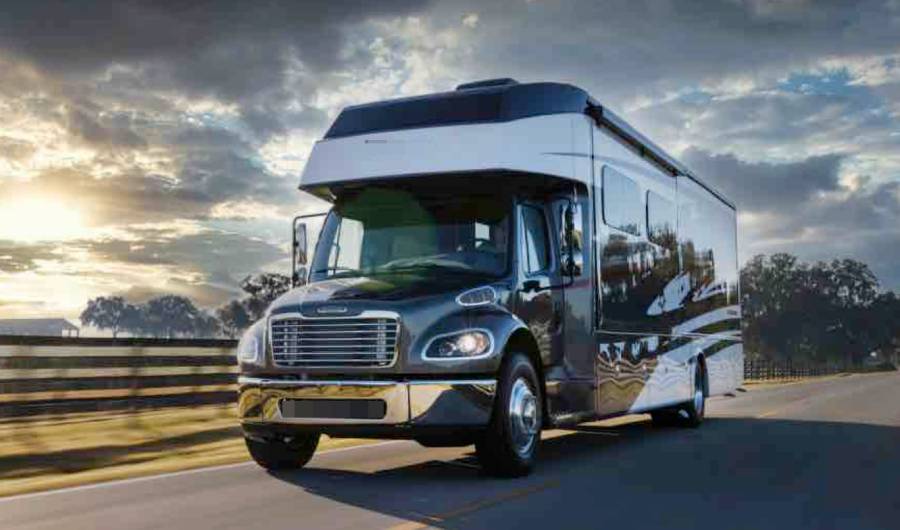
Freightliner RV chassis problems can affect the air suspension, steering, brakes, electrical system, cooling system, drivetrain, and tires. These problems range from air leaks and uneven tire wear to steering instability, overheating, electrical faults, and vibration while driving. The exact cause depends on the chassis configuration, mileage, maintenance history, operating conditions, and affected component.
A chassis problem does not necessarily mean the entire Freightliner chassis is failing. For example, an RV that leans to one side may have an air suspension or ride-height issue, while vibration at highway speeds may originate from the tires, wheels, suspension, or driveline. Identifying when the symptom occurs and which system is affected helps narrow the possible causes before parts are replaced.
Some Freightliner RV chassis problems require immediate professional attention. Brake faults, significant air-pressure loss, steering problems, persistent overheating, and severe driveline vibration can affect vehicle safety and should not be ignored. Other issues can first be investigated through visual inspections, warning indicators, fluid levels, tire condition, and basic electrical checks. This guide explains the most common Freightliner RV chassis problems, their symptoms and causes, how they are diagnosed and fixed, and which maintenance practices can reduce the risk of recurring failures.
What Are the Most Common Freightliner RV Chassis Problems?
The most common Freightliner RV chassis problems involve the air suspension, steering and handling, air brakes, electrical system, cooling system, drivetrain, and tires. Each system produces different symptoms, so identifying where and when a problem occurs is the first step toward finding its cause.
Air suspension problems can cause the RV to lean, sit at an incorrect ride height, lose air pressure, or provide a rougher ride. Air leaks are particularly important because the chassis uses compressed air for multiple functions. A problem that initially appears to involve suspension can therefore require inspection of air lines, fittings, valves, air springs, or other components in the air system.
Steering and handling problems commonly appear as wandering, pulling, excessive steering correction, or vibration through the steering wheel. These symptoms do not always indicate a defective steering component. Tire pressure, tire condition, wheel alignment, suspension wear, weight distribution, and steering-system components can produce similar driving behavior. Diagnosis should therefore consider the complete chassis rather than replacing a steering component based on one symptom.
Brake, electrical, and cooling problems create another group of chassis concerns. An air-brake fault can cause low-pressure warnings or changes in braking performance, while electrical faults can produce a discharged chassis battery, intermittent warning lights, starting problems, or unreliable electrical accessories. Cooling-system faults can cause an abnormal rise in engine temperature, especially under sustained load or demanding operating conditions.
Drivetrain vibration and uneven tire wear can also indicate underlying chassis problems. Vibration may originate from tires and wheels or from driveline components, while irregular tire wear can result from incorrect inflation, alignment, suspension geometry, or loading. The symptom alone does not identify the failed component; its location, frequency, vehicle speed, and operating conditions provide the diagnostic context.
What Causes Air Suspension Problems on a Freightliner RV Chassis?
Freightliner RV air suspension problems can result from air leaks, damaged air springs, faulty valves, incorrect ride height, deteriorated air lines or fittings, and other faults that prevent the system from maintaining the required air pressure or chassis height. The specific components vary by chassis configuration, so diagnosis should be based on the applicable Freightliner chassis documentation rather than a universal component layout.
An air leak is one of the first conditions to investigate when the chassis loses air pressure or changes height after being parked. Compressed air can escape through a damaged hose, loose connection, fitting, valve, or air spring. A sufficiently large leak prevents the suspension from maintaining normal pressure, while a smaller leak may cause a gradual change in ride height over several hours.
A Freightliner RV that leans to one side can have a problem with ride-height control or the suspension components supporting that side of the chassis. The symptom becomes more useful diagnostically when the RV is parked on level ground and loading differences have been considered. Persistent leaning under comparable conditions provides stronger evidence of a suspension or ride-height issue than a temporary height difference caused by uneven terrain.
Air suspension faults can also affect ride quality. An RV operating outside its intended ride height changes the relationship between suspension and driveline components. The driver may notice a harsher ride, unusual handling, excessive movement, or other behavior that was not present when the chassis was operating normally. These symptoms should be investigated together rather than treated as unrelated problems.
How Do You Fix Freightliner RV Air Suspension Problems?
Fix Freightliner RV air suspension problems by identifying the source of pressure loss or incorrect ride height before replacing components. Start with the visible condition of air lines, fittings, air springs, and related suspension components, then determine whether the system maintains pressure and normal ride height.
The repair depends on the diagnosed failure. A leaking connection requires a different corrective action from a damaged air spring or malfunctioning ride-height component. Replacing parts without isolating the cause can leave the original problem unresolved and increase repair costs.
Persistent air-pressure loss, abnormal ride height, or damaged suspension components should receive professional diagnosis when the source cannot be identified through basic inspection. Air-system problems can overlap with other chassis functions, and repairs involving safety-critical pneumatic systems require the correct procedures and specifications for the specific Freightliner chassis.
What Causes Steering Problems on a Freightliner RV Chassis?
Freightliner RV chassis steering problems can result from incorrect tire pressure, uneven tire wear, wheel alignment problems, suspension wear, steering-system faults, or improper weight distribution. Common symptoms include wandering, pulling to one side, frequent steering corrections, loose steering response, and steering-wheel vibration. Because several chassis systems can produce similar symptoms, the cause should be diagnosed before steering components are replaced.
Wandering occurs when the motorhome does not maintain its intended direction without frequent steering corrections. Tire condition and inflation should be checked because differences in tire pressure or wear can change how the RV tracks on the road. Wheel alignment and suspension condition are also relevant because changes in chassis geometry can affect directional stability. Road conditions and crosswinds can influence handling as well, so persistent wandering across different roads provides more useful diagnostic information than an isolated incident.
Steering-wheel vibration provides another diagnostic clue. Vibration that appears within a particular road-speed range can point toward a tire, wheel, or rotating-component problem, while symptoms that change with steering input can justify closer inspection of steering and suspension components. The location and frequency of the vibration matter because replacing steering parts will not correct a vibration originating elsewhere in the chassis.
Weight distribution can also affect handling. A motorhome places substantial loads on its chassis, and those loads are not always distributed equally between axles or from side to side. Loading outside the appropriate limits or poor weight distribution can change tire loading and suspension behavior, producing handling symptoms that resemble a mechanical problem.
How Do You Fix Poor Handling on a Freightliner RV Chassis?
Fix poor handling on a Freightliner RV chassis by identifying whether the symptom originates from the tires, alignment, suspension, steering system, or vehicle loading. Check tire pressure and condition first, document when the handling problem occurs, and inspect the chassis for visible suspension or steering abnormalities before moving to component-level diagnosis.
Wheel alignment should be evaluated when the RV consistently pulls, tracks poorly, or develops abnormal tire wear. Alignment correction should follow inspection of the tires and suspension because adjusting alignment will not permanently solve a problem caused by worn or damaged components.
Professional inspection is appropriate when steering feels loose, the RV requires excessive correction, handling changes suddenly, or the driver cannot isolate the cause. Steering directly affects vehicle control, so a persistent steering fault should be corrected rather than compensated for through driving technique.
What Brake Problems Can Occur on a Freightliner RV Chassis?
Freightliner RV chassis brake problems can include loss of air pressure, air-system leaks, abnormal brake response, warning indicators, and faults within components that support the air-brake system. Brake problems require prompt attention because reduced braking performance or insufficient system pressure can directly affect the driver’s ability to control and stop the motorhome.
Low air pressure is one of the most important symptoms to investigate on a chassis equipped with air brakes. The air system must build and maintain sufficient pressure for normal operation. Pressure that builds unusually slowly, repeatedly drops, or triggers a low-air warning indicates that the system needs diagnosis. Possible fault locations include air lines, fittings, valves, reservoirs, or other pneumatic components, depending on the chassis configuration.
Changes in braking behavior also require investigation even when there is no obvious air leak. Longer stopping response, unusual brake feel, abnormal noises, warning lights, or a noticeable change from normal braking performance can indicate a problem that requires inspection. A symptom should be evaluated in combination with dashboard warnings and air-pressure behavior rather than used alone to identify a specific failed component.
Air-system and brake symptoms can overlap because compressed air supports braking functions on applicable Freightliner motorhome chassis. For example, a pressure-loss problem should not automatically be classified as an air-suspension fault simply because the RV also has air suspension. The location of the leak and the behavior of the affected systems must be identified before the failure can be classified correctly.
Brake faults are not appropriate for trial-and-error repairs. Stop operating the RV and seek qualified inspection when a low-air warning persists, system pressure cannot be maintained, braking performance changes substantially, or another warning indicates that safe braking may be compromised. The repair procedure and acceptable operating specifications should follow the documentation for the specific Freightliner chassis rather than assumptions based on another motorhome model.
What Electrical Problems Can Affect a Freightliner RV Chassis?
Freightliner RV chassis electrical problems can include a discharged chassis battery, charging-system faults, loose or corroded connections, damaged wiring, blown fuses, sensor faults, and dashboard warning lights. These problems should be distinguished from faults in the motorhome’s house electrical system because the chassis and coach systems perform different functions even though connections may exist between them.
A chassis battery that repeatedly loses its charge requires more than a battery replacement. The battery may be unable to hold sufficient charge, but the underlying problem can also involve the charging system, electrical connections, or a parasitic electrical load while the RV is parked. Battery age and condition should therefore be evaluated together with charging voltage and cable connections before the battery is identified as the failed component.
Loose and corroded electrical connections can create intermittent problems that are harder to diagnose than a complete electrical failure. Increased resistance at a battery terminal, ground connection, connector, or damaged section of wiring can interrupt current flow and cause starting difficulties or inconsistent operation. A connection may appear intact during a visual inspection while still requiring electrical testing to confirm that it carries current correctly.
Dashboard warning lights provide diagnostic information rather than identifying a failed part by themselves. A warning indicator can point toward a system requiring further diagnosis, while the corresponding fault information helps narrow the possible cause. Replacing a sensor simply because a warning light appears can leave the actual electrical or mechanical fault unresolved.
Troubleshooting should begin with the power source and basic connections before moving deeper into the electrical system. Check the chassis battery condition, terminals, cables, grounds, applicable fuses, and visible wiring, then use the relevant diagnostic information to investigate persistent faults. Electrical problems involving control modules, recurring warning indicators, or faults that remain after basic checks generally require appropriate diagnostic equipment.
What Causes a Freightliner RV Chassis to Overheat?
A Freightliner RV can overheat when the cooling system cannot remove engine heat at the rate required under the current operating load. Possible causes include insufficient coolant, coolant leaks, restricted heat transfer, airflow problems, or malfunctioning cooling-system components. The exact cooling-system configuration varies by chassis and powertrain, so the cause should be diagnosed using specifications for the particular motorhome.
Operating conditions matter when evaluating an overheating complaint. A heavy motorhome climbing a long grade places more demand on the powertrain and cooling system than the same vehicle traveling steadily on level terrain. An abnormal temperature increase under high load can therefore expose a marginal cooling-system problem that remains less noticeable during lighter driving.
Coolant condition and level provide useful starting points for diagnosis. Insufficient coolant reduces the system’s ability to transfer heat, while an external leak can cause the coolant level to fall repeatedly. Visible leakage, coolant residue, or repeated coolant loss indicates that the source should be identified instead of continually adding coolant without addressing the underlying problem.
Airflow and heat rejection also affect operating temperature. The radiator and related cooling components must transfer heat away from the engine effectively. Restricted airflow, contamination, or a component that is not functioning as intended can reduce cooling capacity. The resulting temperature increase may become most apparent during sustained loads, high ambient temperatures, or other conditions that increase heat production.
When a Freightliner RV begins overheating, reduce the load and monitor the temperature rather than continuing to drive until a severe warning occurs. Stop operating the vehicle when temperature continues to rise or the manufacturer’s warning system indicates an unsafe condition. Allow the system to cool before inspection, and do not open a pressurized cooling system while it is hot.
Persistent overheating requires diagnosis rather than repeated coolant top-offs or continued driving. The inspection should establish whether the problem involves coolant loss, circulation, airflow, heat transfer, or another cooling-system component. Continuing to operate an overheating motorhome can turn a cooling-system fault into more extensive engine damage, making early diagnosis important even when the RV appears to return to normal temperature after the load decreases.
Why Does a Freightliner RV Chassis Vibrate While Driving?
A Freightliner RV chassis can vibrate while driving because of problems involving the tires, wheels, suspension, or driveline. The speed at which the vibration begins, where it can be felt, and whether it changes during acceleration or deceleration provide important clues for identifying the affected system.
Tires and wheels are among the first areas to inspect when vibration appears at a particular road speed. Incorrect tire balance, irregular tire wear, tire damage, or wheel-related problems can create a repeating vibration as rotational speed increases. A vibration felt strongly through the steering wheel can justify closer inspection of the front tires, wheels, steering, and suspension, although the location of the sensation alone does not confirm the source.
Suspension problems can also contribute to vibration by allowing unwanted wheel or chassis movement. Worn, loose, or damaged components can affect how the tires maintain contact with the road and how forces are transferred through the chassis. These problems may appear together with poor handling, unusual noises, or irregular tire wear, giving the technician additional evidence beyond vibration alone.
Driveline components become more relevant when vibration changes with vehicle speed, acceleration, or load. The driveshaft and related rotating components transfer power toward the drive axle, so a mechanical problem in this path can create vibration that travels through the floor or chassis. A persistent driveline vibration should be inspected because continued operation can increase wear on connected components.
How Do You Diagnose Freightliner RV Chassis Vibration?
Diagnose Freightliner RV chassis vibration by documenting when the vibration occurs before replacing any component. Record the road speed, whether the RV is accelerating or coasting, where the vibration is strongest, and whether steering input changes it. These observations help separate tire and wheel problems from suspension or driveline faults.
Inspect the tires and wheels for visible damage, abnormal wear, inflation problems, and other irregularities first. Then evaluate the suspension and steering components when the vibration is accompanied by wandering, pulling, steering-wheel movement, or abnormal tire wear. Investigate the driveline when the vibration is transmitted through the chassis and changes predictably with speed or load.
Professional diagnosis is appropriate when vibration is severe, appears suddenly, continues to worsen, or cannot be isolated through basic inspection. Driving for extended periods with an unresolved vibration can allow the underlying problem to progress and may damage related components.
Why Does a Freightliner RV Have Uneven Tire Wear?
A Freightliner RV can develop uneven tire wear because of incorrect tire pressure, wheel alignment problems, suspension faults, improper loading, or a combination of these conditions. The location and shape of the wear pattern provide diagnostic information because different mechanical conditions place different loads on the tire’s contact surface.
Incorrect inflation changes how the tire contacts the road. Pressure that does not match the appropriate operating requirement can concentrate wear in specific areas of the tread and can also affect handling and heat generation. Tire pressure should therefore be evaluated in relation to the RV’s actual loading and applicable tire specifications rather than by selecting an arbitrary pressure.
Wheel alignment affects the direction and angle at which each tire travels relative to the road. An alignment problem can cause part of the tread to experience greater friction than the rest, producing a recognizable uneven wear pattern over time. Alignment becomes particularly important when abnormal wear appears together with pulling, wandering, or a steering wheel that does not remain correctly positioned during straight-line driving.
Suspension condition also influences tire wear because suspension components control wheel position and movement. Worn or damaged components can alter the intended geometry or allow excessive movement, causing the tire to contact the road unevenly. Performing an alignment without correcting an underlying suspension problem may therefore provide only a temporary improvement.
Loading should be considered when mechanical inspections do not fully explain the wear pattern. A motorhome carries passengers, fuel, water, storage items, and installed equipment, creating substantial loads across the chassis. Uneven or excessive loading can change the forces placed on individual tires and axles, so actual vehicle weight and distribution are relevant when investigating recurring tire wear.
Uneven tire wear should be treated as a symptom rather than the complete diagnosis. Replacing a worn tire removes the visible result but does not correct incorrect inflation, alignment, suspension, or loading that caused it. Identifying and correcting the underlying condition helps prevent the replacement tire from developing the same wear pattern.
How Can You Troubleshoot Freightliner RV Chassis Problems?
Troubleshoot Freightliner RV chassis problems by identifying the symptom, determining which system is affected, checking warning indicators, inspecting accessible components, and isolating the likely cause before replacing parts. A systematic diagnosis is more reliable than treating a single symptom as proof that a specific component has failed.
Start by documenting exactly what the RV is doing. Record whether the problem occurs while starting, idling, braking, accelerating, turning, cruising at highway speed, climbing a grade, or sitting parked. For example, vibration that appears only within a certain speed range provides different diagnostic information from vibration that increases primarily under acceleration. The operating condition gives context to the symptom and helps narrow the systems that require inspection.
Identify the affected system next. A leaning RV or loss of air pressure points toward inspection of the pneumatic and suspension systems, while wandering can involve tires, alignment, suspension, steering, or loading. A discharged chassis battery directs diagnosis toward the battery and charging system, while rising engine temperature shifts attention toward the cooling system. More than one system may need inspection when symptoms overlap.
Check dashboard warnings and gauges before performing component-level troubleshooting. Low-air warnings, abnormal temperature readings, charging-system indicators, and other chassis warnings provide evidence about the system experiencing a fault. Record the warning and the conditions under which it appears rather than clearing or ignoring it before the underlying cause has been identified.
Perform a visual inspection after the symptom and affected system have been established. Look for fluid leaks, damaged air lines, loose electrical connections, deteriorated wiring, damaged suspension components, abnormal tire wear, and other visible changes. Compare findings with the symptom instead of assuming that every worn component discovered during inspection caused the original problem.
Verify operating conditions and measurable values where appropriate. Tire pressure, air-system pressure, battery condition, charging output, fluid levels, and vehicle loading can provide more useful evidence than visual inspection alone. The applicable specifications should come from documentation for the specific Freightliner chassis, components, and motorhome configuration because one value should not be assumed to apply to every RV.
Isolate the likely cause before authorizing or performing a repair. If several systems can produce the same symptom, eliminate causes using inspection and testing rather than replacing multiple parts sequentially. This diagnostic sequence reduces unnecessary repairs and makes it easier to confirm whether the corrective action actually resolved the original problem.
Which Freightliner RV Chassis Problems Require Professional Repair?
Freightliner RV chassis problems involving braking, steering, major air-pressure loss, persistent overheating, severe driveline vibration, or complex electrical faults should receive professional diagnosis when they can affect vehicle control or cannot be safely isolated through basic inspection. Owner inspection is useful for identifying symptoms, but it is not a substitute for qualified repair of safety-critical systems.
Brake problems require particular caution. A persistent low-air warning, inability to maintain appropriate air pressure, substantial change in braking response, or another indication of compromised braking should be investigated before normal driving continues. Trial-and-error repair is inappropriate when the fault can reduce stopping capability.
Steering problems also justify professional inspection when the motorhome becomes difficult to control, develops excessive steering play, suddenly pulls or wanders, or requires substantially more correction than normal. Tire pressure and visible tire condition can be checked first, but persistent handling problems may require inspection of steering, suspension, alignment, and related chassis components.
Persistent overheating should be professionally diagnosed when basic checks do not identify the cause or the temperature repeatedly rises into an abnormal range. Continuing to drive and repeatedly adding coolant does not correct a leak, airflow restriction, circulation problem, or failed cooling component. Early diagnosis can prevent a cooling-system problem from causing more extensive powertrain damage.
Severe or worsening vibration also requires further inspection. A technician may need to distinguish between tire and wheel problems, suspension faults, and driveline problems based on when and where the vibration occurs. Sudden vibration accompanied by abnormal noises or a noticeable change in handling deserves more immediate attention than a mild, stable vibration with an already identified cause.
Complex electrical faults require diagnostic testing when basic battery, connection, fuse, and wiring checks do not isolate the problem. Intermittent electrical failures can involve circuits, sensors, grounds, wiring, or electronic controls, and replacing components without testing can increase repair costs without eliminating the fault.
Owners can still perform useful preliminary checks before professional service. Document the symptoms, warning messages, operating conditions, recent repairs, and when the problem first appeared. Providing this information gives the technician a clearer diagnostic starting point and can help distinguish a recurring chassis problem from an unrelated failure.How Can You Prevent Common Freightliner RV Chassis Problems?
Prevent common Freightliner RV chassis problems by maintaining the air system, steering and suspension, brakes, tires, electrical system, cooling system, and driveline according to the applicable service requirements. Preventive maintenance cannot eliminate every component failure, but it can identify leaks, wear, loose connections, abnormal tire patterns, and fluid problems before they develop into larger repairs.
Inspect the air system for pressure loss and visible deterioration. Changes in ride height, unusually frequent pressure loss, or differences in how the chassis sits after parking can indicate a developing pneumatic or suspension problem. Finding a deteriorated air line, connection, or suspension component early can prevent the fault from progressing into a more noticeable handling or ride-height problem.
Monitor steering and suspension behavior while driving. New wandering, pulling, steering-wheel vibration, excessive correction, or changes in ride quality should be investigated rather than accepted as normal motorhome behavior. These symptoms can develop gradually, making comparison with the RV’s previous handling characteristics useful for identifying changes.
Maintain the braking system and respond to air-pressure or brake warnings immediately. Brake performance should remain predictable, and significant changes in stopping behavior require diagnosis. Air-brake and related pneumatic components are safety-critical, so maintenance procedures and service limits should follow the requirements for the specific chassis rather than generalized RV maintenance advice.
Check tire pressure, condition, and wear patterns regularly. Tire wear can reveal problems beyond the tire itself, including alignment, suspension, inflation, and loading issues. A tire that repeatedly develops abnormal wear after replacement indicates that the underlying cause has not been corrected.
Maintain chassis electrical connections and monitor battery condition. Battery terminals, grounds, cables, connectors, and accessible wiring should remain secure and free from significant deterioration. Repeated battery discharge, starting difficulty, or intermittent warning indicators should be diagnosed early because replacing the battery alone will not solve a charging, connection, or parasitic-load problem.
Inspect the cooling system for coolant loss, leakage, contamination, and other changes that can reduce its ability to control temperature. Temperature behavior should also be monitored during demanding conditions such as long climbs or sustained operation under load. A gradual change from the motorhome’s normal temperature behavior can provide an early indication that the cooling system needs inspection.
Pay attention to new vibration and abnormal noises from the chassis or driveline. A developing vibration may initially be mild but become stronger as wear progresses. Recording whether it changes with road speed, acceleration, deceleration, or steering input provides useful information for diagnosis before the condition becomes severe.
Preventive maintenance is most effective when observations are recorded. Keep service records for inspections, repairs, tire work, alignment, battery replacement, cooling-system service, and recurring symptoms. A maintenance history makes it easier to identify patterns and determine whether a new symptom is related to a previous Freightliner RV chassis problem.
How Often Should a Freightliner RV Chassis Be Inspected?
A Freightliner RV chassis should be inspected according to the maintenance schedule and service requirements for its specific chassis, model year, components, mileage, and operating conditions. A single inspection interval should not be applied to every Freightliner motorhome chassis because service requirements can differ between chassis configurations.
Use both mileage and time when determining when maintenance is due. An RV that accumulates substantial highway mileage can reach mileage-based service points quickly, while a motorhome that spends long periods parked can still develop battery, tire, seal, corrosion, or fluid-related issues. Low annual mileage therefore does not eliminate the need for periodic inspection.
Operating conditions can justify additional checks between scheduled services. Long-distance travel, repeated mountain driving, heavy loading, prolonged storage, rough-road operation, and extreme temperatures place different demands on chassis systems. Inspecting relevant components before and after demanding trips can identify developing problems that would otherwise remain unnoticed until the next scheduled service.
Perform additional inspection whenever a new symptom appears rather than waiting for the next maintenance interval. Steering changes, pressure loss, warning lights, overheating, unusual vibration, abnormal noises, or uneven tire wear are condition-based triggers for diagnosis. A scheduled maintenance date should not delay inspection of a symptom that affects vehicle operation or safety.
The correct maintenance interval should ultimately come from the service information applicable to the individual chassis and installed components. Record the chassis identification and relevant component information when establishing a maintenance plan so that inspection and service decisions are based on the actual motorhome rather than a generic Freightliner RV schedule.
Read more: How to Stop Engine Idle Shutdown on Freightliner
Are Freightliner RV Chassis Problems Expensive to Fix?
Freightliner RV chassis problems can be expensive to fix when they involve major brake, steering, suspension, cooling, electrical, or driveline components, but repair cost depends on the failed component, labor required, chassis configuration, and whether the original fault caused additional damage. A minor electrical connection or air leak should not be placed in the same cost category as a major driveline or steering repair.
Diagnostic complexity affects the final repair bill. A visible leak or clearly damaged component can be relatively straightforward to isolate, while intermittent electrical faults, vibration, or handling problems may require testing of several related systems. Additional diagnostic labor can therefore become a significant part of the repair cost even when the replacement component itself is not particularly expensive.
Parts accessibility also matters on a motorhome. The chassis supports a complete RV body and multiple mechanical systems, so access to a failed component can require more labor than the component price alone suggests. Chassis configuration and installed equipment can further change the amount of work required between two Freightliner-based motorhomes with similar symptoms.
Secondary damage can make a repair substantially more expensive. Continuing to operate an overheating RV can allow a cooling-system fault to contribute to engine damage, while unresolved vibration can place additional stress on related driveline or suspension components. Uneven tire wear can also create recurring tire replacement costs when the underlying alignment, loading, inflation, or suspension problem remains uncorrected.
The most useful way to control repair costs is to diagnose the cause before replacing parts. A written estimate should identify the failed or suspected component, diagnostic work, required parts, labor, and any related repairs. Comparing this information is more meaningful than relying on a single average cost for all Freightliner RV chassis problems.
Are Freightliner RV Chassis Reliable Despite These Problems?
The existence of Freightliner RV chassis problems does not by itself establish that Freightliner RV chassis are unreliable. A list of possible failures describes what can go wrong, but reliability requires additional context such as chassis configuration, mileage, maintenance history, operating conditions, component condition, and verified failure data.
Maintenance history has a direct role in how an individual chassis performs over time. An RV with documented inspections, appropriate fluid and component service, correct tire maintenance, and early repair of developing faults presents a different reliability profile from an RV with unknown service history and unresolved warning signs. Mileage alone therefore provides an incomplete picture of chassis condition.
Operating conditions also change the stress placed on chassis components. Vehicle loading, long-distance travel, mountain driving, extended storage, road conditions, and environmental exposure can affect tires, suspension, brakes, batteries, cooling components, and other systems differently. Two motorhomes built on similar chassis can consequently develop different maintenance histories and problems.
Recurring symptoms deserve more attention than an isolated repair when evaluating a specific RV. Repeated air-pressure loss, persistent steering problems, recurring overheating, unexplained electrical faults, or continuing abnormal tire wear can indicate that the underlying cause has not been resolved. Service records can reveal whether a repair corrected the original problem or whether the same symptom continued to return.
Evaluate a used Freightliner-based RV by its actual condition and maintenance documentation rather than assuming reliability or unreliability from the chassis name alone. Inspect the air system, steering, suspension, brakes, tires, electrical system, cooling system, and driveline, and review records for previous repairs and recurring faults. This approach provides a more useful assessment of an individual motorhome than treating every reported Freightliner RV chassis problem as evidence that all Freightliner chassis have the same failure pattern.