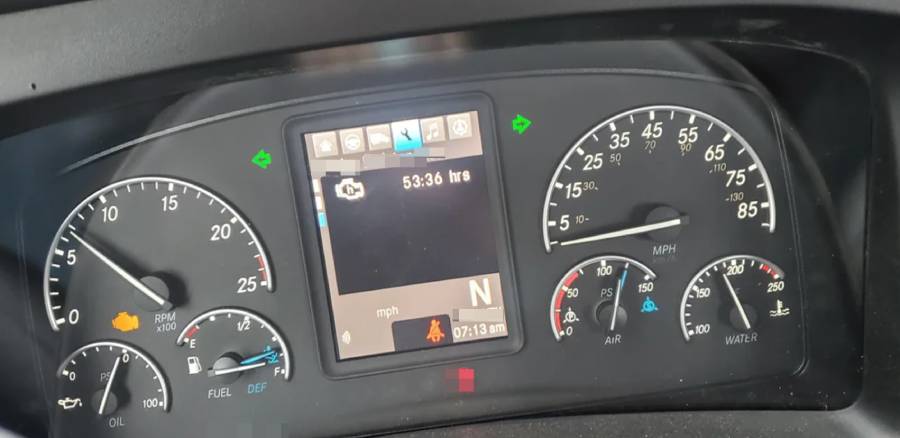
The Freightliner Stop Engine light should be reset only after the fault that triggered the warning has been identified and corrected. This warning can appear when the engine control system detects an operating condition that requires attention, such as abnormal coolant temperature, low oil pressure, an engine sensor fault, or an aftertreatment system problem. Simply clearing the warning without fixing its cause can result in the light returning after the engine control module detects the same fault again.
The reset procedure depends on the Freightliner model, engine configuration, and whether the diagnostic fault remains active. In some cases, the warning may disappear after the underlying condition is corrected and the engine completes the required monitoring cycle. Other faults require a compatible diagnostic scanner to read SPN/FMI fault information, confirm the repair, and clear stored codes. Disconnecting the battery or repeatedly restarting the engine is not a reliable substitute for diagnosing an active fault.
This guide explains how to reset the Stop Engine light on a Freightliner, when a scanner may be required, what commonly triggers the warning, and why the light may stay on or return after a reset. It also explains when the warning indicates a condition that should be diagnosed before the truck is driven further.
How Do You Reset the Stop Engine Light on a Freightliner?
Reset the Stop Engine light on a Freightliner by identifying the active fault, correcting the condition that caused it, clearing the applicable fault code, and verifying that the warning does not return after restarting the engine. The exact reset procedure depends on the Freightliner model, engine, electronic control module (ECM), and type of fault. A Stop Engine warning is tied to a detected operating condition, so resetting the light without addressing that condition does not repair the underlying problem.
Start by parking the truck safely, applying the parking brake, and checking the dashboard for additional warnings or fault information. Inspect conditions that can require immediate attention, including engine coolant temperature, coolant level, and engine oil pressure. If the Stop Engine light appears with signs of overheating, abnormal oil pressure, unusual engine noise, or another serious warning, diagnose that condition rather than attempting to clear the light first.
Next, retrieve the diagnostic fault information available for the truck. Freightliner vehicles can use diagnostic information such as SPN and FMI codes to identify the affected parameter and the type of failure detected by the electronic control system. A compatible diagnostic tool can provide additional information when the dashboard does not provide enough detail. Once the fault has been identified, repair or correct its actual cause before attempting to erase stored diagnostic information.
After the repair, clear the applicable fault code with compatible diagnostic equipment when the system requires manual clearing. Turn the ignition off and restart the truck according to the applicable vehicle and engine procedure. Check the instrument panel again and confirm that the Stop Engine warning remains off. If the light immediately returns, the ECM may still detect an active fault, the original repair may not have corrected the root cause, or another related fault may be present.
Can You Reset a Freightliner Stop Engine Light Without a Scanner?
A Freightliner Stop Engine light may turn off without a scanner when the condition that triggered the warning is no longer present and the applicable control system allows the warning to clear automatically. This is different from manually resetting an active diagnostic fault. Whether automatic clearing occurs depends on the engine, ECM strategy, fault type, and vehicle configuration.
Restarting the engine can show whether a warning remains active, but repeatedly cycling the ignition is not a repair procedure. Likewise, disconnecting the truck’s battery should not be treated as a universal Stop Engine light reset method. Removing electrical power does not correct overheating, low oil pressure, a failed sensor, an aftertreatment problem, or another physical condition that caused the ECM to generate the warning.
A diagnostic scanner becomes important when the warning remains active, returns after restarting, or is associated with a diagnostic code that requires further investigation. The scanner allows the technician or owner to retrieve diagnostic information, determine whether a fault is active or stored, and clear applicable codes after the repair. The warning should remain off after the system monitors the repaired component or condition again; if it returns, further diagnosis is required.
What Does the Stop Engine Light Mean on a Freightliner?
The Stop Engine light on a Freightliner indicates that the engine control system has detected a condition serious enough to require prompt attention. The warning is different from a routine maintenance reminder because it is associated with an operating condition monitored by the truck’s electronic control system. Depending on the engine and vehicle configuration, the warning can accompany additional dashboard messages, fault codes, audible alerts, or changes in engine operation.
The warning appears when the electronic control module receives information indicating that a monitored parameter is outside its expected operating range. For example, the system monitors engine-related parameters through sensors and other electronic modules. When a value or system condition meets the criteria for a specific fault, the control module records diagnostic information and can activate the appropriate dashboard warning. This creates a diagnostic sequence of abnormal condition → fault detection → diagnostic code → dashboard warning.
A Stop Engine warning should therefore be treated according to the fault that triggered it rather than according to the warning light alone. Conditions involving excessive coolant temperature or inadequate engine oil pressure require a different response from a sensor or electrical fault. The dashboard warning identifies that intervention is required, while the associated diagnostic information helps determine the component, system, or operating condition responsible for it.
Continuing to drive with the Stop Engine light illuminated can increase the risk of engine damage when the warning is associated with a critical operating condition. Move the truck to a safe location and shut the engine down when the vehicle or engine instructions require an immediate shutdown or when the warning accompanies signs such as overheating, abnormal oil pressure, unusual engine noise, or a significant loss of performance. Do not continue operating the truck solely because it still appears to run normally; some faults are detected electronically before severe mechanical symptoms become obvious.
The appropriate response depends on the active fault and the instructions specified for the truck and engine. Check additional dashboard warnings and available diagnostic information first. A fault code can then be used to narrow the diagnosis before any reset is attempted. Clearing the Stop Engine light without determining why it appeared removes diagnostic information from view but does not eliminate the condition that caused the warning.
What Causes the Stop Engine Light to Come On in a Freightliner?
A Freightliner Stop Engine light comes on when the engine control system detects a fault or operating condition that meets the criteria for a serious engine warning. The exact causes depend on the truck model, engine, emissions system, and electronic configuration. Common fault categories include cooling-system problems, abnormal engine oil pressure, sensor or electrical faults, and aftertreatment-system problems.
Cooling-system problems can trigger serious engine warnings when the engine operates outside its permitted temperature range. High coolant temperature can result from conditions such as low coolant, restricted coolant circulation, cooling-fan problems, or other cooling-system faults. Because excessive heat can damage engine components, the control system monitors temperature-related parameters and can activate a warning when predetermined limits are reached. Check coolant-related warnings and temperature information before attempting to reset the Stop Engine light.
Abnormal engine oil pressure is another condition that requires immediate attention. Engine oil creates the lubricating film that separates moving components, including bearings, crankshaft surfaces, and other internal engine parts. Insufficient oil pressure can reduce this protection and increase the risk of mechanical damage. If the Stop Engine light appears with a low-oil-pressure warning or an abnormal oil-pressure reading, investigate the lubrication problem instead of clearing the warning and continuing to drive.
Sensor, wiring, and electrical faults can also cause the engine control system to register diagnostic trouble codes. The ECM depends on electronic inputs to monitor engine operation, so an incorrect signal can indicate either a genuine operating problem or a fault in the sensor circuit itself. Examples include a failed sensor, damaged wiring, poor electrical connection, or an implausible signal. Diagnostic codes are important in these cases because replacing a component based only on the dashboard warning can lead to an incorrect repair.
DEF, DPF, SCR, and other aftertreatment-system faults can also produce engine warnings or operating restrictions on Freightliner trucks equipped with applicable diesel emissions systems. These systems monitor functions such as diesel exhaust fluid delivery, exhaust aftertreatment, and emissions-control performance. A fault that remains unresolved can progress through different warning stages and, depending on the engine and system strategy, may contribute to reduced engine performance or derate conditions.
The cause should therefore be identified from the truck’s actual diagnostic information rather than assumed from the Stop Engine light alone. The warning tells the driver that a serious condition has been detected; the associated fault code identifies where the diagnostic process should begin. Reading the available codes before clearing them preserves information that can help distinguish a cooling or lubrication problem from an electrical, sensor, or aftertreatment fault.
How Do You Find the Fault Causing a Freightliner Stop Engine Light?
Find the fault causing a Freightliner Stop Engine light by retrieving the diagnostic fault information and using it to identify the affected system before attempting a reset. The warning light identifies that the control system has detected a problem, but it does not identify the failed component by itself. Diagnosis therefore starts with the available dashboard information or a compatible diagnostic tool rather than replacing parts based only on the warning.
Check the instrument cluster for accompanying messages and fault information first. Depending on the Freightliner model, engine, and electronic configuration, diagnostic information may be available through the vehicle display or through service diagnostic equipment. Record the available codes before clearing them because those codes provide evidence of the condition detected by the control module. Clearing diagnostic information too early can remove useful clues and make an intermittent problem more difficult to trace.
A compatible diagnostic scanner can provide additional information by communicating with the truck’s electronic modules. The diagnostic process should determine whether a fault is active or previously stored and then connect that fault to the relevant system, circuit, sensor, or operating condition. A code should be treated as the starting point for diagnosis rather than automatic proof that the component named in the diagnostic information must be replaced. Wiring, connectors, operating conditions, and related components can produce faults involving the same monitored parameter.
How Do You Read Freightliner SPN and FMI Fault Codes?
Read a Freightliner SPN/FMI fault by using the SPN to identify the parameter or system involved and the FMI to identify the type of failure detected. SPN stands for Suspect Parameter Number, while FMI stands for Failure Mode Identifier. Used together, they provide more useful diagnostic context than the Stop Engine warning alone.
For example, the SPN directs the diagnostic process toward a monitored parameter, while the FMI describes how the reported condition has failed or moved outside its expected range. The failure information can indicate conditions involving a signal, value, circuit, or other monitored behavior depending on the specific code. The complete SPN/FMI combination should therefore be interpreted using service information applicable to the truck’s engine and electronic system rather than interpreting the SPN by itself.
After identifying the code, verify the actual condition before replacing a component or clearing the warning. This can require checking fluid levels, operating temperatures, sensor readings, wiring, connectors, or other components associated with the fault. The required checks depend on the specific SPN/FMI combination. This sequence moves the repair process from warning → fault code → affected system → verification → repair instead of treating the reset itself as the repair.
Once the underlying fault has been corrected, clear the applicable diagnostic information when required and operate or restart the truck according to the relevant procedure. Monitor the system afterward to confirm that the fault does not become active again. If the same SPN/FMI code returns, the triggering condition is still present, has recurred, or was not fully corrected during the first repair.
Why Won’t the Freightliner Stop Engine Light Reset?
A Freightliner Stop Engine light usually will not reset when the triggering fault is still active, the underlying problem has not been repaired, the fault returns during system monitoring, or the reset method does not apply to that particular engine control system. Clearing diagnostic information and repairing a fault are two different actions. The warning can return as soon as the ECM detects that the condition responsible for the original fault still exists.
An active fault is one of the first conditions to check when the light remains on. An active code indicates that the electronic control system currently detects the fault condition. For example, clearing diagnostic information will not correct an engine that continues to report an abnormal monitored parameter. The ECM continues receiving the problematic input, recognizes that the fault criteria are still satisfied, and activates the warning again. Diagnosis and repair must therefore occur before another reset attempt.
The light can also return when the original repair addresses a symptom rather than the root cause. A sensor-related code, for example, does not automatically prove that the sensor itself has failed. The problem can involve the sensor circuit, wiring, connector, electrical supply, or the physical condition being measured. Replacing a component without verifying the complete fault path can leave the original condition unresolved and cause the same diagnostic code to become active again.
Some faults reappear only after the ECM performs another monitoring cycle. The warning may initially remain off after codes are cleared, then return after the engine starts, reaches a particular operating condition, or the affected system is monitored again. The sequence is code cleared → system monitored → fault detected again → code becomes active → warning returns. A light that comes back after apparently being reset is therefore useful diagnostic evidence rather than simply a failed reset.
Using an inappropriate reset method can create the same result. Repeatedly cycling the ignition or disconnecting battery power should not be treated as a universal Freightliner Stop Engine light reset procedure. Different Freightliner configurations can use different engines, electronic modules, and diagnostic strategies. A compatible diagnostic tool and the applicable service procedure are required when the system does not clear the warning automatically after the fault has been corrected.
If the Stop Engine light returns, retrieve the diagnostic codes again and compare them with the codes recorded before the repair. When the same fault returns, diagnose the affected system again instead of repeatedly clearing the code. Verify the relevant operating condition, circuit, wiring, connector, sensor, or mechanical system according to the diagnostic information. When a different code appears, investigate that code separately because it can identify another fault or provide additional information about the original problem.
A recurring Stop Engine warning should remain off only after the underlying condition no longer meets the criteria that activate the fault. The correct sequence is read the fault → identify the affected system → verify the cause → complete the repair → clear the applicable code → monitor for recurrence. If the fault remains active after these steps or requires testing beyond the available diagnostic equipment, further diagnosis is necessary rather than another reset attempt.What Is the Difference Between the Stop Engine and Check Engine Lights on a Freightliner?
The Stop Engine light and Check Engine light on a Freightliner indicate different levels or types of engine-system warnings, and the Stop Engine warning generally requires a more immediate response. The exact meaning and response depend on the Freightliner model, engine, instrument cluster, and active diagnostic fault. Drivers should therefore use the warning message and diagnostic information applicable to their specific truck instead of treating the two lights as interchangeable.
A Check Engine light indicates that the electronic control system has detected a fault that requires diagnosis. The truck may continue operating with some faults, but the diagnostic code should still be retrieved because the warning can involve an engine, sensor, electrical, emissions, or aftertreatment condition. The presence of a Check Engine light does not identify the defective component by itself; the associated diagnostic information provides the starting point for determining what caused the warning.
A Stop Engine light requires greater attention because it can be associated with a condition for which continued operation risks engine damage or triggers an engine-protection response. Examples of conditions that require immediate investigation include abnormal coolant temperature and abnormal engine oil pressure. When the Stop Engine warning appears, check for accompanying messages, gauges, audible warnings, and fault information before deciding whether the truck can continue operating.
The required response is therefore based on warning severity + active fault + operating condition. A Check Engine warning calls for fault diagnosis, while a Stop Engine warning can require the driver to safely stop the truck and address the detected condition before further operation. Follow the vehicle and engine instructions when the dashboard indicates that an engine shutdown is required.
Reset procedures also should not be used to erase this distinction. Clearing either warning does not repair the condition that generated its diagnostic fault. If a Stop Engine or Check Engine warning returns after codes have been cleared, retrieve the fault information again and diagnose the condition that caused the ECM to reactivate it.
Can a Freightliner Stop Engine Light Cause Engine Derate?
A fault associated with a Freightliner Stop Engine warning can coincide with engine derate when the engine control system uses reduced power as part of its protection or emissions-control strategy. A derate limits engine performance under specified fault conditions. However, a Stop Engine light does not mean that every Freightliner will automatically enter the same level of derate.
Engine derate occurs because the control system can modify engine operation after detecting a condition that meets defined fault criteria. Depending on the engine and fault, the driver may notice reduced engine power, restricted performance, or other changes in vehicle operation. The warning light and the performance reduction are related outputs of the control strategy when applicable; the dashboard light itself is not what physically causes the engine to lose power.
Aftertreatment faults can also be associated with operating restrictions on diesel trucks equipped with systems such as DEF, DPF, and SCR. The response depends on the specific fault and engine strategy. A persistent aftertreatment problem can progress through warning stages and operating restrictions, which is why the applicable diagnostic codes should be read rather than assuming that every derate has the same cause.
Resetting or clearing codes does not permanently remove a derate when the condition responsible for it remains active. After the codes are cleared, the control system continues monitoring the affected parameter or system. If the fault criteria are detected again, the diagnostic code, warning, or operating restriction can return.
When a Freightliner has both a Stop Engine warning and reduced engine performance, retrieve the active fault information before attempting repeated resets. The diagnostic goal is to identify and correct the condition responsible for the warning and derate, not simply to restore full power by clearing the dashboard light. A recurring derate requires diagnosis of the associated engine or aftertreatment fault using the procedures applicable to that truck and engine.
Read more: How to Reset ABS Light on Freightliner Cascadia
How Can You Prevent the Freightliner Stop Engine Light From Coming Back?
Prevent the Freightliner Stop Engine light from coming back by correcting the root cause of each fault and maintaining the engine systems that the ECM monitors. Clearing a diagnostic code only removes or resets diagnostic information when permitted; it does not prevent recurrence. Prevention therefore depends on keeping cooling, lubrication, electrical, sensor, and applicable aftertreatment systems within their specified operating conditions.
Maintain the cooling system because abnormal engine temperature can produce serious engine warnings. Check coolant at the intervals specified for the truck and investigate unexplained coolant loss rather than repeatedly topping off the system without identifying the leak or other cause. Cooling-system components such as hoses, connections, the radiator, thermostat, water pump, and cooling fan should be inspected when symptoms indicate a problem. A recurring temperature-related fault requires diagnosis because clearing the warning does not restore proper heat control.
Maintain proper engine lubrication and investigate abnormal oil-pressure readings immediately. Correct oil level and condition are important, but an oil-pressure problem can involve more than the quantity of oil in the engine. A lubrication-system fault, pressure-sensing problem, electrical issue, or mechanical condition can produce abnormal readings. When an oil-related diagnostic code returns, use the applicable diagnostic procedure instead of assuming that adding oil will resolve every pressure warning.
Address electrical and sensor faults by checking the complete circuit associated with the diagnostic code. Sensors depend on wiring, connectors, electrical supply, grounding, and communication with electronic modules. A loose connector, damaged wire, corrosion, or intermittent electrical connection can cause a fault to disappear temporarily and return later. This is one reason a warning that repeatedly appears and disappears should still be diagnosed even when the truck seems to operate normally between events.
Maintain the DEF, DPF, SCR, and related aftertreatment components according to the requirements of trucks equipped with these systems. Do not ignore recurring emissions or aftertreatment codes because unresolved faults can lead to additional warnings or operating restrictions depending on the engine strategy. Identify the specific diagnostic code and affected system before replacing parts or attempting another reset.
Keep a record of recurring SPN/FMI codes, the operating conditions under which they appear, and the repairs already performed. For example, note whether a warning occurs during startup, under load, after the engine reaches operating temperature, or during an aftertreatment-related event. This information helps distinguish a persistent fault from an intermittent condition and gives the diagnostic process more context than the warning light alone.
When Should a Freightliner Stop Engine Warning Be Diagnosed by a Technician?
A Freightliner Stop Engine warning should be professionally diagnosed when the fault remains active, repeatedly returns after repair, is accompanied by abnormal engine operation, or cannot be accurately tested with the diagnostic equipment available. Continuing to clear a recurring code can hide useful diagnostic information without correcting the condition responsible for the warning.
Professional diagnosis becomes particularly important when the warning appears with overheating, abnormal oil pressure, unusual engine noise, substantial power loss, repeated engine derate, or another indication of a potentially serious engine condition. These symptoms can require measurements and tests beyond reading a fault code. Operating the truck despite a critical warning can allow an existing problem to progress into more extensive engine or system damage.
A technician may also be required when an SPN/FMI code identifies a system but does not establish the failed component. Diagnostic codes direct troubleshooting toward a parameter or failure condition; they do not always provide a complete repair diagnosis. Testing can involve inspecting wiring and connectors, comparing sensor readings, checking circuits, verifying mechanical conditions, or using engine-specific diagnostic software and service procedures.
Recurring faults deserve additional attention even when the Stop Engine light disappears after a reset. If the same code returns after the affected system has supposedly been repaired, either the original cause remains, the fault is intermittent, or another condition is producing the same diagnostic result. Recording the original and returning codes gives the technician a clearer diagnostic history.
The reset is complete only when the underlying fault has been corrected, the applicable diagnostic information has been cleared or becomes inactive as designed, and the Stop Engine warning does not return during subsequent system monitoring. This distinction prevents the reset procedure from being mistaken for the repair itself and provides a more reliable way to address a Freightliner Stop Engine warning.
1 thought on “How to Reset Freightliner Stop Engine Light”