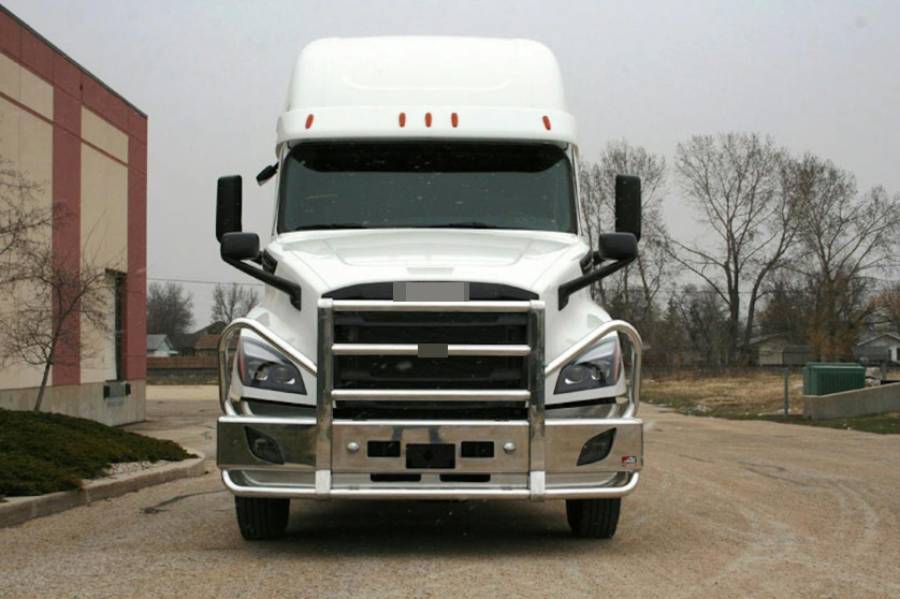
Freightliner collision avoidance system problems can result from blocked or misaligned sensors, electrical faults, damaged wiring, communication errors, or failed system components. Depending on the truck’s model, model year, and installed safety system, these faults can affect functions such as forward collision warnings, adaptive cruise control, and automatic emergency braking. A warning on the dashboard does not automatically mean the radar sensor or another expensive component has failed because several connected systems can trigger similar symptoms.
Common signs include repeated collision warnings, a collision mitigation system fault message, adaptive cruise control becoming unavailable, or driver-assistance features operating inconsistently. Dirt, snow, ice, or road debris covering a forward-facing sensor may interfere with object detection, while front-end repairs or physical impacts can affect sensor alignment. Wiring, connectors, power supply, and communication between control modules can also contribute to system faults.
Diagnosing the problem requires identifying the warning or symptom first, inspecting relevant sensors and components, and checking diagnostic trouble codes when necessary. The correct repair depends on the actual cause and may range from cleaning an obstructed sensor to repairing wiring, calibrating a radar or camera, or replacing a failed component. This guide explains the main Freightliner collision avoidance system problems, their causes, diagnostic steps, and appropriate fixes.
What Are the Most Common Freightliner Collision Avoidance System Problems?
The most common Freightliner collision avoidance system problems involve sensor detection, false or repeated warnings, adaptive cruise control interruptions, system fault messages, and electrical or communication faults. The exact problem depends on the Freightliner model, model year, and collision mitigation system installed on the truck. Because multiple driver-assistance functions can share sensors and vehicle data, one fault can affect more than one feature.
Sensor detection problems occur when the collision avoidance system cannot reliably identify vehicles or obstacles ahead. A forward-facing radar sensor or camera needs an unobstructed field of detection to provide accurate information. Dirt, mud, snow, ice, road debris, physical damage, or sensor misalignment can interfere with this process. For example, contamination covering the sensor area may cause the system to become temporarily unavailable even though the sensor itself has not failed.
False or repeated collision warnings occur when the system identifies a potential collision threat that does not match what the driver observes. This symptom should not automatically be treated as a failed radar sensor. Sensor alignment, environmental conditions, mounting problems, electrical faults, and other system inputs may need to be checked before replacing a component. The diagnostic process should identify why the warning is being generated rather than treating the warning itself as the root cause.
Adaptive cruise control problems can also appear alongside collision avoidance faults because these functions may depend on common detection and vehicle-data inputs. A truck may display an adaptive cruise control unavailable message or disable the function when the system cannot obtain reliable information from a required sensor or control module. This protective behavior prevents a driver-assistance function from operating when its required inputs cannot be verified.
Electrical and communication problems form another important fault category. Damaged wiring, loose or corroded connectors, unstable power supply, or communication faults between control modules can interrupt information required by the collision avoidance system. These problems can be intermittent, which means a warning may appear during one trip and disappear during another. Reading diagnostic trouble codes and checking the affected circuits is therefore more reliable than assuming that an intermittent warning has resolved itself.
What Are the Symptoms of a Freightliner Collision Avoidance System Problem?
Freightliner collision avoidance system problems can produce dashboard warnings, repeated collision alerts, unavailable driver-assistance functions, adaptive cruise control problems, or inconsistent system operation. The warning or behavior is a symptom of the fault, not necessarily proof that a specific sensor or module has failed.
A dashboard warning is often the first symptom a driver notices. Depending on the collision mitigation system installed, the truck may indicate that a safety function has a fault or is unavailable. The timing of the message provides useful diagnostic context. For example, a warning that appears after the front of the truck becomes covered with snow or road debris suggests a different diagnostic path from a warning that begins after collision damage, electrical work, or component replacement.
Unexpected collision alerts are another symptom that requires investigation. The system uses information from its detection components and other vehicle inputs to determine whether an object presents a collision risk. Incorrect, incomplete, or unreliable input can therefore affect the resulting warning. Repeated unexpected alerts should be diagnosed rather than addressed by simply disabling or ignoring the safety feature.
Adaptive cruise control becoming unavailable can provide an additional clue. If the collision avoidance and adaptive cruise control functions rely on a shared radar or related vehicle information, a fault affecting that input can influence both functions. The presence of multiple related warnings can therefore help narrow the diagnostic scope, although diagnostic trouble codes and system-specific testing are still required to identify the actual cause.
Automatic braking or other collision mitigation behavior also requires greater attention because it involves a safety-critical function. A driver should not assume that clearing a dashboard message restores normal operation. Persistent warnings, unexpected braking-related behavior, or repeated loss of collision mitigation functions require diagnosis of the underlying fault before the system can be considered properly repaired.
What Causes Freightliner Collision Avoidance System Problems?
Freightliner collision avoidance system problems can result from sensor obstruction, radar misalignment, camera or windshield issues, electrical faults, damaged wiring, connector problems, and communication faults between vehicle systems. The exact causes vary by Freightliner model, model year, and installed collision mitigation system. Identifying the cause matters because similar dashboard warnings can originate from different components.
Sensor obstruction is one of the first conditions to inspect because forward-facing detection equipment needs a clear field of view. Dirt, mud, road salt, snow, ice, or accumulated debris around a radar or camera can interfere with its ability to detect objects correctly. This can cause a collision avoidance function to become unavailable or produce inconsistent warnings without an internal sensor failure. Cleaning the relevant area can address an obstruction, but it will not correct physical damage, alignment errors, or electrical faults.
Physical changes around a sensor can create a separate problem. Front-end collision damage, bumper work, sensor removal, mounting damage, or other repairs near the detection equipment can alter its position. A sensor that appears intact may still provide inaccurate information if its mounting position or alignment falls outside the required specification. This is why a collision avoidance warning that begins after front-end work deserves an alignment and calibration assessment rather than an immediate sensor replacement.
Camera-related problems should also be considered on configurations that use a forward-facing camera. The camera requires adequate visibility and correct positioning to interpret the road environment. Windshield damage, contamination in the camera’s viewing area, camera mounting issues, or work involving the windshield may affect this input. The applicable inspection and calibration requirements depend on the specific safety system installed on the truck.
Electrical faults can produce symptoms that resemble sensor failure. Collision avoidance components depend on stable power, ground connections, wiring, connectors, and communication with other electronic modules. A damaged harness or poor electrical connection can interrupt a signal even when the radar or camera remains functional. For this reason, replacing a sensor before checking related fault codes and circuits can result in an unnecessary repair.
Vehicle communication faults can also affect collision avoidance operation. Driver-assistance functions may rely on information exchanged between several electronic systems rather than operating as completely independent units. If required information becomes unavailable or unreliable, the collision avoidance system may disable a function and generate a warning. Diagnostic trouble codes are particularly useful in this situation because they help identify which system, circuit, or communication path requires further testing.
Can a Misaligned Radar Sensor Cause Collision Avoidance Problems?
A misaligned radar sensor can cause collision avoidance problems because the sensor must monitor the correct area in front of the truck to provide reliable object information. If its physical orientation changes, the data supplied to the collision mitigation system may no longer accurately represent the intended detection area.
Radar misalignment can occur after an impact or work involving components around the sensor mounting area. The important distinction is that misalignment does not necessarily mean the radar has internally failed. The component may still power on and communicate with the vehicle while its physical position prevents it from operating within specification.
Calibration and alignment procedures should therefore follow the requirements for the collision mitigation equipment installed on the specific Freightliner. Simply repositioning a sensor by eye is not equivalent to verifying its alignment. Where specialized calibration equipment or manufacturer procedures are required, the repair should be completed using those procedures before normal system operation is assumed.
Can Electrical Problems Cause Collision Avoidance System Faults?
Electrical problems can cause Freightliner collision avoidance system faults by interrupting power, ground, signal, or communication circuits required by the system. Relevant faults can include damaged wiring, poor connector contact, unstable electrical supply, and communication problems between electronic control modules.
Intermittent electrical faults can be particularly difficult to identify. Vibration, moisture, corrosion, or a damaged connection may cause a circuit to work normally at one moment and fail at another. The driver may consequently see a warning disappear after restarting the truck even though the underlying electrical condition remains.
The correct diagnostic approach is to use the warning and stored diagnostic trouble codes to determine which circuit or system requires inspection. Wiring and connector condition, power and ground integrity, and relevant communication faults can then be tested before a radar, camera, or control module is condemned. This sequence separates an actual component failure from a fault elsewhere in the circuit and reduces unnecessary parts replacement.
How Do You Diagnose a Freightliner Collision Avoidance System Problem?
Diagnose a Freightliner collision avoidance system problem by identifying the warning, inspecting the detection components, checking related vehicle faults, reading diagnostic trouble codes, and testing the indicated circuit or component. Diagnosis should move from visible conditions to electronic testing instead of starting with radar, camera, or control module replacement.
Start with the exact dashboard warning and the conditions present when it appeared. Determine whether the fault is constant or intermittent and whether another function, such as adaptive cruise control, became unavailable at the same time. Multiple related symptoms can indicate that the systems share a sensor, vehicle input, electrical circuit, or communication path. The warning should be treated as the starting point for diagnosis rather than proof that the component named or associated with the warning has failed.
Inspect the accessible detection areas next. Check for dirt, mud, snow, ice, road debris, obvious physical damage, or changes around the radar or camera mounting area. Recent front-end collision repairs, bumper work, windshield replacement, or work around a sensor are also relevant because they may affect mounting or calibration. Removing an obstruction may restore operation when contamination is the cause, but a persistent warning requires further diagnosis.
Check for other vehicle warnings before isolating the collision avoidance system. A driver-assistance function can depend on information supplied by other electronic systems. If related faults are present, diagnosing those faults together provides more useful information than treating every warning as an independent failure.
The next step is to retrieve diagnostic trouble codes with diagnostic equipment compatible with the truck and installed safety system. A DTC can identify an affected circuit, sensor, communication path, or operating condition. Use that information to determine what needs to be tested next. A code associated with a radar sensor, for example, does not by itself prove that replacing the radar will correct the problem.
Electrical testing becomes necessary when the fault information indicates a power, ground, wiring, connector, or communication problem. Inspect the relevant harness and connectors for physical damage, loose connections, corrosion, or other conditions that can interrupt a circuit. Persistent sensor-related faults may require additional component testing, alignment verification, or calibration according to the procedures specified for the system installed on the truck.
How Do You Read Freightliner Collision Avoidance Fault Codes?
Read Freightliner collision avoidance fault codes by identifying the active or stored DTC and using the code to determine which system, circuit, or operating condition requires diagnosis. The diagnostic code narrows the search area; it should not automatically be interpreted as an instruction to replace a component.
Start by recording the complete code rather than relying only on the dashboard description. Diagnostic information can distinguish between different fault types, including electrical circuit problems, communication errors, sensor-related conditions, and other system abnormalities. This distinction matters because several faults can produce similar symptoms for the driver.
The status of the code also provides useful context. An active fault indicates that the system currently detects the condition, while a stored or previously recorded fault can provide evidence of an intermittent problem. For example, an electrical connection that loses contact because of vibration may generate a fault that is no longer active when the truck reaches a repair facility. Clearing the code without investigating its cause removes diagnostic information but does not repair the intermittent connection.
Use the DTC together with physical inspection and circuit testing to identify the root cause. If a code points toward a sensor circuit, check the associated wiring, connectors, power, ground, and other specified conditions before concluding that the sensor itself has failed. If the code indicates alignment or calibration, verify the physical installation and follow the appropriate calibration procedure. This approach establishes the sequence fault code → affected system → diagnostic test → confirmed cause → repair, reducing unnecessary component replacement.
How Do You Fix Freightliner Collision Avoidance System Problems?
Fix a Freightliner collision avoidance system problem by correcting the confirmed cause, which may involve cleaning an obstructed sensor, repairing wiring or connectors, correcting a mounting problem, calibrating the radar or camera, or replacing a failed component. The correct repair should follow diagnosis because the same warning can result from different faults. Replacing the radar or another expensive component without confirming failure can leave the original problem unresolved.
Start with an obstruction when inspection shows that dirt, mud, snow, ice, or road debris is interfering with a detection area. Remove the obstruction without damaging the sensor, camera, mounting hardware, or surrounding components. After cleaning, verify whether the warning clears and whether the affected driver-assistance function returns to normal operation. A warning that remains after the detection area is clean indicates that another condition requires diagnosis.
Repair electrical faults according to the affected circuit. Damaged wiring, poor connector contact, corrosion, unstable power, or an inadequate ground can interrupt information even when the sensor itself is functional. The repair should restore electrical integrity and address the cause of the damage rather than simply clearing the associated diagnostic trouble code. The system should then be rechecked to confirm that the fault does not return.
A sensor mounting or alignment problem requires a different repair. Inspect the sensor and its mounting area for impact damage, displacement, loose hardware, or previous repair work that may have changed its position. If the installed collision mitigation system specifies an alignment or calibration procedure, complete that procedure using the required method and equipment. Visual positioning alone does not confirm that a radar or camera is operating within its specified detection geometry.
Replace a radar sensor, camera, control module, or related component only after diagnosis confirms that the component has failed or cannot meet the applicable specifications. Component replacement may also require programming, setup, alignment, or calibration depending on the installed system. Completing those requirements is part of the repair rather than an optional step after replacement.
The repair should finish with verification. Recheck diagnostic trouble codes, confirm that relevant warnings have cleared appropriately, and verify that the affected functions operate as specified. A dashboard message disappearing after a restart is not sufficient evidence that an intermittent electrical, communication, or alignment problem has been repaired.
How Do You Reset a Freightliner Collision Avoidance System?
A Freightliner collision avoidance system should only be reset or have its fault cleared after the underlying problem has been identified and corrected. A reset can remove a warning or stored fault under the appropriate conditions, but it cannot repair damaged wiring, a blocked sensor, incorrect radar alignment, communication failure, or a defective component.
The exact reset procedure depends on the Freightliner model, model year, and collision mitigation equipment installed. There is therefore no single reset sequence that should be applied to every Freightliner truck. A system may resume operation after a temporary condition disappears, while another fault may remain active until it is diagnosed, repaired, and cleared with compatible diagnostic equipment.
Before attempting to clear a fault, record the diagnostic trouble codes and their status. This information can be valuable when diagnosing an intermittent problem. Clearing codes too early can remove evidence showing which circuit or operating condition triggered the warning, making a fault that occurs only occasionally more difficult to trace.
If the warning returns after the fault is cleared, treat the repeated warning as evidence that the underlying condition still exists or has reoccurred. Repeatedly clearing a collision avoidance fault is not a substitute for repairing it. The appropriate sequence is diagnose the fault → correct the cause → clear the applicable code → verify system operation.
Resetting should also be distinguished from calibration. Clearing a code tells the electronic system to remove applicable fault information; calibration establishes or verifies the operating reference required by a sensor. A radar that is physically misaligned does not become correctly aligned because its fault code has been erased.
When Does a Freightliner Collision Avoidance System Need Calibration?
A Freightliner collision avoidance system may require calibration when radar or camera positioning has changed, a relevant component has been removed or replaced, or repair work has affected the sensor’s mounting or viewing geometry. The exact calibration triggers and procedures depend on the collision mitigation equipment installed, so the applicable service information should determine whether calibration is required.
Front-end damage is an important reason to evaluate radar alignment. An impact can affect a sensor, bracket, bumper, or surrounding structure without producing obvious external damage to the radar itself. Because radar operation depends on its orientation relative to the vehicle, a change in mounting position can affect the area the system monitors. Calibration or alignment verification may therefore be necessary even when the sensor continues to communicate electronically.
Component work can create another calibration requirement. Removing or replacing a radar, camera, mounting bracket, windshield, or related component may alter the reference used by the driver-assistance system. This does not mean every repair automatically requires calibration; the requirement should be determined by the specific system and service procedure.
Calibration is also different from replacing a component. A functional but misaligned sensor may need calibration rather than replacement, while an internally failed sensor may require replacement followed by the applicable setup or calibration. Correctly distinguishing these conditions prevents unnecessary parts replacement and ensures that a new component is not installed without completing the procedures required for proper operation.
Calibration should be performed with the specified procedure and equipment when the system requires it. Collision avoidance functions depend on accurate environmental information, so approximate visual adjustment is not an adequate substitute for a required calibration. After calibration, the system should be checked for relevant diagnostic trouble codes and verified for correct operation before the repair is considered complete.
Is It Safe to Drive a Freightliner With a Collision Avoidance System Fault?
Driving a Freightliner with a collision avoidance system fault can reduce or disable safety functions such as forward collision warnings, adaptive cruise control, or automatic emergency braking, depending on the system and fault involved. A truck that remains mechanically drivable should not automatically be considered fully functional because the collision mitigation features may no longer provide their intended assistance.
The severity of the problem depends on which function has been affected. A temporarily obstructed sensor may make a driver-assistance feature unavailable until the obstruction is removed. A persistent radar, camera, electrical, or communication fault can prevent the system from receiving the information required for collision detection. Faults accompanied by additional ABS, braking, steering, or other vehicle warnings require greater attention because the problem may extend beyond the collision avoidance system itself.
Drivers should also treat unexpected system behavior differently from a simple unavailable-system message. Repeated false collision alerts, unexpected braking-related behavior, or inconsistent operation indicates that the system requires diagnosis. Continuing to rely on a malfunctioning driver-assistance feature can create risk because its response may not match the driver’s expectations.
The collision avoidance system is an assistance system rather than a replacement for normal vehicle control and safe following practices. When a warning appears, record the message, note any other active warnings, and determine which functions are unavailable. Persistent faults or abnormal braking-related behavior should be professionally diagnosed before normal collision mitigation performance is assumed.
How Much Does It Cost to Fix a Freightliner Collision Avoidance System?
The cost to fix a Freightliner collision avoidance system depends on whether the repair requires diagnosis, cleaning, wiring repair, calibration, or component replacement. A single universal repair price is not reliable because Freightliner trucks can use different collision mitigation equipment, and the labor and parts required vary according to the confirmed fault.
Sensor obstruction is generally the least complex condition because the problem may only require proper cleaning and inspection. However, a warning that remains after an obstruction is removed requires additional diagnostic work. Paying for diagnosis at this stage can prevent a more expensive component from being replaced unnecessarily.
Electrical repairs vary according to the location and extent of the fault. A poor connector connection may require less labor than tracing an intermittent wiring or communication problem through several circuits. Diagnostic time can become a significant part of the repair because technicians may need to reproduce an intermittent fault and test power, ground, signal, and communication circuits before identifying the failed connection.
Calibration adds another category of cost. Radar or camera calibration may require dedicated equipment, a controlled setup, and a specific service procedure. A component that has been moved or replaced can therefore involve both parts or labor for the physical repair and additional labor for calibration.
Sensor or module replacement generally creates a higher repair bill because the total can include the replacement component, diagnostic labor, installation, programming or setup, and calibration where required. For this reason, the fault should be confirmed before an expensive electronic component is replaced. The most useful repair estimate is one based on a specific DTC and completed diagnosis rather than the dashboard warning alone.
Read more: Freightliner Speed Sensor Problems: Causes & Fixes
When Should a Freightliner Collision Avoidance Problem Be Diagnosed by a Professional?
A Freightliner collision avoidance problem should be professionally diagnosed when the warning persists, repeatedly returns, involves abnormal braking behavior, follows physical damage, requires calibration, or points to an electrical or communication fault that cannot be confirmed through basic inspection. These conditions require more than cleaning a visible sensor area or restarting the truck.
A persistent warning is one of the clearest reasons for further diagnosis. If the sensor area is clean and there is no obvious temporary obstruction, the fault may involve alignment, wiring, connectors, communication, or an internal component problem. Diagnostic equipment can retrieve fault information that is not available from the dashboard message alone.
Professional diagnosis is also appropriate after front-end collision damage or repairs near a radar sensor. A mounting bracket or sensor can change position even when the component still powers on normally. A technician can determine whether the installed system requires alignment verification or calibration and perform the applicable procedure with the required equipment.
Unexpected braking-related behavior deserves prompt attention because automatic braking is a safety-critical function. Repeated false alerts, unexpected intervention, or a persistent loss of collision mitigation functionality should not be addressed by repeatedly clearing warnings. The underlying cause should be identified and corrected.
Electrical and communication faults can also require professional testing when visual inspection does not reveal the problem. Intermittent wiring faults are especially difficult because the circuit may operate normally during an inspection and fail later because of vibration, moisture, temperature, or connector movement. Diagnostic testing helps establish whether the fault originates in a sensor, wiring circuit, connector, power supply, communication network, or another related system.
How Can You Prevent Freightliner Collision Avoidance System Problems?
Prevent Freightliner collision avoidance system problems by keeping detection areas clean, protecting sensor mounting points, addressing electrical faults early, checking the system after front-end repairs, and completing required calibration procedures. Preventive maintenance cannot eliminate every electronic component failure, but it can reduce problems caused by obstruction, physical damage, poor connections, and incorrect sensor positioning.
Keep radar and camera detection areas free from dirt, mud, snow, ice, and road debris. A sensor needs an unobstructed detection area to provide reliable information to the collision mitigation system. Inspect these areas when a warning appears after driving in snow, heavy rain, mud, or other conditions that can contaminate the front of the truck. Cleaning should follow the applicable component or manufacturer guidance to avoid damaging the sensor or its surrounding hardware.
Inspect sensor mounting areas after front-end impacts or repair work. A radar does not have to be visibly broken to develop an alignment problem. Damage or movement involving a bracket, bumper, mounting point, or surrounding structure can alter sensor orientation. If work has affected a component involved in the collision avoidance system, determine whether the applicable service procedure requires alignment verification or calibration before assuming normal operation.
Address electrical warnings and intermittent faults instead of repeatedly clearing them. Wiring, connectors, power supply, grounds, and communication circuits support the electronic components used by driver-assistance systems. Moisture, corrosion, physical damage, vibration, or a loose connection can turn a minor intermittent condition into a recurring system fault. Recording diagnostic trouble codes before clearing them also preserves information that can help identify the affected circuit.
Pay attention to multiple warnings that appear together. A collision avoidance warning accompanied by adaptive cruise control, ABS, or another related system warning can provide diagnostic context because driver-assistance functions may depend on information from other vehicle systems. Treating each dashboard message independently can make the underlying problem harder to identify.
Complete required calibration after relevant component or structural work. Radar or camera removal, replacement, mounting changes, windshield work, or front-end repairs may create a calibration requirement depending on the installed collision mitigation system. Calibration establishes or verifies the operating reference used by the sensor; clearing a fault code does not perform this function.
Finally, investigate recurring warnings even when they disappear after restarting the truck. An intermittent Freightliner collision avoidance system problem is still a fault if the underlying cause remains present. Recording when the warning occurs, which other functions become unavailable, and which diagnostic codes are stored gives a technician better information for distinguishing sensor, wiring, alignment, and communication problems. Early diagnosis also reduces the likelihood of replacing parts without confirming the actual cause.