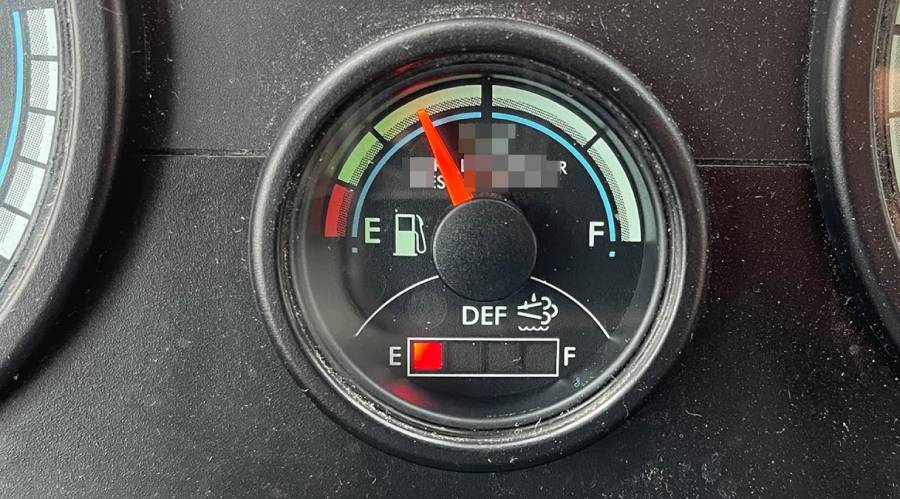
A Freightliner DEF light can blink even when the tank is full because the truck may be detecting a DEF system fault rather than an actual shortage of diesel exhaust fluid. A faulty DEF level sensor, failed DEF header, damaged wiring or connectors, contaminated DEF, or an SCR system problem can cause the warning to remain active despite having enough fluid in the tank.
The DEF tank level is only one part of the Selective Catalytic Reduction (SCR) system. Sensors monitor conditions such as DEF level, temperature, and quality, while other components control DEF delivery and emissions treatment. When a sensor sends an incorrect reading or the control system detects a related fault, the dashboard can display a DEF warning even though a visual inspection confirms that the tank is full. Refilling the tank again will not correct an underlying sensor, electrical, or emissions-system problem.
Diagnosing the warning therefore requires checking the actual DEF level, fluid condition, sensor readings, wiring, connectors, and diagnostic fault codes. This guide explains the main causes of a blinking Freightliner DEF light, how to identify the faulty component, what to check first, how the problem is repaired, and when an unresolved DEF fault can lead to an engine derate.
Why Is My Freightliner DEF Light Blinking When the Tank Is Full?
A Freightliner DEF light can blink with a full tank when the DEF system detects an incorrect level reading or another emissions-related fault. The amount of fluid physically inside the tank and the amount reported electronically to the truck are not necessarily the same when a sensor, DEF header, wiring connection, or control-system component is malfunctioning.
The truck does not determine DEF status by visually measuring the fluid. Instead, the DEF system uses electronic sensors and related components to monitor operating conditions and send information to the truck’s control system. The dashboard warning is generated from this electronic information. A tank can therefore contain sufficient DEF while a faulty level signal tells the control system that the level is low or that the DEF system is not operating correctly.
The behavior of the DEF gauge provides an important diagnostic clue. For example, a tank that has just been filled while the dashboard continues to show a low or empty DEF level points toward a sensing or communication problem rather than a genuine lack of fluid. A reading that changes unpredictably can also indicate an intermittent sensor, connector, or wiring problem. These symptoms should be diagnosed before adding more DEF or replacing components.
A full tank also does not rule out faults elsewhere in the emissions system. DEF must be stored, monitored, delivered, and dosed correctly for the SCR system to reduce nitrogen oxide emissions. A problem involving DEF quality, fluid delivery, electrical communication, or another SCR-related component can therefore keep an emissions warning active even when DEF quantity is sufficient.
What Causes a Freightliner DEF Light to Blink With a Full Tank?
There are 7 main causes of a Freightliner DEF light blinking with a full tank: a faulty DEF level sensor, failed DEF header, damaged wiring or connectors, contaminated DEF, DEF crystallization, a DEF delivery problem, and an SCR system fault. Identifying which cause is responsible requires comparing the actual DEF level with the dashboard reading and checking the system for related symptoms and diagnostic fault codes.
A faulty DEF level sensor can report an incorrect fluid level. The sensor provides the system with information about how much DEF remains in the tank. When its reading is inaccurate, the control system can interpret a full or adequately filled tank as having insufficient DEF. A common indication is a DEF gauge that remains low or empty after the tank has been refilled.
A failed DEF header can produce incorrect information about conditions inside the tank. The DEF header is associated with monitoring and managing important tank functions, and the exact sensor arrangement depends on the truck and emissions-system configuration. A failure within this assembly can therefore cause DEF-related warnings even when the physical fluid level is correct. The sensor data and applicable fault codes should be checked before concluding that the complete header needs replacement.
Damaged wiring or electrical connectors can interrupt the signal between DEF components and the control system. Loose connections, corrosion, damaged wires, or poor electrical contact can create missing or intermittent sensor data. In this situation, replacing a sensor may not fix the warning because the actual failure exists in the electrical path carrying its signal.
Contaminated or incorrect DEF can trigger a system problem even when the tank is completely full. DEF quantity and DEF quality are separate conditions. Adding unsuitable fluid or introducing contaminants into the tank can interfere with proper SCR operation. Filling a contaminated tank with additional DEF does not address the underlying quality problem and can increase the amount of fluid that must later be removed.
DEF crystallization can interfere with components involved in storing or delivering the fluid. DEF residue can form deposits when fluid dries around susceptible areas of the system. Significant buildup can contribute to restricted flow or component operation problems. Visible deposits can therefore provide a diagnostic clue, but crystallization should not automatically be treated as proof that a specific sensor or pump has failed.
A DEF delivery problem can prevent the SCR system from receiving the required amount of fluid. The tank may contain enough DEF while another part of the system cannot supply or dose it correctly. This creates an important distinction between having DEF available in the tank and having a DEF system that can use that fluid as intended.
An SCR or related emissions-system fault can also keep the warning active. The DEF system operates as part of the broader emissions-control system rather than as an isolated tank and gauge. When the control system detects an unresolved emissions fault, adding DEF alone may not clear the warning. Diagnostic trouble codes are therefore important when the tank is confirmed full but the DEF light continues blinking.
How Can You Tell Whether the DEF Level Sensor Is Bad?
A bad DEF level sensor is most likely when the actual DEF tank is full but the dashboard continues to report a low, empty, or inconsistent DEF level. The strongest diagnosis comes from combining the gauge behavior with sensor data and diagnostic fault codes rather than assuming the sensor has failed because the DEF light is blinking.
A DEF gauge that does not respond after refilling is one of the clearest symptoms to investigate. For example, if the tank is confirmed full but the displayed level remains near empty after the truck has recognized the refill, the reported value does not match the actual fluid level. The fault may be in the level sensor or DEF header, but damaged wiring, a loose connector, or another communication problem can produce a similar symptom.
Erratic DEF gauge behavior provides another diagnostic clue. A level reading that suddenly moves between full, partially full, and empty without a corresponding change in the amount of fluid indicates that the control system is receiving unreliable information. Intermittent electrical connections are particularly important to inspect when the reading changes as the truck moves or the warning appears and disappears without DEF being added.
Diagnostic fault codes help separate a sensor problem from other DEF and SCR faults. A technician can compare the reported DEF level with the amount physically present in the tank and then review active and stored codes. When the tank is full, the electronic level remains incorrect, and diagnostic information identifies a level-sensing circuit or related component, the evidence for a sensor, header, wiring, or connector problem becomes stronger.
Do not replace the DEF level sensor based only on the warning light. A blinking DEF light can originate from several parts of the DEF and SCR system, so replacing a functioning sensor will not correct contaminated DEF, damaged wiring, a delivery failure, or another emissions fault. Confirming the mismatch between the physical DEF level and the electronic reading is the first step toward identifying the actual failure.
What Should You Check First When the Freightliner DEF Light Is Blinking?
Check the actual DEF level first, then inspect the fluid condition, visible DEF components, electrical connections, dashboard reading, and diagnostic fault codes. Following this sequence helps separate a simple fluid-level problem from a sensor, electrical, or SCR system fault before parts are replaced.
1. Verify the actual DEF level. Confirm that the tank really contains enough DEF instead of relying exclusively on the dashboard gauge. This establishes whether the warning corresponds to an actual low-fluid condition. If the tank is physically full while the gauge reports low or empty, continue diagnosing the sensing and electrical system rather than repeatedly adding DEF.
2. Check the DEF condition. Inspect the fluid for an obvious contamination problem and consider whether the correct fluid was added. A full tank does not guarantee that the SCR system has usable DEF. If another liquid was accidentally introduced into the DEF tank, adding more DEF is not an appropriate correction because it does not remove the contaminant.
3. Inspect the DEF tank and visible system components. Look for leaks, damaged components, abnormal deposits, or other visible signs of a problem. DEF residue or crystallized deposits around a component can identify an area that requires closer inspection. Visual evidence should be treated as a diagnostic clue rather than automatic proof that a particular component has failed.
4. Inspect accessible wiring and electrical connectors. Check for loose connections, damaged wiring, corrosion, and connectors that are not seated correctly. The DEF level can be measured correctly at the tank but reported incorrectly when its electrical signal cannot reach the control system reliably. Wiring inspection is therefore important before replacing a sensor or DEF header.
5. Compare the dashboard reading with the actual tank level. A full physical tank combined with a persistently low electronic reading narrows the diagnostic path toward the level-sensing system, wiring, connectors, or communication between components. An apparently normal DEF level accompanied by a warning can instead point toward another DEF or SCR-related fault.
6. Scan for active and stored diagnostic fault codes. Fault codes provide information that a visual inspection cannot. They can identify the system or circuit in which the truck has detected an abnormal condition and help determine whether the warning involves DEF level sensing, electrical communication, DEF delivery, or another emissions component. The codes should be diagnosed rather than simply cleared because an active underlying fault can cause the warning to return.
This inspection sequence moves from the simplest physical checks to electronic diagnosis. It also reduces unnecessary component replacement because each result narrows the possible causes before the next diagnostic step is taken.
What Fault Codes Can Appear With a Freightliner DEF System Problem?
A Freightliner DEF system problem can generate diagnostic trouble codes related to DEF level sensing, DEF quality, temperature, electrical circuits, dosing, or the broader SCR system. The exact code depends on the truck’s engine, model year, emissions configuration, and the component that triggered the fault. For this reason, the diagnostic code should be interpreted with the specific vehicle configuration rather than treated as a universal Freightliner DEF code.
Heavy-duty truck diagnostics commonly use SPN and FMI information to describe detected faults. The SPN identifies the parameter or system associated with the problem, while the FMI describes the type of failure detected, such as an abnormal value, electrical condition, or communication problem. Reading both pieces of information is necessary because an SPN without its corresponding FMI does not fully describe the fault condition.
Fault codes become particularly useful when the physical DEF level conflicts with the dashboard reading. For example, a confirmed full tank combined with a low electronic level and a fault related to DEF level sensing provides a more focused diagnostic path than the blinking light alone. The technician can then test the sensor circuit, connector, wiring, and associated DEF header components instead of assuming that additional DEF is required.
Codes associated with other parts of the emissions system require a different diagnostic path. A truck can have a full DEF tank and an accurate level reading while still detecting a problem with DEF delivery, dosing, SCR performance, or another emissions component. In this situation, replacing the level sensor will not correct the warning because the detected fault originates elsewhere in the system.
Do not clear diagnostic codes before recording and diagnosing them. Clearing a code can temporarily remove useful diagnostic information without correcting the condition that generated it. An active fault can return after the system runs its monitoring checks, and an unresolved emissions fault may continue progressing toward additional warnings or an engine derate.
How Do You Fix a Freightliner DEF Light That Blinks With a Full Tank?
Fix a blinking Freightliner DEF light by repairing the fault responsible for the incorrect DEF or emissions warning, not by repeatedly filling the tank or clearing the warning. The correct repair depends on whether diagnosis identifies an inaccurate level reading, electrical failure, defective sensor or DEF header, contaminated fluid, crystallization, DEF delivery problem, or SCR system fault.
Correct an inaccurate DEF level reading by first determining why the electronic reading differs from the actual tank level. A sensor that consistently reports an incorrect value requires further testing of the sensor, its electrical circuit, and related components. This prevents a wiring problem from being misdiagnosed as a failed sensor.
Repair damaged wiring and connectors when inspection or electrical testing identifies an open circuit, poor connection, corrosion, damaged wire, or another signal problem. Electrical faults can produce symptoms that closely resemble sensor failure because both conditions prevent the control system from receiving valid information. Repairing the electrical path can restore the correct reading without replacing an otherwise functional sensor.
Repair or replace a failed DEF sensor or DEF header when diagnostic testing confirms the component is defective. The exact service procedure depends on how the DEF sensing components are configured on the specific Freightliner and engine system. Diagnosis should therefore identify the failed component or assembly before replacement rather than using the blinking DEF light alone as justification for installing a new DEF header.
Remove and correct contaminated DEF when the fluid itself is responsible for the problem. Adding fresh DEF on top of incorrect or contaminated fluid does not eliminate the contamination already inside the system. The tank and affected components may require appropriate service before the system can operate normally again.
Address significant DEF crystallization at the affected part of the system rather than assuming that the fluid level is responsible for the warning. Deposits around DEF components can indicate leakage, dried fluid, or another condition that requires inspection. The underlying reason for the deposit should also be corrected when necessary so that the problem does not immediately return.
Diagnose the DEF delivery system when sufficient fluid is present but the SCR system cannot receive or use it correctly. A full tank only confirms that DEF is available; it does not confirm that the fluid is being delivered and dosed as required. Diagnostic data and fault codes are needed to identify where the delivery process is failing.
Repair SCR-related faults according to the component and condition identified during diagnosis. A DEF warning associated with the broader emissions system will remain unresolved if the actual SCR fault is ignored. Once the underlying problem has been corrected and the control system confirms normal operation, the warning can clear according to the truck’s monitoring and fault-management logic.
Will the Freightliner DEF Light Reset After You Fill the Tank?
A Freightliner DEF light may clear after filling the tank when low DEF is the actual cause, but refilling will not reset a warning caused by a sensor, electrical, DEF quality, delivery, or SCR system fault. The system must recognize that the condition responsible for the warning has returned to an acceptable state before the warning can clear.
When the DEF level was genuinely low, adding sufficient fluid gives the level-sensing system an opportunity to detect the new quantity. Once the truck receives a valid level reading and the relevant monitoring conditions are satisfied, a low-level warning can clear. The response should therefore be evaluated after the refill rather than assuming that the warning must disappear the instant DEF enters the tank.
A different diagnostic path is required when the tank has been filled but the dashboard still reports a low or empty DEF level. In this situation, adding more fluid cannot correct an inaccurate electronic reading. The level sensor, DEF header, wiring, connectors, and related circuits should be inspected to determine why the reported level does not correspond with the actual amount of DEF.
A warning can also remain active even when the DEF gauge correctly shows a full tank. This indicates that DEF quantity may not be the condition responsible for the warning. DEF quality, delivery, dosing, or another SCR-related fault can remain active independently of the amount of fluid stored in the tank.
Repeatedly topping off a full tank is therefore not an effective way to clear a persistent warning. Determine whether the truck recognizes the correct DEF level and check the diagnostic information when the light remains active. This separates a refill-related warning from a fault that requires diagnosis and repair.
How Do You Reset a Freightliner DEF Warning Light?
Reset a Freightliner DEF warning by correcting the condition that triggered it and allowing the system to verify that the fault is no longer present. There is no single reset procedure that should be applied to every Freightliner because the required process depends on the engine, emissions configuration, warning condition, and fault that has been detected.
Start by confirming that the DEF tank contains the correct fluid at an adequate level. A genuine low-level warning may clear after the system recognizes the refill. If the DEF level displayed on the dashboard remains incorrect, diagnose the level sensor, DEF header, electrical connectors, and wiring rather than trying to force the warning off.
Read the diagnostic trouble codes when the warning persists despite a confirmed full tank. The codes help identify whether the system is detecting a level-sensing problem or another DEF/SCR fault. Correct the identified failure first, then confirm that the affected parameter has returned to its expected operating condition.
Clearing diagnostic codes with a scan tool does not repair the underlying problem. The warning can return when the control system performs another diagnostic check and detects the same condition. This distinction is important because a temporarily cleared dashboard light can create the impression that the repair is complete while the emissions fault remains active.
Professional diagnostic equipment may be required when the warning remains after basic inspections and the fault involves electronic testing, component operation, or SCR system diagnosis. The objective is not simply to switch off the DEF light; it is to restore normal system operation so that the truck no longer has a reason to activate the warning.
Can You Keep Driving a Freightliner With the DEF Light Blinking?
A Freightliner with a blinking DEF light may continue to operate initially, but the warning should not be ignored because an unresolved DEF or SCR fault can progress to additional warnings and operating restrictions. Whether the truck should continue driving depends on the warning state, accompanying dashboard messages, diagnostic fault, and whether engine performance has already been affected.
A truck that has sufficient DEF, normal engine performance, and no immediate shutdown indication still requires diagnosis when the DEF light continues blinking. The full tank only eliminates actual low fluid as one possible explanation. It does not eliminate a failed sensor, electrical fault, contaminated DEF, delivery problem, or SCR system malfunction.
Treat additional dashboard warnings as evidence that the problem has moved beyond a simple fluid-level discrepancy. A check engine light, emissions warning, derate message, reduced power, or other fault indication provides additional diagnostic context. Continuing to operate the truck without determining the cause can allow an emissions-related fault to remain unresolved.
Reduced engine power requires more immediate attention than an isolated warning with otherwise normal operation. Once the truck has entered a derate condition, adding more DEF will not necessarily restore normal power if sufficient fluid is already present. The fault responsible for the derate must be identified and corrected.
The safest diagnostic approach is to read the warning messages and fault codes before deciding how far the truck should continue operating. The required response can differ between a simple level-reading problem and an active emissions fault that is progressing toward an operating restriction.
Can a Blinking DEF Light Cause a Freightliner to Derate?
A blinking DEF light can be associated with an engine derate when the truck detects an unresolved DEF or SCR emissions-system fault. A full DEF tank does not prevent a derate if the actual problem involves an incorrect sensor reading, electrical failure, DEF delivery problem, or another condition that prevents the emissions system from operating correctly.
An engine derate reduces available engine performance when the control system determines that certain operating or emissions conditions have not been satisfied. The DEF warning can therefore be an early indication that the truck has detected a condition requiring attention. The warning itself is not necessarily what causes the power reduction; the unresolved fault represented by the warning is the condition that must be diagnosed.
The progression toward a derate depends on the specific fault and emissions configuration. A truck may initially display a DEF or emissions warning while continuing to operate normally. Additional warnings or operating restrictions can appear when the detected condition remains unresolved. This is why the dashboard messages and diagnostic codes are more useful than DEF tank level alone when determining the seriousness of the problem.
A faulty level signal illustrates this distinction. The tank may physically contain enough DEF, but the control system can only respond to the information it receives from the monitoring system. If the system continues to detect an unacceptable DEF-related condition, filling an already full tank does not resolve the reported fault.
A DEF delivery or SCR problem creates a similar situation for a different reason. Sufficient fluid can be stored in the tank while the system is unable to deliver, dose, or use it correctly. The correct response is to diagnose the active fault before the problem progresses rather than assuming that a full tank eliminates the possibility of a derate.
What Is the Difference Between a DEF Light and a Check Engine Light on a Freightliner?
The DEF light primarily indicates a condition associated with the diesel exhaust fluid or emissions system, while the check engine light can indicate faults across a broader range of engine and emissions systems. The two indicators can appear together when a DEF-related problem also creates a diagnostic fault monitored by the engine or emissions control system.
A DEF warning directs attention toward conditions such as fluid level or a related DEF/SCR problem. When the tank is full, this warning becomes particularly useful because it tells the driver that the actual fluid quantity may not explain what the truck is detecting. Sensor readings, electrical connections, DEF condition, delivery components, and the SCR system then become relevant diagnostic areas.
The check engine light has a wider diagnostic scope. It should not automatically be interpreted as evidence that the engine itself has suffered a mechanical failure. On a truck experiencing a DEF system problem, the light may accompany an emissions-related diagnostic code that helps identify the system or circuit requiring inspection.
When both lights are present, diagnose them as related indicators until the fault-code information shows otherwise. Reading the active and stored diagnostic codes can reveal whether both warnings originate from the same DEF/SCR problem or whether the truck has separate faults. Treating each dashboard light as an isolated problem without reading the diagnostic information can lead to unnecessary component replacement.
The dashboard indicators should therefore be used as starting points for diagnosis rather than as component-level diagnoses. A DEF light does not prove that the tank is low, and a check engine light does not identify a specific failed part. The fault codes, live data, physical inspection, and operating symptoms provide the additional information needed to determine the cause.
Does Cold Weather Affect the Freightliner DEF System?
Cold weather can affect the Freightliner DEF system because DEF can freeze when exposed to sufficiently low temperatures, but frozen DEF does not automatically mean the system has failed. The truck’s DEF system is designed to account for low-temperature operation, so a cold-weather warning must still be diagnosed according to the detected condition rather than assuming that freezing is the only cause.
Temperature becomes especially relevant when a DEF warning appears during winter and disappears or changes as operating conditions change. The diagnostic process should consider the DEF temperature, the operation of components responsible for managing low-temperature conditions, and any related fault codes. This helps distinguish normal temperature-related behavior from an actual component or electrical failure.
Cold conditions can also expose an existing electrical or sensor problem. A connector, wiring circuit, or sensing component that operates intermittently can produce inconsistent readings under changing environmental conditions. If the tank is full but the DEF level reading remains incorrect after normal operating conditions are restored, the problem requires further diagnosis rather than repeated refilling.
Do not assume that warming the truck or adding more DEF has repaired a persistent warning. If the light remains active, compare the actual tank level with the reported level and check the diagnostic information. A full tank accompanied by an incorrect reading or active DEF/SCR fault still points toward a problem that needs to be identified.
Read more: Freightliner ABS Light Is On: Causes and Fixes
How Can You Prevent Freightliner DEF System Problems?
You can reduce Freightliner DEF system problems by using the correct DEF, preventing contamination, storing DEF properly, inspecting visible system components, and diagnosing warning lights before faults progress. Preventive maintenance cannot eliminate every sensor or electrical failure, but it can reduce fluid-related problems and help identify developing faults before they result in more serious emissions-system warnings.
Use DEF that meets the specifications required for the truck and keep other fluids, dirt, fuel, and foreign material out of the DEF tank. DEF quality matters independently of quantity, so a full tank of contaminated or incorrect fluid does not provide the conditions the SCR system requires. Use clean equipment when handling DEF and avoid transferring it through containers previously used for other automotive fluids.
Store DEF under appropriate conditions when carrying or keeping additional fluid. Exposure to unsuitable storage conditions can affect fluid quality over time. Keep the container sealed and follow the storage and shelf-life information supplied with the product instead of assuming unused DEF remains suitable indefinitely.
Inspect the DEF system when performing routine truck maintenance. Look for visible leaks, damaged wiring, loose electrical connectors, and abnormal deposits around accessible components. Early identification of a damaged connector or developing leak can prevent an intermittent problem from becoming more difficult to diagnose after multiple warnings appear.
Respond to an inaccurate DEF gauge before it becomes an operational problem. A gauge that repeatedly shows the wrong level should not be treated as a harmless dashboard defect because the DEF level information is part of the emissions monitoring system. Compare the displayed level with the actual tank level and investigate persistent discrepancies.
Diagnose recurring DEF warnings instead of repeatedly clearing fault codes. A warning that returns after being cleared indicates that the system is continuing to detect a condition outside its expected parameters. Recording the codes and the conditions under which they appear gives a technician more useful diagnostic information than repeatedly erasing the fault history.
When Should You Take a Freightliner to a Technician for a Blinking DEF Light?
Take a Freightliner to a qualified technician when the DEF light continues blinking despite a confirmed full tank, the DEF gauge remains inaccurate, diagnostic faults return, additional emissions warnings appear, or the truck begins losing power. These symptoms indicate that the problem has progressed beyond a straightforward low-fluid condition and may require electronic testing or component-level diagnosis.
Professional diagnosis is appropriate when the dashboard level does not correspond with the physical DEF level. A technician can use diagnostic equipment to compare sensor information with actual tank conditions and determine whether the fault involves the DEF level sensor, DEF header, wiring, connectors, or another part of the monitoring system. This is more reliable than replacing the most obvious component based on the warning light alone.
Seek service when the warning returns after basic checks have been completed. If the tank contains the correct DEF, visible wiring and connectors show no obvious problem, and the warning remains active, diagnostic data is needed to narrow the fault. Active and stored codes can direct testing toward the affected circuit or emissions-system function.
Additional dashboard warnings increase the need for diagnosis. A DEF warning accompanied by a check engine light, emissions-system message, derate notification, or reduced engine performance indicates that the truck is detecting more than a simple refill requirement. Continuing to add DEF to an already full tank will not correct these conditions.
Reduced power or an active derate warning should receive prompt attention. At this stage, the objective is to identify and repair the fault responsible for the operating restriction. Depending on the diagnosis, the repair may involve an electrical circuit, sensor or DEF header, DEF delivery component, contaminated fluid, or another part of the SCR emissions system.
A persistent blinking DEF light with a full tank should ultimately be treated as a diagnostic problem rather than a fluid-level problem. Confirm the physical level first, compare it with the electronic reading, inspect accessible components, and retrieve the diagnostic codes. This sequence provides the evidence needed to repair the actual fault instead of replacing parts unnecessarily or repeatedly refilling a tank that already contains sufficient DEF.